For many Australian men, achieving men, weight loss and aesthetic goals is a journey that requires as much planning after the scale stops moving as it did during the process. Losing a significant amount of weight is a genuine achievement, one that demands discipline, consistency, and a fundamental shift in daily habits. The health benefits are undeniable: reduced cardiovascular risk, better blood sugar control, improved mobility, and a longer life expectancy. Yet the physical aftermath of major weight loss often catches men off guard. The face that looks back from the mirror may appear hollowed or aged. The jawline that was meant to emerge from beneath the chin can look undefined, draped with loose skin. The body, rather than appearing toned and athletic, can feel deflated. These changes are not a sign of failure. They are a predictable consequence of how the body responds to rapid volume loss. Understanding why they happen, and why thoughtful planning matters more than rushing toward a fix, is the foundation of any successful aesthetic outcome.
Table of Contents
- The Hidden Cost of Transformation: What Happens to the Face and Body After Major Weight Loss
- Why Rushing into Aesthetic Treatments Is a Mistake
- The Core Aesthetics Approach: Consultation, Assessment, and Staged Planning
- Muscle Preservation and Body Confidence: The Missing Link in Aesthetic Planning
- When Treatment May Not Be Appropriate (or Should Be Delayed)
- Natural-Looking Outcomes: The Art of Restraint and Long-Term Planning
- Frequently Asked Questions
- Start Your Post-Weight-Loss Journey with a Consultation
The Hidden Cost of Transformation: What Happens to the Face and Body After Major Weight Loss
When a man loses a substantial amount of weight, the changes extend far beyond the number on the scale. The face, in particular, undergoes a transformation that many find confronting. Beneath the skin of the cheeks, temples, and under-eye area sit discrete fat pads that provide structural support and youthful fullness. These pads shrink during weight loss, sometimes dramatically. The result can be a gaunt, drawn appearance that adds years to a man's perceived age. This is the paradox of facial weight loss: the same volume that once contributed to a rounder, less defined face was also providing essential support. When it disappears, the underlying bone structure becomes more visible, which can be flattering in some areas but harsh in others.
The jawline presents its own set of contradictions. Losing a double chin is often a primary motivator for weight loss, and for good reason. A defined jawline is associated with vitality and masculinity. However, the skin that stretched to accommodate excess fat does not always retract in kind. Men who lose weight later in life, or who carried significant weight for many years, may find that the skin beneath the chin and along the neck simply hangs. This creates what is colloquially known as a turkey neck, or jowls that obscure the very jawline they worked to reveal. Skin is not a rubber band. Its ability to snap back depends on age, genetics, sun exposure, smoking history, and the total amount of weight lost. A man who drops 40 kilograms will face a different skin reality than one who loses 10.
Beyond the face, the body tells a similar story. Weight loss is a catabolic process: the body breaks down tissue for energy. Without deliberate intervention, this breakdown affects both fat and muscle. Men who lose weight through diet alone, or through excessive cardio without resistance training, often end up with a softer, less defined physique. The term skinny fat describes this outcome well: a lower body weight but a higher body fat percentage relative to muscle mass. The chest may appear sunken, the arms thin, the abdomen still soft. This is not what most men envision when they set out to transform their health. The gap between expectation and reality can be wide, and it is in that gap that aesthetic planning becomes essential.
Why Rushing into Aesthetic Treatments Is a Mistake
The period immediately after reaching a goal weight is emotionally charged. There is pride, relief, and a natural desire to complete the transformation. This is precisely the moment when restraint matters most. The body continues to change for six to twelve months after weight stabilisation. Fluid balance shifts, skin slowly adapts, and the face settles into its new contours. Treating too early, before this settling has occurred, risks results that look unnatural or that fail to hold. A filler placed to restore cheek volume at month three may sit differently at month nine, when the overlying skin has tightened further and the underlying fat pads have finished shrinking.
A common error in rushed consultations is confusing volume loss with skin laxity. These are two distinct problems requiring two distinct approaches. When a man presents with a tired or aged appearance after weight loss, the cause may be deflation: the fat pads that once filled the mid-face and temples are simply gone. This responds well to dermal filler, which can restore structure and support. Alternatively, the cause may be excess skin that has lost its elasticity. Filler cannot lift loose skin. Attempting to use it for that purpose leads to a heavy, unnatural look that does not address the underlying issue. A proper assessment distinguishes between the two, and that assessment cannot be done accurately while the body is still in flux.
The risk of overcorrection is real, particularly for men who are new to aesthetic treatments. The desire to see dramatic change can lead to requesting too much volume too quickly. The result is a puffy, overfilled appearance that reads as unnatural. Restraint is not about doing less for its own sake; it is about respecting the limits of anatomy and the importance of proportionality. A chiselled jawline looks striking only when it harmonises with the rest of the face. When it dominates, it becomes a distraction. Medical stability is another factor that cannot be overlooked. Significant weight loss affects blood pressure, blood sugar regulation, and the body's capacity to heal. Aesthetic treatments, even non-surgical ones, place demands on the body's repair systems. Proceeding only once a patient is metabolically stable is a matter of safety, not preference.
The Core Aesthetics Approach: Consultation, Assessment, and Staged Planning


The Initial Consultation: Setting Realistic Expectations
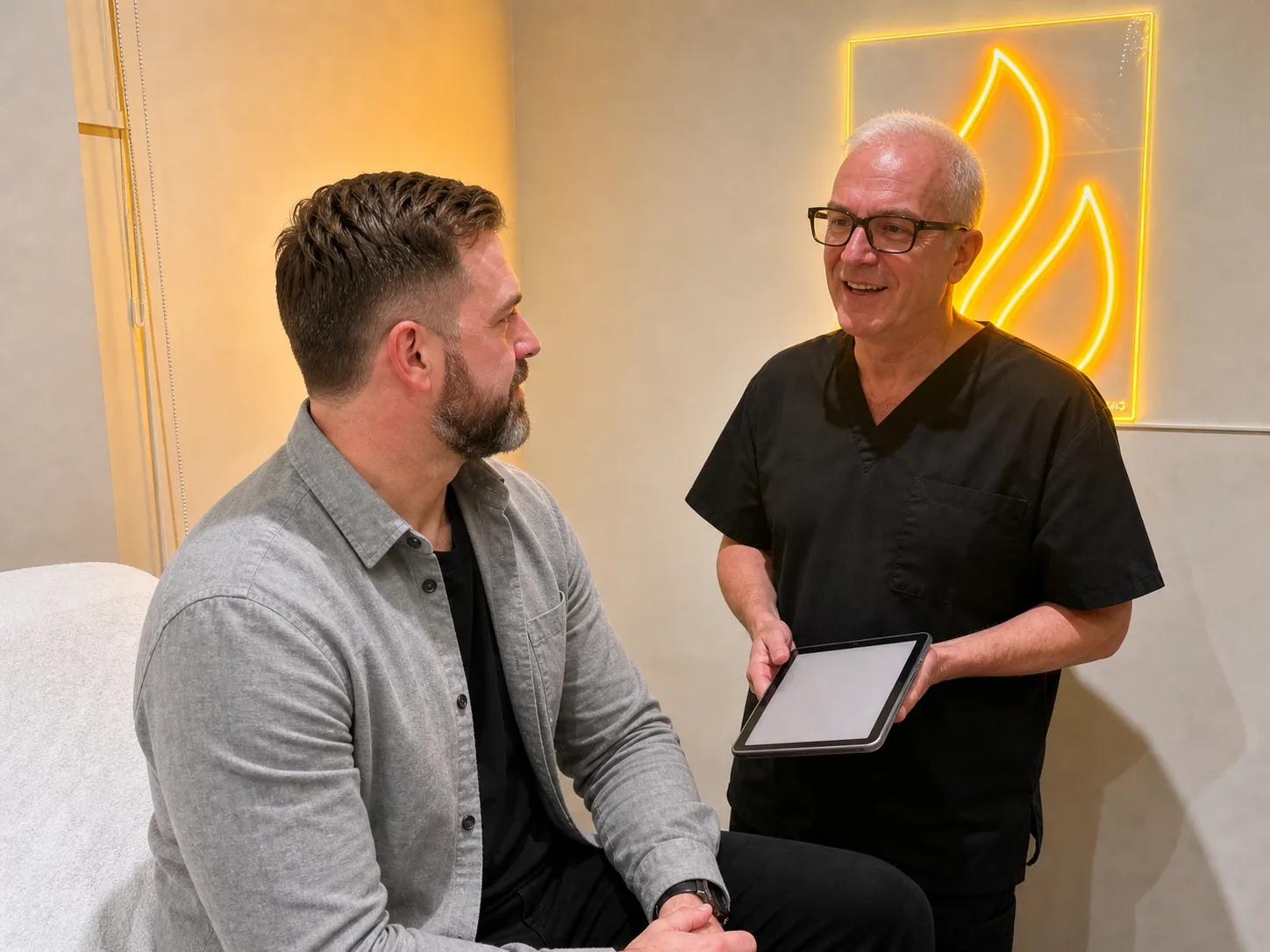
A meaningful aesthetic plan begins with an honest conversation. The initial consultation at Core Aesthetics is not a sales pitch. It is an anatomy audit: a careful assessment of bone structure, current muscle mass, skin thickness, and residual fat distribution. These factors determine what is achievable and what is not. A man with strong underlying bone structure and good skin elasticity has more options than one with significant laxity and minimal skeletal projection. Neither is better or worse; they are simply different starting points that demand different strategies.
Part of this conversation involves discussing what aesthetic treatments cannot fix. Loose skin on the abdomen, for example, will not respond to lasers or radiofrequency devices in any meaningful way. That is a surgical problem, and a responsible clinician says so plainly. Similarly, deep folds caused by excess skin on the neck may require a surgical lift rather than injectables. Setting these boundaries early prevents disappointment and wasted investment. The consultation also maps out a timeline that aligns with the patient's ongoing fitness and nutrition journey. A man who is still building muscle through strength training may benefit from waiting until his body composition stabilises before addressing facial volume. The plan follows the patient's life, not the other way around.
Staged Treatment: Why Less Is More Over Time
The most natural outcomes emerge from a phased approach that respects the body's timeline. Phase one focuses on stabilisation. During this period, the emphasis is on skin quality and muscle support. Energy-based skin tightening devices can stimulate collagen production and improve skin texture, laying a foundation for later treatments. Nutritional optimisation, particularly adequate protein intake to support muscle repair and skin elasticity, is reinforced. Strength training continues to build the frame that facial aesthetics will sit upon.
Phase two introduces volume restoration, but conservatively. Dermal fillers are used to restore cheek projection and temple hollowing, areas that age the face significantly when depleted. Jawline definition is approached with restraint, using firmer fillers placed precisely to enhance the natural contour without creating an artificial shelf. The goal is to look like a healthier, more rested version of oneself, not a different person entirely. Phase three addresses refinement. After volume has settled and the face has adapted, neuromodulators may be considered for dynamic wrinkles that have become more apparent after fat loss. Crow's feet, forehead lines, and frown lines often deepen when the supportive fat that once cushioned the skin diminishes. Treating these subtly preserves natural movement while softening the signs of ageing.
Muscle Preservation and Body Confidence: The Missing Link in Aesthetic Planning


Aesthetic treatments on the face do not exist in isolation. They look most natural when the body they sit atop is strong and well-proportioned. A defined jawline and restored cheek volume will appear incongruous on a man with a narrow, under-muscled frame. Strength training is not optional in this context; it is the foundation upon which facial aesthetics rest. Resistance exercise builds the shoulder, chest, and neck musculature that frames the face and contributes to a masculine silhouette. Without it, even the most skilfully placed filler can look out of place.
Nutrition supports this process at every level. Adequate protein intake, aligned with Australian dietary guidelines of approximately 0.8 grams per kilogram of body weight for sedentary adults and higher for those actively building muscle, provides the amino acids necessary for skin repair and muscle synthesis. Hydration is equally important. Dehydrated skin loses pliability and appears more wrinkled, undermining the benefits of any aesthetic treatment. These are simple, foundational habits that cost little but pay dividends over time.
Body confidence after weight loss is a psychological journey as much as a physical one. The language men use to describe their goals matters. Framing the objective as restoring the body, rather than simply looking good, shifts the focus toward health, function, and long-term wellbeing. This aligns with the deeper motivations that research identifies in men who pursue weight loss: health concerns, body satisfaction, and a desire to feel normal again. Celebrating milestones with non-food rewards, such as new training gear or a skin consultation, reinforces the identity of a man who takes care of himself without tying every achievement to the scale or the mirror.
When Treatment May Not Be Appropriate (or Should Be Delayed)
Not every man who walks through the door is ready for treatment, and part of a responsible consultation is saying so. Unstable weight is the most common reason to delay. If a patient is still actively losing more than half a kilogram per week, any aesthetic work is premature. The face and body are still changing, and results will not hold. Medical contraindications also require careful screening. Active skin infections, uncontrolled diabetes, or recent major surgery, including bariatric procedures, necessitate a clearance period before any treatment can proceed safely.
Psychological readiness is equally important. Post-weight-loss body dysmorphia is a documented phenomenon. A man who has spent years seeing himself as overweight may struggle to accurately perceive his new body. When a patient cannot articulate what he wants beyond chasing a trend, or points to a heavily filtered social media image as his goal, he may need time, or a referral to a psychologist, before proceeding. Aesthetic treatments are not a solution for unresolved body image distress. Budget and commitment also warrant honest discussion. High-quality, natural results often require multiple sessions spread over twelve to eighteen months. A single quick fix rarely delivers what it promises, and a patient who is not prepared for that reality may be better served by waiting until he is.
Natural-Looking Outcomes: The Art of Restraint and Long-Term Planning
The philosophy that guides natural outcomes is simple: build gradually, respect anatomy, and ignore trends. At Core Aesthetics, the approach is to add one unit at a time, reassessing after each session. Micro-dosing filler and building up slowly avoids the overdone look that occurs when too much product is placed in a single visit. The face adapts, the skin accommodates, and the result is a subtle restoration that reads as healthy rather than altered.
Anatomy must always take precedence over fashion. The best results honour the patient's unique facial structure: his bone shape, his muscle insertions, his natural asymmetries. Chasing a viral filter or a celebrity jawline ignores the reality that those features belong to someone else's skeleton. The goal is to enhance what is already there, not to impose a template. In the Australian context, this means respecting the preference many men have for a subtle, rugged look. The polished, high-volume aesthetic common in some international markets does not translate well to a culture that values understatement and authenticity. Maintenance, too, should be framed as part of a sustainable routine. Annual skin tightening sessions or quarterly filler top-ups are not about reversing ageing; they are about preserving the investment made in one's health and appearance over the long term.
Frequently Asked Questions
How long after weight loss should I wait for facial treatments? A period of six to twelve months of stable weight is recommended. This allows the skin to retract as much as it naturally will and the face to settle into its new contours before any intervention.
Can fillers fix loose neck skin? No. Loose neck skin typically requires a surgical neck lift or energy-based skin tightening devices. Filler adds volume; it cannot lift or tighten skin that has lost its elasticity.
Will I lose my jawline again if I gain weight? Yes. Facial volume changes are dynamic. Weight gain will redistribute fat to the face and neck, potentially reversing the definition achieved through treatment. Weight maintenance is essential for long-term results.
Do men need different filler types than women? Yes. Men often require fillers with a higher G-prime, meaning a firmer, more structural product, particularly for the jawline and chin. This maintains a masculine contour and avoids the softer look that may be desirable for female patients.
Start Your Post-Weight-Loss Journey with a Consultation
The work of weight loss deserves a thoughtful finish. At Core Aesthetics, the commitment is to honest assessment, realistic timelines, and a plan that respects the journey you have already undertaken. A no-obligation consultation provides the space to discuss what has changed, what is achievable, and what timeline makes sense for your body and your life. Natural, confident results do not come from rushing. They come from patience, planning, and professional guidance. Visit Coreaesthetics.com.au to begin the conversation.