Mens Health Week 2026

Gay Men’s Aesthetics: Navigating Pressure and Finding Your Style

Two men share a kiss on a city street with a colorful graffiti wall behind them.

Walking into a room, a bar, or even just opening a dating app can feel like stepping onto a stage where the spotlight is already on you. For gay, bisexual, and trans men in Australia, the question of how we look is rarely just about vanity. It is tangled up with history, community politics, personal safety, and a deep-seated desire to be seen and desired. Gay men’s aesthetics have evolved over decades into a complex language of belonging and resistance, but they have also created a set of pressures that can feel impossible to meet. This article is not about telling you to try harder or spend more. It is about understanding where these pressures come from, how they affect your mental health, and how you can navigate the world of grooming and aesthetic treatments in a way that feels genuinely good for you, not just for everyone else.

Table of Contents

Where Did These Standards Come From? A Brief History of Gay Male Aesthetics

The muscular, chiselled ideal that dominates so much of gay culture today did not appear out of nowhere. Its roots reach back to the 1950s and 1960s, a time when overt homosexuality was criminalised and gay pornography was heavily censored. In that repressive climate, gay men turned to bodybuilding magazines like Physique Pictorial and Beefcake as a coded substitute for erotic imagery. These publications celebrated the male form under the guise of health and fitness, creating a secret visual language of desire that linked muscularity with masculine beauty.

Man following a personal grooming routine in a bathroom setting.

Around the same time, the Finnish artist Tom of Finland began producing explicit, hyper-masculine artwork that deliberately queered the notion that gay men were inherently feminine. His drawings of leather-clad bikers, lumberjacks, and soldiers presented a powerful counter-narrative to the limp-wristed stereotype. This was not just art; it was a political statement that said gay men could be strong, dominant, and unapologetically male.

By the 1970s, this aesthetic had crystallised into the "clone" look: a uniform of moustaches, denim, leather, and a gym-sculpted body. It was a look of rebellion and community visibility, a way of recognising each other on the street. Fast forward to the 1990s and 2000s, and mainstream media began presenting a much narrower, more palatable version of gay aesthetics through shows like Will & Grace and the original Queer Eye. These representations were overwhelmingly white, affluent, and safely non-threatening. Understanding this history matters because it reveals that many of the standards we internalise today were originally defence mechanisms or political acts. Knowing that gives you the power to ask which parts of this legacy you want to carry forward and which you are ready to leave behind.

The Triple Threat: Where the Pressure Comes From

Pressure from the Straight World

Long before many of us ever set foot in a gay bar, we learned to read the straight world’s expectations. There is a long history of being told, either explicitly or through social cues, to "tone it down" or "act straight" to be accepted in workplaces, families, and public spaces. This pressure often translates into an internalised fear of being seen as too camp, too feminine, or simply too much. For many men, adopting a hyper-masculine aesthetic becomes a shield against homophobic judgment, a way of moving through the world without attracting unwanted attention.

There is also what some call the "model minority" trap. This is the feeling that, as a gay man, you need to be exceptionally well-groomed, fit, and successful just to prove that your existence is acceptable or non-threatening to straight society. It is exhausting to feel like your worth hinges on being palatable, and it can drive a relentless pursuit of an aesthetic that was never really yours to begin with.

Pressure from Within the LGBTQIA+ Community

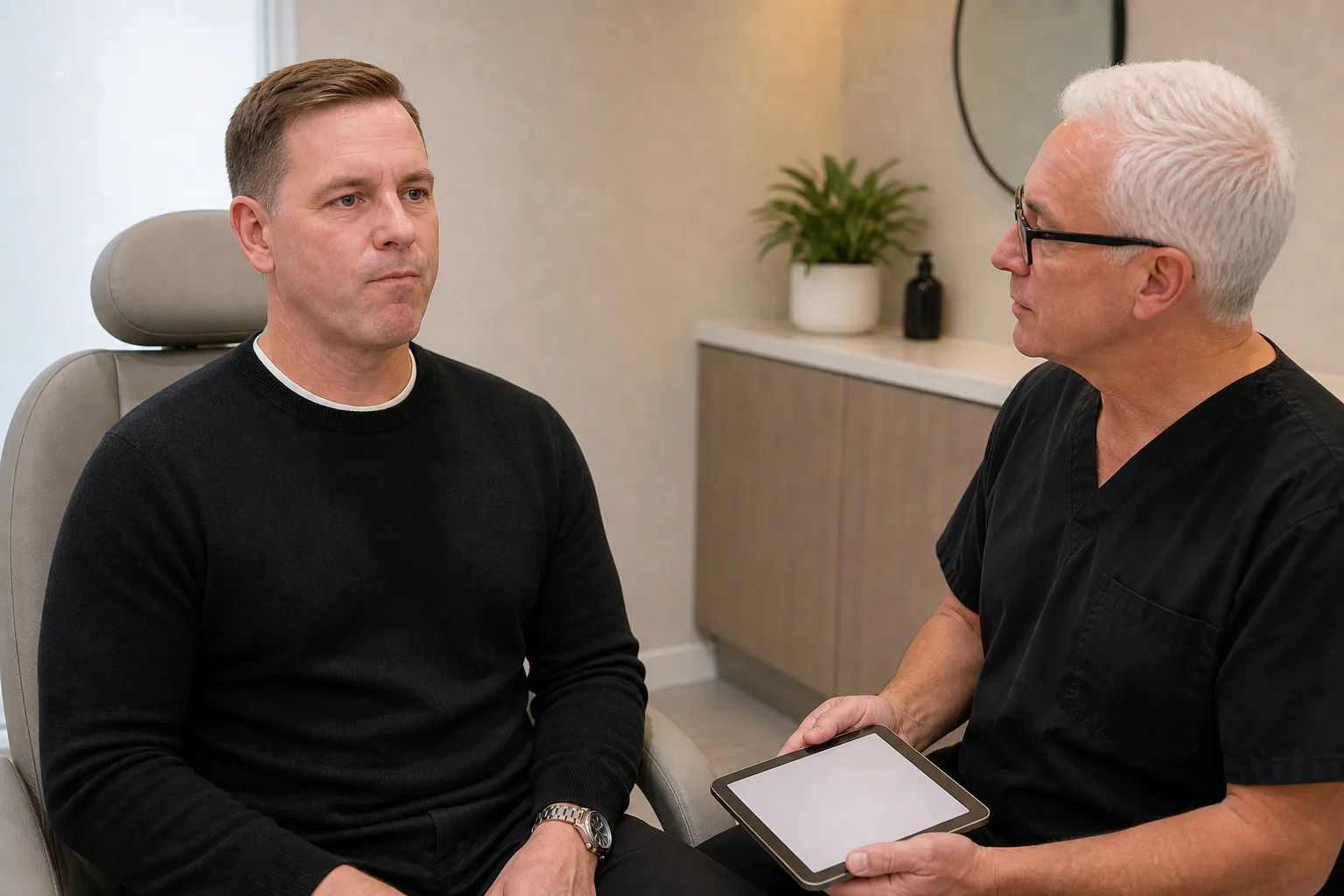
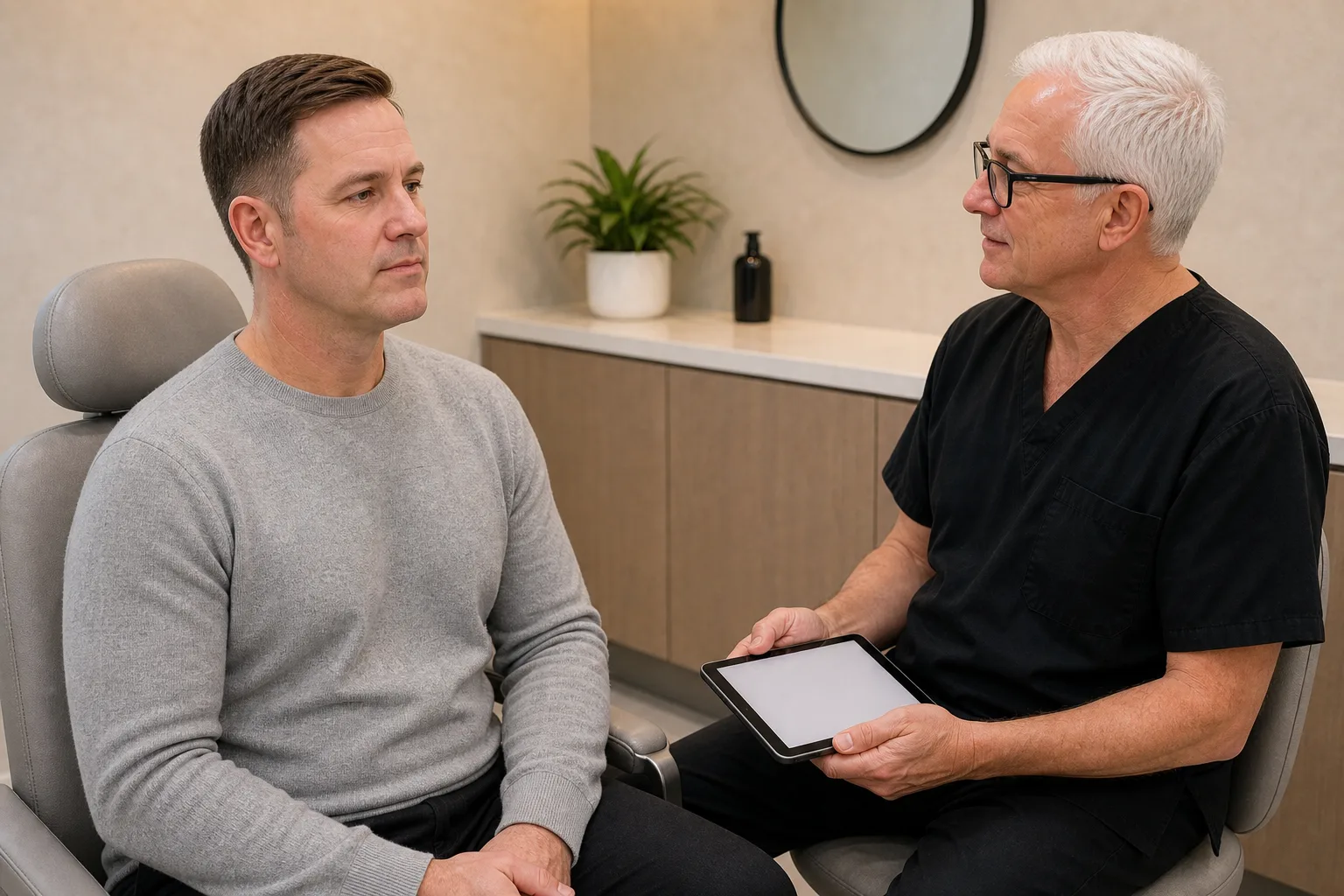
Private consultation context image supporting discussion of men's aesthetic decisions.

If the straight world sets the stage for insecurity, the LGBTQIA+ community can sometimes amplify it in unexpected ways. Dating apps have become a central part of how many gay men connect, and with them came the "tribe" system: labels like twink, bear, jock, and cub that categorise bodies into narrow boxes of desire. While these labels can help people find their niche, they can also make men feel invisible or undesirable if they do not fit neatly into a category.

The jock remains the most popular and sought-after tribe on many apps, prizing a specific, often unattainable level of muscularity and youth. This feeds into a culture where bios openly state "no fats, no fems, no Asians," a blunt and painful reminder that body-shaming, femme-shaming, and racism persist within a community that should be a safe haven. The pressure to be aesthetically pleasing for social media validation adds another layer, often encouraging a homogenised look where individuality takes a back seat to likes and follows.

Pressure from Partners

Even within a loving relationship, aesthetic pressures can surface in quiet, insidious ways. There is the anxiety of knowing your partner has a "type" and wondering whether you still fit it as the years pass. Conversations about ageing, weight gain, or changing appearances can feel loaded with unspoken expectations. It is important to distinguish between a partner who encourages you to be healthy and one who pressures you to look a certain way for their ego or attraction.

Having honest, vulnerable conversations about body image with a partner is difficult but essential. These talks should not be about shame or blame. They should be about understanding each other’s insecurities and finding ways to support one another without making love conditional on a six-pack or a full head of hair.

The Real Cost: Mental Health and Body Image in the Gay Community

The relentless focus on aesthetics comes with a serious mental health toll. A 2007 survey found that 42 percent of all men with eating disorders in the UK were gay, despite gay men making up only about five percent of the male population. While that data is nearly two decades old, the dynamics it revealed are still relevant in 2026. LGBTQIA+ people of all genders continue to show higher rates of binge eating, laxative abuse, and body dysmorphia, all tied to the pressure of chasing a perfect aesthetic.

Part of this pressure is fuelled by what critics call "pinkwashing." Advertisers identified gay men as a lucrative market decades ago and have since played on our insecurities to sell products, much like diet culture has targeted women for generations. The message is subtle but powerful: you are not quite good enough, but this product or procedure will fix you.

The intersection of race and aesthetics adds another layer of complexity. The #GayMediaSoWhite movement in 2016 highlighted the lack of diversity in gay media and the fetishisation of people of colour in porn and dating spaces. These exclusions are not just about representation; they shape who is considered desirable and who is left out of the conversation entirely.

Trans men face unique pressures that are often overlooked in discussions about gay men’s aesthetics. Navigating gay spaces can involve an added layer of dysphoria around body image, and trans men remain largely invisible in mainstream gay porn and media. The aesthetic standards that dominate the community rarely account for trans bodies, leaving many men to carve out their own sense of belonging in a culture that has not made room for them.

How to Look Your Best (Without Losing Yourself)

Defining "Your Best" on Your Own Terms

The first and most radical step you can take is to shift the goal from looking good for others to feeling good in your own skin. This requires honest self-reflection. Ask yourself: does this aesthetic choice bring me genuine joy, or is it driven by a fear of rejection? Dressing for yourself, embracing camp, or playing with gender expression can be acts of political resistance and personal liberation. When your style becomes an extension of your identity rather than a costume for approval, the pressure begins to lift.

Aesthetic Treatments: A TGA-Safe Approach

Cosmetic procedures are becoming more common among men in 2026, and there is no shame in exploring them. The key is to do so safely and thoughtfully. Always choose a qualified, reputable practitioner who uses TGA-approved products. Cutting corners with cheap, unregulated treatments can lead to complications that are far more damaging than the insecurity you were trying to address.

Common treatments for men include anti-wrinkle injections, dermal fillers, and skin tightening procedures. When used well, these tools can enhance your natural features rather than erase them. A "less is more" philosophy often yields the best results: subtle, well-placed treatments that boost confidence without creating an obviously "done" look. A good consultation should listen to your goals and respect your boundaries, not push a package of treatments you did not ask for.

Practical Style and Grooming Tips for the Australian Man

Living in Australia means dealing with a climate that demands practical thinking. Sun protection is non-negotiable. The Australian sun is harsh, and a good SPF 50+ moisturiser is the single best aesthetic investment you can make. It protects your skin from premature ageing and, more importantly, from cancer.

Dressing for the climate does not mean sacrificing style. In summer, linen shirts, well-fitted shorts, and quality tees in natural fibres keep you looking sharp without overheating. In cooler months, layering is your friend: a structured jacket over a simple knit, paired with good denim, creates a clean, considered look. Grooming basics matter too. A consistent skincare routine (cleanse, treat, moisturise, protect), a solid haircut, and well-maintained facial hair if you have it will do more for your appearance than any single trend. Experiment with different styles until you find what feels authentically you, whether that is beachy and relaxed or sharp and tailored.

How to Stop Being Embarrassed About Wanting to Look Good

Wanting to look good is not shallow. It is a form of self-respect, self-care, and community connection. Yet many men carry a sense of embarrassment about their grooming habits or aesthetic interests, partly because of a persistent double standard. Society often praises women for a "glow up" but mocks men who care too much about their appearance.

Overcoming this shame starts with normalising the conversation. Talk about your insecurities with a trusted friend or therapist. You will likely discover that they feel the same way. Curate your social media feed ruthlessly: unfollow accounts that make you feel inadequate and follow diverse bodies, ages, and styles that reflect the real world. Start small with changes that build confidence, like a new skincare product or a well-fitted shirt. Most importantly, separate vanity from health. Ask yourself whether you are working out to feel strong and energised or to punish yourself for not looking like someone else. The motivation behind the action changes everything.

Remember that aesthetics can be a tool for expression, not just a cage for conformity. The goal is not to abandon caring about how you look. It is to care in a way that serves you rather than constrains you.

Final Thoughts: Finding Freedom in Your Own Aesthetic

The pressure to look a certain way is real, but it is not your fault. It is a product of decades of history, media representation, and community dynamics that have shaped what we see as desirable. The most attractive quality in any person is confidence, and true confidence comes from aligning your outer appearance with your inner truth, not from contorting yourself to fit someone else’s ideal.

Whether you identify as a twink, a bear, a jock, or something completely undefined, your aesthetic is valid. Your body is your home. Treat it with kindness, not constant criticism. If body image concerns are severely impacting your mental health, please reach out to a professional. Organisations like QLife, Beyond Blue, and body-image-informed therapists are available to support you. You do not have to navigate this alone, and you do not have to change who you are to look your best.

Written and reviewed by Corey Anderson RN, AHPRA NMW0001047575 · Reviewed June 2026 · TGA and AHPRA guidance is regularly reviewed in preparing this website.

Begin With A Conversation

Book your consultation.

No commitment, no pressure. A considered first step toward understanding what is and isn’t right for you.

Book Consultation

Elegance, Perfected.