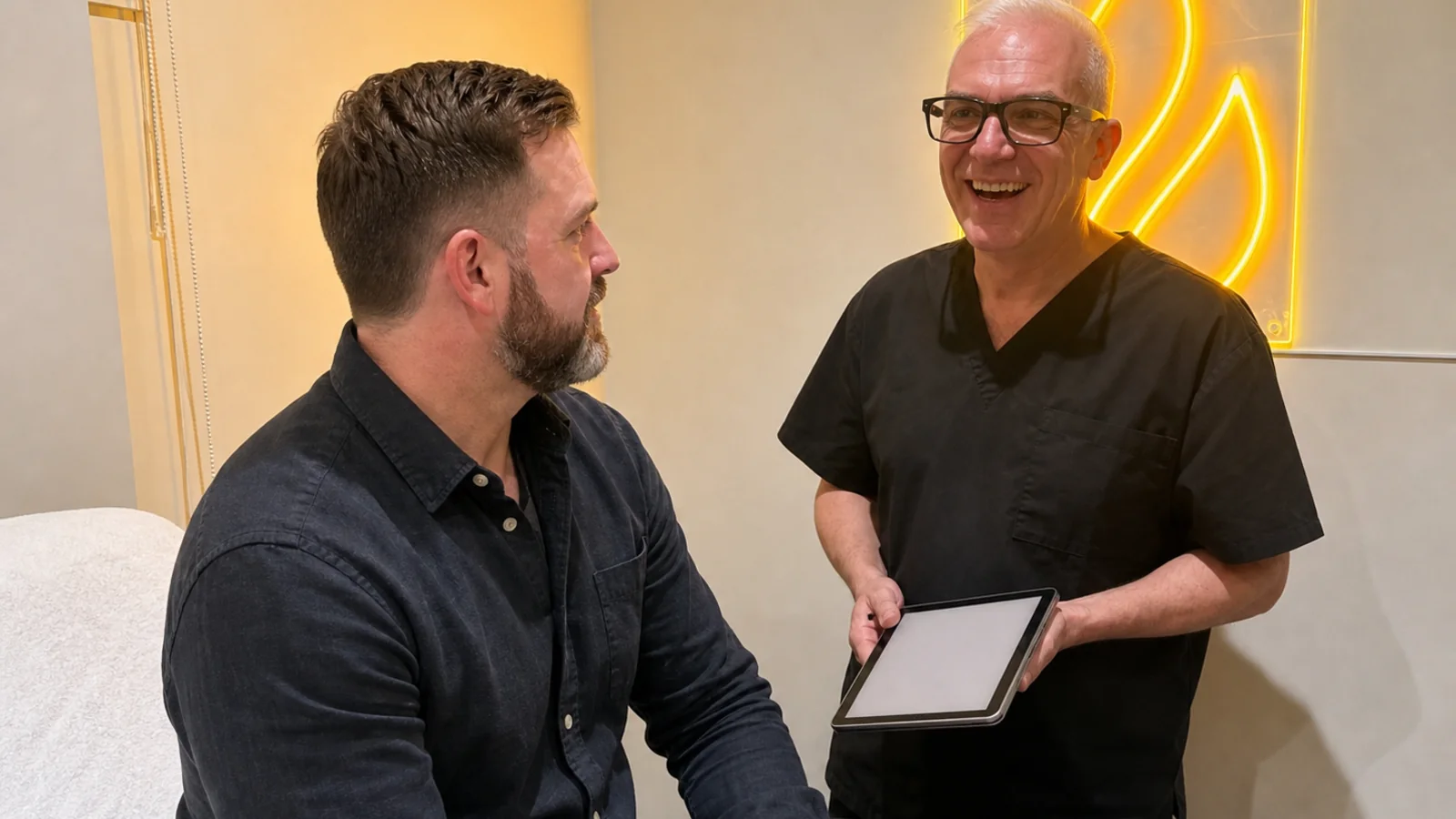
If someone is helping you travel from Altona North, you can choose whether they join the consultation, hear health information or receive later contact. Those are three separate permissions. Corey will speak with you directly, make room for private questions and keep the decision about any next step with you.
Bring support without giving up your voice
If someone is driving you from Altona North, taking notes or simply helping the day feel less daunting, they are welcome to have a useful role. That role begins with what makes you comfortable.
Before you arrive, decide three things separately: whether they may enter the room, whether they may hear health information and whether the clinic may contact them later. You can say yes to one and no to another, and you can change your mind during the visit.
Choose the kind of support you want
Help with the journey
Your companion can drive, meet you nearby or help with timing without joining the health conversation.
Listen or take notes
Invite them in for the part you choose, then continue privately when you are ready.
Offer quiet support
They can listen and ask an agreed question while your own account and preferences remain central.
Decide the role before you arrive
Write your companion’s name and one sentence about their role. For example: Alex is driving and may join while I describe my concern, but I want to discuss my health history and photographs alone.
This is not a legal form. It is a practical starting point for Corey to confirm with you. A companion can help you remember dates or questions, but they do not answer for you or decide what happens next.
Three permissions are enough
Enter the room. Hear health information. Receive later contact. Treat each as a separate choice. If you want broader preparation for the appointment itself, use the Altona consultation planning guide. This page stays focused on the person coming with you.
Keep part of the conversation private
You may be happy for someone to hear the opening conversation, yet prefer privacy for medicines, previous care, photographs, costs, mental health or the reason the concern matters to you. Tell Corey what you would like to discuss alone.
Your companion can step out and return later for an agreed summary or final questions. Privacy is not a rejection of their support. It simply creates room for you to speak freely and for Corey to hear the decision in your own words.
If support starts to feel like pressure
Ask for a private conversation if your companion answers first, introduces a deadline, corrects your preference or seems more invested in a cosmetic change than you are. These moments do not automatically mean poor intent, but they are a good reason to slow the conversation down.
You can use the appointment for information only, take more time, choose another health pathway or decide against cosmetic care. Travelling from Altona North never creates an obligation to proceed.
Plan your visit from Altona North
You will meet directly with Corey for a calm, private conversation about what you have noticed, what you want your companion to do and what would feel useful today.
Start with the address your day actually begins at and check current road or public transport conditions close to the appointment. Plan the return separately, especially if your companion is driving or waiting nearby. Corey will assess your concern and health context before explaining any suitable next conversation.
Is this for you?
Consider booking a consultation if
- Adults starting from Altona North who may travel with a driver, note taker, interpreter, carer or support person
- People who want to state what may be heard, answered, recorded or shared after the appointment
- Readers willing to keep their own voice central and request private time when needed
This may not be for you if
- Anyone with an urgent, new, unexplained or worsening health symptom who needs appropriate health care
- Anyone being pressured, coerced or required by another person to change their appearance
- Anyone seeking legal privacy advice, a product, quantity, fixed outcome or confirmation of suitability from a public page
Suitability is confirmed at consultation. This list is general guidance, not a substitute for clinical assessment.
Your choices remain open
A consultation is an assessment and conversation, not a promise of treatment. Corey considers your concern, health history, medicines, expectations, motivation and whether you can decide freely. If a cosmetic option is suitable, material risks, costs, alternatives and the option of no treatment are discussed before you decide.
Seek appropriate medical care for urgent, unexplained, persistent or worsening symptoms rather than treating them as a routine cosmetic question.
Sources for privacy, consent and local context
The Hobsons Bay City Council housing framework supports the Millers Road and Altona Gate starting context only. OAIC, nursing, Ahpra and TGA sources support privacy, informed consent, respectful communication, assessment and product-neutral advertising.
- Hobsons Bay Housing Strategy: Volume Two, Housing Framework Plan and Housing Capacity Assessment
Local evidence that the main Altona North commercial area runs along Millers Road and includes Altona Gate. Used only to define a plausible route starting point.
- Handling health information
Public guidance that health information is sensitive and that health service providers usually collect it with consent for their work.
- Code of conduct for nurses
Informed consent, time to ask questions, decision making, refusal, privacy and respectful communication.
- Guidelines for registered health practitioners who perform non-surgical cosmetic procedures
Holistic assessment, personal and external motivation, realistic expectations, alternatives, voluntary consent and the option of no procedure.
- Guidelines for advertising higher risk non-surgical cosmetic procedures
Patient interests, dignity, privacy and factual advertising that does not exploit body image concerns.
- Advertising health services that involve therapeutic goods
Product neutral public health service advertising and restrictions on prescription medicine promotion.
- Ahpra public register of practitioners
Independent verification of practitioner registration.
These sources do not endorse Core Aesthetics or determine an individual plan. Registration details should be checked on the independent Ahpra register.
Questions about bringing someone from Altona North
Can a driver come into the consultation?
An adult may ask for a driver or support person to join some or all of the conversation, subject to clinic processes and safe care. Decide what you are comfortable sharing and tell Corey if you want part of the appointment to be private.
Does giving someone a lift make them a support person?
No. A driver can help with transport and receive agreed logistics without hearing health history, photographs, motivations or option discussions. Their practical role does not create authority over the consultation.
What should I tell the clinic before arriving together?
State who is coming, whether they are a driver, note taker, interpreter, carer or emotional support, and which parts of the appointment you want private. A qualified interpreter is different from a family member translating sensitive clinical information.
Who should answer Corey first?
The adult patient should ordinarily describe the concern, history, reasons and boundaries in their own words. A companion may add agreed information, but should not replace the patient voice or answer because the patient appears uncertain.
Can I change my mind about who stays in the room?
Yes. You can ask for a private conversation, invite the person back later or limit what is discussed in front of them. Tell Corey if the person reacts, interrupts or changes what you feel able to say.
What information can the clinic give my companion later?
Agree this directly with the clinic. A lift or attendance at the appointment does not automatically authorise later disclosure of health information. Record exactly which logistics or clinical information, if any, may be shared.
What if my support person wants the cosmetic change more than I do?
Say so privately. Ahpra guidance requires the practitioner to discuss internal and external reasons for a request and assess realistic expectations. Another person should not supply the decision, deadline or acceptable outcome.
Does travelling from Altona North make treatment more likely?
No. Millers Road or Altona Gate can describe where a journey begins, but route convenience does not determine health history, motivation, risk, suitability or consent. Treatment during the first visit is never automatic.
Can a consultation finish with my support person still unsure?
Yes. The decision belongs to the patient. The appointment may lead to information, private reflection, records, another clinician, a later review, a private options discussion or no cosmetic treatment.
How can I verify Corey before sharing health information?
Corey Anderson is a Registered Nurse with Ahpra registration NMW0001047575. Use the Core Aesthetics verification guide, then search the independent Ahpra public register and match his name, profession and current registration details.
Come with support and keep the decision yours
Bring your three permissions and the question you want to ask privately. Corey will listen, assess and help you understand a sensible next step.