For a cheek volume consultation near Malvern, compare four everyday viewing contexts. A mirror reverses the familiar face and changes with room lighting; a video call uses a close wide lens and frozen screen position; a candid photograph captures one instant; and in-person conversation includes distance, depth and continuous expression. Differences between them are normal and do not identify a treatment need. Corey Anderson RN combines the pattern with direct cheek, under eye, skin and whole-face assessment, health, medicines, previous care, risks and preservation priorities. Suitable care can be planned when individual assessment and informed consent support it.
Why Compare Four Everyday Contexts?
Most cheek concerns are first noticed outside a clinic. The medium changes perspective, motion and attention, so an apparent disagreement between mirror and camera is common.
Comparing contexts helps Corey understand the concern without dismissing it or treating one image as objective truth.

How Does Each Context Change Perception?
| Context | What changes | Useful question |
|---|---|---|
| Mirror | Reversal, distance and room light | Is this the familiar view you use daily? |
| Video call | Close lens, screen height and compression | Does device position exaggerate the concern? |
| Candid photo | One instant, unknown angle and expression | Is the frame representative? |
| In person | Depth, movement and conversational distance | How does the whole midface read continuously? |
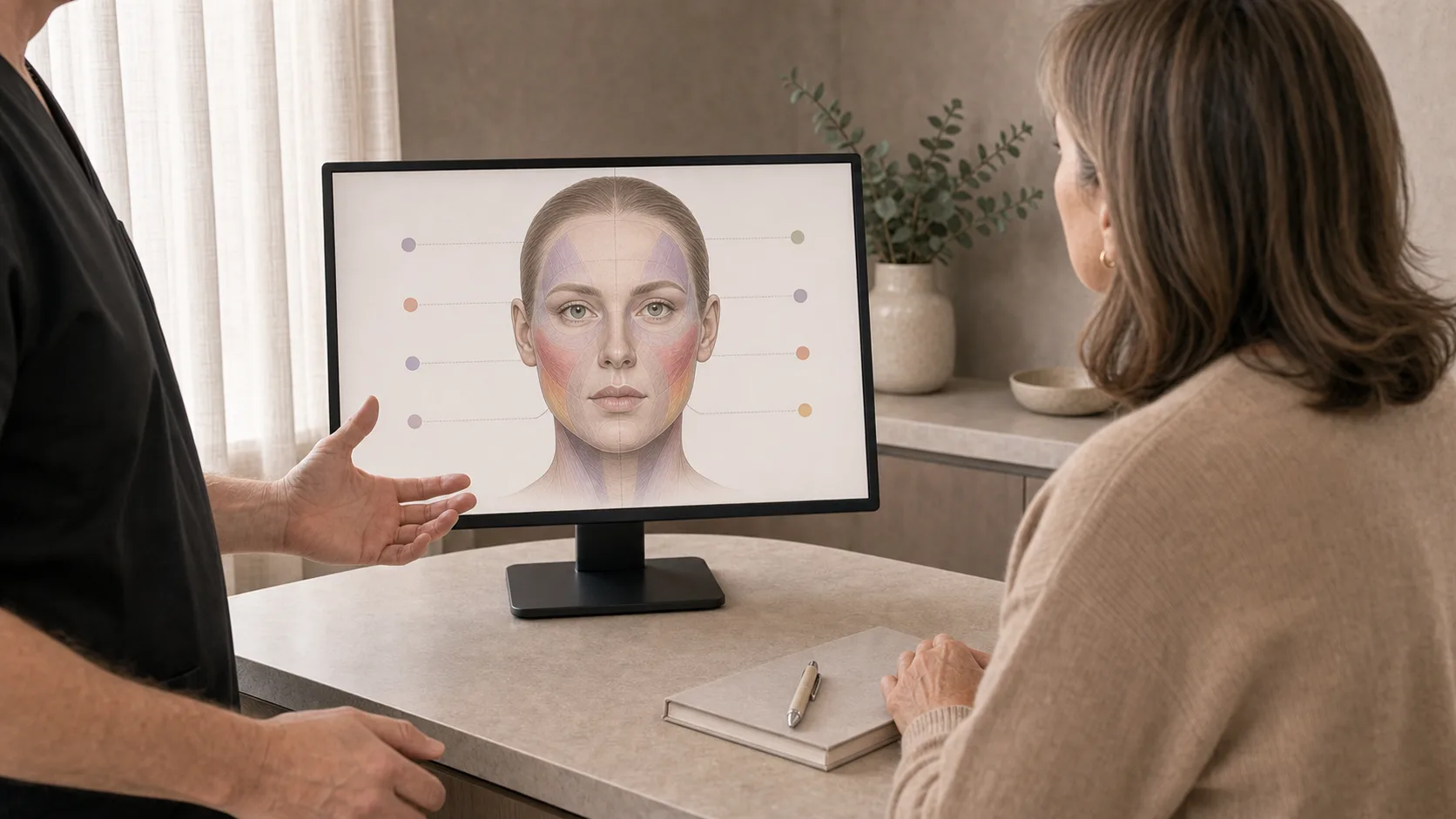
Why Does The Mirror Feel Most Familiar?
A mirror presents a reversed version of the face that you see repeatedly at a chosen distance. Room light, mirror height and how you hold the head also influence cheek shadows.
Familiarity can make a non-reversed photograph feel unexpectedly different even when anatomy is unchanged.
What Can A Video Call Distort?
Laptop and phone cameras are often close, wide and positioned above or below eye level. Screen compression, uneven window light and looking toward another person’s image can alter apparent width and under eye shadow.
Moving the device is not a clinical test, but its position belongs in the history.
Why Can A Candid Photograph Feel So Strong?
A candid image freezes one fraction of speech, smile or head turn. The lens, crop and light may be unknown, and the selected frame may not represent how the face usually moves.
One disliked photograph can identify a question, but it should not become the entire assessment.

What Does In Person Assessment Add?
Direct assessment provides binocular depth, conversational distance, controlled reference light and continuous expression. Corey can compare front, angled and profile relationships while observing a natural smile.
This does not make the other contexts irrelevant. It provides the shared reference used to interpret them.
What If Only One Context Shows The Concern?
The observation remains valid. It may identify lens perspective, a moment of expression, room lighting or a specific angle rather than a feature that dominates continuously.
Context-specific does not mean imaginary, and it does not choose a suitable option by itself.
What If Every Context Shows It?
A consistent concern can be located more clearly but still needs assessment of structure, soft tissue, skin, under eye relationships and expression. Consistency does not diagnose why it appears.
Corey also asks which familiar characteristics you want to preserve.
Which History Should You Bring?
Bring current medicines and supplements, allergies, relevant health and skin history and previous facial care with approximate dates. Mention swelling, tenderness, infection, firmness, altered sensation or a recent unfamiliar change.
One ordinary example from a relevant context is enough; repeated image collection is unnecessary.
How Is Travel Handled?
Travel does not change anatomy or suitability. Check your actual journey from Malvern to Oakleigh and whether planned review access is practical.
Allow enough appointment time to explain the viewing context, receive direct assessment and ask questions.
Which Guide Matches The Main Context?
Read the Melbourne cheek guide for the broad service question, the cheek consultation guide for process, the under eye guide when screen shadow sits above the cheek, and the facial assessment guide for direct examination.
How Do Viewing Contexts Improve Consent?
Consent should distinguish the concern seen in a particular medium from the appearance and expression present in everyday life. Risks depend on the suitable option and may include redness, tenderness, swelling, bruising, asymmetry, lumps, infection, delayed inflammatory response, dissatisfaction and uncommon urgent vascular warning signs.
Corey explains alternatives, realistic limits, total cost, aftercare, review access and contact instructions personally.
Local Real World Cheek Questions
Why can my cheek look different in a mirror and photograph?
A mirror reverses the familiar face and varies with room light and viewing distance. A photograph uses a lens, crop and single instant, so the two contexts can create different impressions without anatomy changing.
What can a video call change?
A close wide lens, screen height, image compression, window light and looking toward another person’s image can alter apparent cheek width and under eye shadow. Device position adds context but is not a diagnostic test.
Why can a candid photograph feel unrepresentative?
It freezes one fraction of speech, smile or head turn, often with an unknown lens, crop and light. The frame can identify a question but should not represent the whole moving face.
What does in person assessment add?
It provides depth, conversational distance, controlled reference light and continuous expression. Corey can compare front, angled and profile relationships and use direct assessment to interpret the other viewing contexts.
What if only one context shows the concern?
The observation remains valid and may identify perspective, expression, lighting or angle. A context-specific feature is not imaginary, but that context alone cannot diagnose the cause or select an option.
What if every context shows the concern?
Consistency can locate the feature more clearly, but structure, soft tissue, skin, under eye relationships and expression still require individual assessment. Consistency alone does not explain why it appears.
Is Core Aesthetics located in this suburb?
No. Core Aesthetics is in Oakleigh. Check the journey from your actual starting point and whether returning for planned review is practical. This local guide does not imply the clinic operates in the suburb.
Is this for you?
Consider booking a consultation if
- Adults near Malvern wanting cheek and midface assessment before treatment discussion
- Patients who want consultation first explanation of cheek support, under eye context, risk and consent
- People comfortable discussing suitable options, practical timing, review needs and any other clinical input
- Patients who want to verify Corey Anderson RN and the Oakleigh clinic before booking
This may not be for you if
- People asking for a predetermined plan without assessment, consent or risk discussion
- People with urgent medical symptoms, active infection, acute swelling or rapidly changing facial symptoms
- People wanting a fixed cosmetic change before facial structure and skin quality are assessed
- People seeking elective cosmetic care for someone who cannot provide informed consent
Suitability is confirmed at consultation. This list is general guidance, not a substitute for clinical assessment.
Clinical references
- Ahpra guidelines for registered health practitioners who perform non surgical cosmetic procedures
- Ahpra advertising higher risk non surgical cosmetic procedures
- Ahpra public register of practitioners
- TGA advertising health services and cosmetic injections FAQ
- TGA advertising health services that involve therapeutic goods