This Caulfield guide prepares you to discuss jawline, chin support, skin quality and lower-face balance with Corey Anderson RN in Oakleigh. The assessment brings together what changed, your health and treatment history, goals, risks, timing and follow-up needs. Corey then explains which options are worth exploring and why.
Where Does Your Eye Stop First?
Trace the lower face border with one finger and stop where your attention first settles. It may be the chin at the centre, the front corner of the jaw, the edge toward the ear, the skin above that edge or the transition beneath it. That point is the beginning of the consultation question.
Corey Anderson RN examines the full lower face, but a precise starting point prevents “jawline” from becoming an assumption about one cause or one option. Core Aesthetics is in Oakleigh and serves adults travelling from Caulfield for individual assessment.
Use A Five Part Border Map
The lower face can be considered as five connected regions: chin anchor, jaw edge, muscle width, skin drape and neck transition. A visible change in one region can alter how another appears, yet each has different anatomy and clinical considerations.
Corey maps what you see from the front, profile and angled views. The map is descriptive, not a diagnosis, and it keeps the conversation tied to your actual observation.
Name The Border Before Naming A Solution
This table turns a broad jawline request into a focused assessment brief.
| Border region | What you might notice | What the consultation explores |
|---|---|---|
| Chin anchor | The centre feels short, long, narrow or visually separate | Projection, height, width and facial proportion |
| Jaw edge | The line appears soft, interrupted or different between sides | Bone contour, soft tissue and viewing angle |
| Muscle width | The lower face changes at rest or during clenching | Movement, function and chewing muscle contribution |
| Skin drape | Skin sits differently over the border | Skin quality, tissue position and movement |
| Neck transition | The border blends into the area beneath the jaw | Lower face and neck relationship |
Could The Jawline Question Begin At The Chin?
The chin forms the central anchor of the lower face. Its projection, height and width can change how the jaw edge reads from the front and side. A person may ask about the jawline when the visual question begins at this centre point.
Corey compares the chin with the lips, nose, jaw corners and overall facial proportions. The purpose is to identify relationships, not to impose a standard profile.
Does The Border Change When You Clench?
Look at the lower face while relaxed and again while gently bringing the teeth together. If the width or contour changes, tell Corey exactly where and whether there is discomfort, grinding, bite change or jaw joint history.
Appearance and function are separate questions that can overlap. Symptoms may warrant appropriate dental or medical input, while cosmetic assessment remains focused on the visible concern and individual suitability.
Read Skin Drape Separately From The Edge
A jaw edge can be present while the skin above it changes the visible outline. Skin quality, tissue position, movement, weight history and natural ageing can all influence this layer. Pulling the skin tight in a mirror does not reproduce a clinical assessment.
Corey observes how the skin sits at rest and in expression. This helps distinguish a border question from a surface or tissue-position question.

Which View Explains The Concern Best?
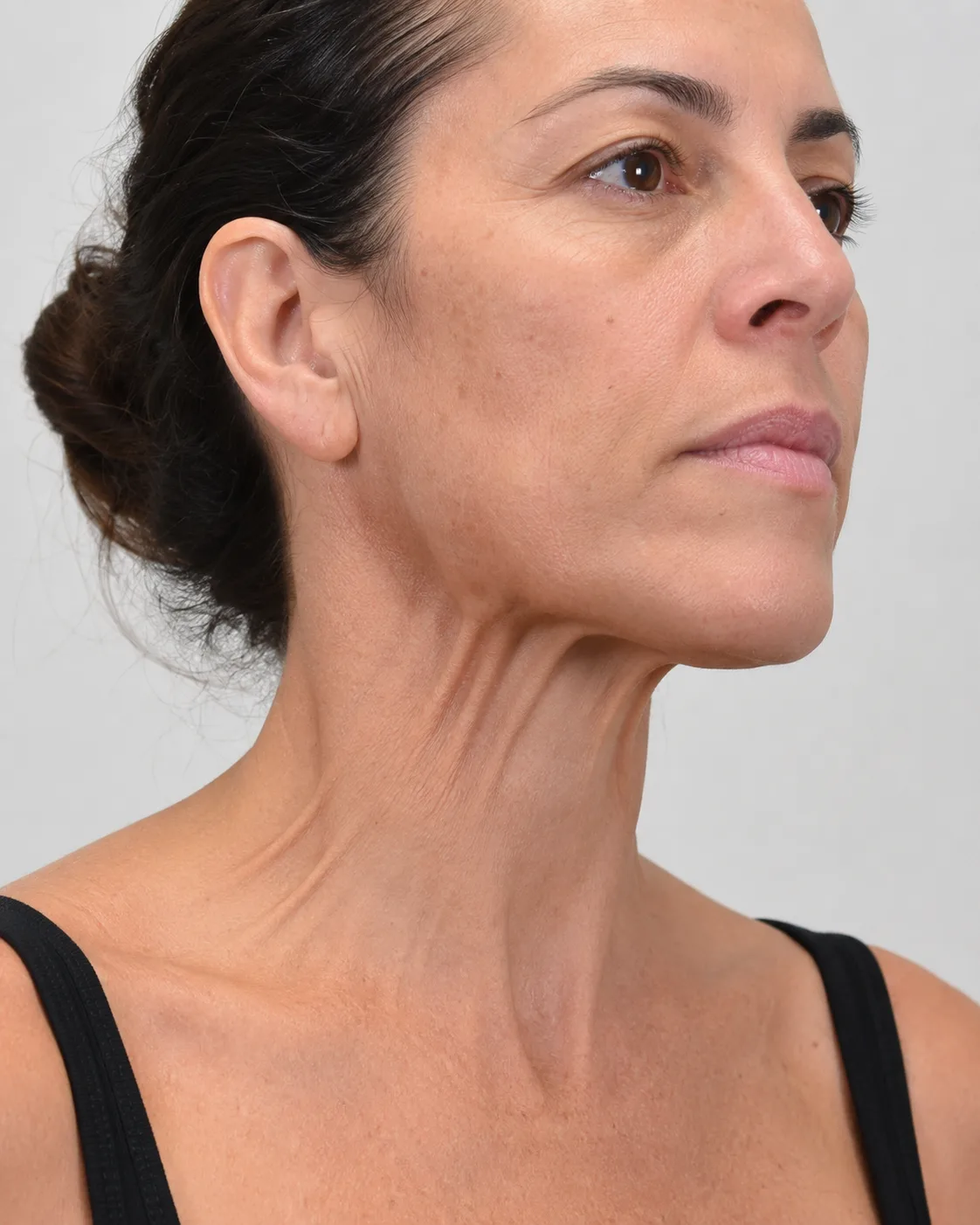
Use front, profile and angled views to describe the concern. Each view contributes different information.
| View | Best for noticing | Question to ask |
|---|---|---|
| Front | Width, symmetry and chin centring | Does one side or the centre draw attention? |
| Profile | Chin projection and neck transition | Where does the border begin and end? |
| Angled | Continuity from chin to jaw corner | Is the line smooth, interrupted or light dependent? |
Ordinary observation is more helpful than forcing the head into an unfamiliar pose. Corey repeats the comparison under consistent clinic conditions.
What Should Stay Familiar?
Name the features you want to preserve: perhaps chin character, a natural difference between sides, lower face width, smile movement or the way the jaw meets the neck. A useful brief contains boundaries as well as desired change.
Corey combines that preservation list with anatomy and clinical findings. Suitable care can be planned when individual assessment and informed consent support it. More information, adjusted timing, another clinical review or a different pathway can be incorporated when useful.

Caulfield Jawline Consultation Questions
What are the five parts of the lower face border map?
The map considers the chin anchor, jaw edge, muscle width, skin drape and neck transition. These regions connect visually but have different anatomy, so Corey assesses them separately and together.
Why might a jawline concern begin at the chin?
The chin is the central anchor of the lower face. Its height, width and projection can change how the jaw edge appears from both front and profile views, even when your first label is jawline.
What does clenching add to the assessment?
Comparing relaxation with gentle clenching can show whether chewing muscle movement contributes to lower face width or contour. Tell Corey about pain, grinding, bite changes or jaw joint history because function requires its own context.
Can skin change how the jaw edge looks?
Yes. Skin quality, tissue position, movement, weight history and natural ageing can affect how the border appears. Corey observes the skin layer separately from bone contour and muscle movement.
Which view is most useful for describing my concern?
Use all three. The front shows width and symmetry, the profile shows chin projection and the neck transition, and an angled view shows continuity between the chin and jaw corner.
What should I ask to preserve?
Name features that remain familiar, such as chin character, natural side difference, smile movement, lower face width or the jaw to neck relationship. These boundaries help make the consultation brief more personal.
Is Core Aesthetics located in Caulfield?
No. Core Aesthetics is in Oakleigh. Plan the journey from your actual starting point and consider whether returning for planned review is practical. This page does not imply a Caulfield clinic location.
Continue With The Region That Matches Your Question
Read the jawline consultation guide for the broader process, jawline and chin comparison when the centre anchor is important, Caulfield jaw muscle guide when width or clenching is central, and jawline and chin anatomy guide for connected proportions.
Use suitability assessment, patient safety, planning your visit and booking for preparation and next steps.
Is this for you?
Consider booking a consultation if
- Adults who want jawline, chin, jowl, jaw muscle and lower face context assessed before treatment discussion
- Patients comparing local access with practitioner verification and review planning
- Patients with previous treatment who may need records review, waiting or original clinic review
- People willing to consider how assessment, timing, follow-up and other clinical input shape the plan
This may not be for you if
- People asking for a predetermined plan without assessment, consent or risk discussion
- People seeking a promised sharper jawline before consultation
- People wanting public prescription product advice or product led recommendations
- People with urgent medical, dental, infection, pain or jaw symptoms who need appropriate medical or dental care
Suitability is confirmed at consultation. This list is general guidance, not a substitute for clinical assessment.