Jawline, Chin & Lower Face Volume treatment: Choosing the Right Treatment Area, consultation based treatment at Core Aesthetics, Oakleigh, Melbourne. Individually assessed. At Core Aesthetics, treatment decisions follow a consultation-first approach with long-term facial outcomes in mind.
Understanding Lower Face Anatomy and Balance
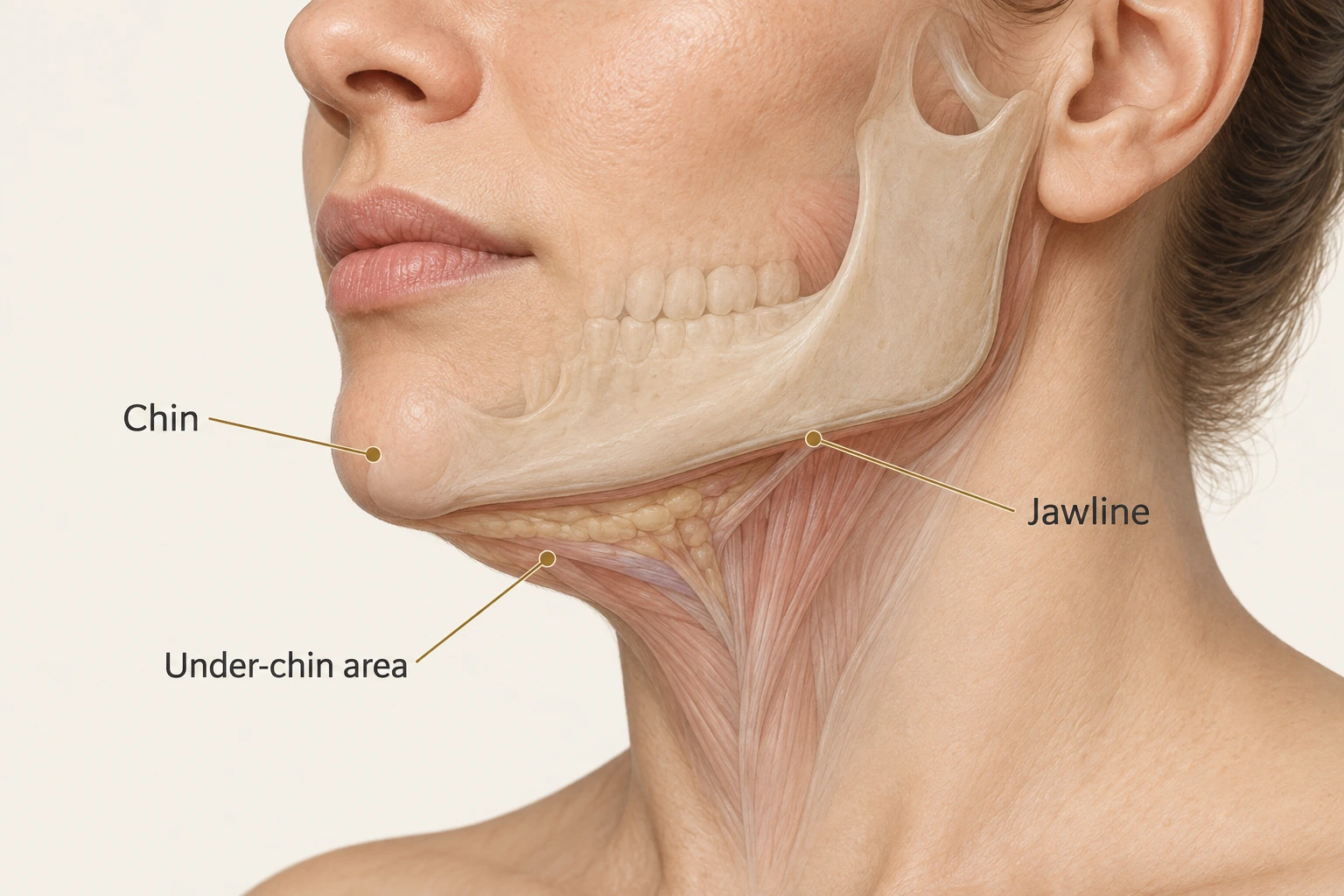
The lower face is a single unit, but it is composed of distinct anatomical areas. The chin, jawline, and lower face together create what we perceive as balance, definition, and proportion. When one area feels ‘soft,’ ‘weak,’ or disproportionate, it often affects how the whole lower face looks. A stronger profile is not always about adding more volume. Often, it is about placing support in the right area. The real question in lower face treatment planning is: which feature is affecting facial balance most? The side profile, the lower face shape, or the way the chin and jaw work together? At a consultation level, these are not interchangeable areas. Chin treatment influences projection and profile. Jawline treatment is more often considered for structure, definition, and lower face framing. For many clients, the most appropriate approach depends on anatomy, proportions, skin quality, and the overall effect they want to achieve.
The Chin: Anatomy and Treatment Considerations
What the Chin Does for Your Face
The chin has profound influence on facial balance, particularly in profile view. The chin relates to: Profile proportion: How the chin projects forward relative to the nose and lips. A chin that sits further back can make the whole lower face feel recessed or imbalanced. Vertical balance: Chin length and the way it relates to the lower face height. A shorter or longer chin changes overall facial proportion. Lower face width: How far forward the chin projects influences how narrow or broad the lower face appears. Jaw angle visibility: A more projected chin can make the jaw angle more visible and defined.
When Chin treatment May Be Considered
Chin treatment is usually discussed when profile balance is the main concern. A chin with less projection can affect how the nose, lips, and lower face relate to each other visually. Concerns that often lead to chin assessment: Weak side profile: You look at your profile photo and feel the lower face recedes too much. You want more projection. Chin that feels short or small: Your chin seems proportionally smaller than your face. Adding length or projection would improve balance. Recessed chin relative to nose: Your nose projects forward, and your chin sits behind it. This creates an imbalanced profile. Bringing the chin forward improves the nose to chin relationship. Double chin appearance: Sometimes what looks like a double chin is actually a chin that sits further back, creating folds where the chin meets the neck. Moving the chin forward can improve this. Width concerns: A chin that is too narrow relative to the face. This is less common but can be addressed with width focused treatment placement. Softer or less defined appearance: The chin looks soft or undefined, particularly where it meets the neck. Subtle firming through volume treatment can help. A conservative chin treatment plan may be considered to support facial proportions and create a more harmonious lower face. The aim, where clinically appropriate, is refinement rather than dramatic change. For clients who want subtle enhancement, chin treatment can sometimes have a noticeable influence on overall balance without requiring broad treatment elsewhere. Important nuance: Not every profile concern is a chin concern. Bite, muscle activity, skin laxity, and natural bone structure all contribute to profile appearance. If your bite is set back, adding chin treatment helps only so much. If your concern is actually muscle bulk (jaw muscle), that requires different treatment. If your concern is sagging skin, volume treatment alone may not address it adequately. Your practitioner should assess the true cause of your concern before proposing treatment.
Chin Anatomy: Side Profile Assessment
Chin assessment happens primarily in side profile. Your practitioner will look at: Horizontal projection: How far forward does your chin project relative to your lips and neck profile? Vertical length: How tall is your chin? Does it balance the upper and middle face? Chin point: Is it sharp and defined, or soft and rounded? Where exactly does the chin project? Chin to neck transition: How defined is the border between chin and neck? Is there good support or does it look soft? Relationship to other features: How does the chin position relate to your nose, lips, and overall profile balance?
The Jawline: Anatomy and Treatment Considerations
What the Jawline Does for Your Face
The jawline extends from the jaw angle (where the jaw turns the corner from vertical to horizontal) around to the front of the chin. It has different functions than the chin: Lower face framing: Definition along the jawline creates a cleaner outline of the lower face, particularly visible in front view. Face shape definition: A well defined jawline makes the lower face appear more sculpted or chiselled. A softer jawline makes the lower face appear rounder. Neck to face transition: Clear jawline definition separates the face from the neck visually, creating better visual proportion. Cheekbone relationship: Stronger jawline definition can make cheekbones appear more prominent by contrast. Jaw angle prominence: The angle of the jaw (where the jaw turns from vertical to horizontal) becomes more visible with good definition.
When Jawline treatment May Be Considered
Jawline treatment is usually more relevant when the lower face lacks definition or appears less structured. This may be due to natural anatomy, age related volume change, or the way soft tissue sits along the jaw border. Concerns that often lead to jawline assessment: Soft or undefined jawline: Looking at yourself head on, the border between the lower face and neck is not well defined. You want a cleaner outline. Rounded lower face: Your lower face feels too round or soft. You want more sculpted appearance. age related softening: Your jawline was more defined when you were younger. You want to restore that definition. Face shape change: You notice your lower face is softer now than it was. This is often due to volume changes or skin laxity with age. Jowling appearance: Some clients have early jowling (sagging along the jaw). Strategic volume treatment can provide some support, though significant jowling requires surgical intervention. Neck definition: You want better visual separation between face and neck. This often involves jawline definition more than chin treatment. Jawline treatment may be considered to support contour through selected points of the lower face, depending on individual anatomy. In practice, this area often requires restraint. Too much product, or placement that does not suit the face, can make the lower face look heavier rather than more refined. For that reason, a sophisticated result is rarely about chasing a sharp line at all costs. It is about preserving natural movement and proportion while improving overall definition where appropriate. Strategic placement: Rather than placing volume treatment along the entire jaw (which can look heavy), strategic placement at specific points (jaw angle, anterior jaw, lateral chin) creates definition without overdoing it. Your practitioner should explain where and why specific points are being treated.
Jawline Anatomy: Front View and Profile Assessment
Jawline assessment happens in both front view and profile: Front view: How defined is the border between lower face and neck? Is there a visible line, or does the lower face blend softly into the neck? How does the jaw width relate to your face width overall? Is the jawline symmetrical? Profile view: How much definition is there along the jaw from the angle back to the chin? Does the jaw appear strong and defined, or soft and undefined? How does the jaw profile relate to your neck? Movement: How much natural definition is there when you clench your teeth (which engages jaw muscles)? Sometimes what looks soft is actually just relaxed anatomy, not deficient anatomy.
Chin vs Jawline: Which Area is Contributing to Your Concern?
When Chin Treatment May Be More Appropriate
Choose chin focus if: Your main concern is side profile. You look at your profile and feel your lower face recedes. Your concern involves chin projection, length, or width (front on appearance). Your chin feels proportionally smaller or shorter than your face. You have a deep profile concern (nose to chin relationship) rather than a front view concern. Improving chin projection would improve your overall facial balance in profile.
When Jawline Treatment May Be More Appropriate
Choose jawline focus if: Your main concern is how defined or sculpted your lower face looks front on. You want better visual separation between face and neck. Your concern is lower face softness or lack of definition, not projection or length. You want improved jaw angle visibility or lower face outline. Your side profile is fine; it is the front view appearance that bothers you.
When Both Areas May Need Assessment
In many cases, both the chin and jawline are assessed together because they work as a unit. A chin that sits slightly back can make the jawline look softer, even if the jaw itself is structurally sound. In the same way, reduced definition along the jaw can make the chin appear less balanced than it actually is. This is why an in person assessment matters more than choosing a treatment based on photographs alone. Your practitioner assesses your entire lower face and determines which area (or areas) would benefit most from treatment. Combined treatment: Many clients benefit from a measured combination. A client may have mild chin retrusion as well as reduced jaw definition. Treating one area only can leave the result feeling incomplete. Treating both, conservatively and in proportion, may create a more cohesive lower face. That does not mean everyone needs combined treatment. It simply means the lower face should be assessed as a whole. Factors such as facial symmetry, chin length, jaw width, skin support, and side profile all help determine whether one area, both, or neither is appropriate.
Other Lower Face Considerations
Marionette Lines (Lines From Mouth to Chin)
Marionette lines run vertically from the corners of your mouth down towards the jawline. They can make the lower face look aged or sad. Treatment involves: Volume treatment in the lines: Direct placement along the lines to plump them and soften their appearance. Volume treatment in the lower face area: Strategic placement along the lower face and jaw to provide support and reduce the appearance of lines through better overall structure. wrinkle treatment: Sometimes the lines are caused partly by muscles pulling downward. wrinkle treatment can help. Often, addressing chin and jawline structure reduces marionette lines indirectly by improving support in that area. Your practitioner can advise which approach suits you.
Jowls and Lower Face Sagging
Jowls are sagging tissue along the jaw and lower face. They are primarily a skin laxity issue, not a volume issue. While volume treatment can provide some support, significant jowls are better addressed with surgical intervention (facelift or mini lift) because the issue is loose skin, not missing volume. If jowling is mild and early, strategic treatment placement might provide support and delay or reduce the appearance of jowling. However, if jowling is moderate to severe, clients are usually better served consulting with a plastic surgeon about surgical options rather than expecting volume treatment alone to address it.
Assessing Your Own Lower Face: Self-Assessment Questions
Before your consultation, ask yourself: Front view or profile concern?: Do you mostly notice the issue when looking at yourself face on, or when you see your profile? This guides whether jawline or chin is the priority. Definition or projection?: Do you want more sculpted/defined appearance, or do you want your chin to project further forward? Definition suggests jawline; projection suggests chin. Symmetry concerns?: Do you notice one side of your jaw or chin is less defined or projects differently? This affects treatment planning. How long has this concerned you?: Is this something you have always noticed, or is it a recent change? Long standing concerns are often anatomical; recent changes often suggest volume loss or age related changes. What specifically would make you happy?: Do you have reference images of chins or jawlines you like? (Realistic references, not celebrities, are most helpful.) Are you concerned about one area, or is it overall lower face?: Isolated concern suggests targeted treatment; overall concern suggests broader assessment.
Red Flags: When to Seek a Second Opinion
Be cautious if a practitioner: Cannot clearly explain why they are recommending chin vs jawline treatment for your specific face. Proposes extensive jawline or chin treatment when your concern is actually something else (like neck laxity or skin quality). Does not assess your whole lower face and profile. Recommends aggressive amounts of product without discussing restraint or staged approach. Does not discuss asymmetry, natural appearance, or movement preservation. Pressures you to decide without time to think.
Booking Your Consultation at Core Aesthetics
At Core Aesthetics in Oakleigh, lower face assessment is thorough and individual. We assess your chin, jawline, and overall lower face proportion to recommend the approach most suited to your anatomy and goals. You can book a consultation or call 0491 706 705 to discuss your lower face concerns.
A well balanced lower face rarely comes from following trends. It comes from careful assessment, measured planning, and a result that still looks like you.
General Information Only
This article is general in nature and does not replace a consultation with a qualified health practitioner. Treatment outcomes, suitability, and risks vary by individual and depend on facial anatomy, skin quality, and individual factors. Any medical or treatment decisions should be based on professional assessment.
How Facial volume treatment Is Used as a Structural Tool
Facial volume treatment is often described in terms of volume, adding more to make something look bigger. This framing misrepresents how volume treatment functions in skilled clinical practice. Volume treatment is a structural tool. It can restore lost support in areas where facial volume has diminished with age. It can define a contour that was never clearly pronounced. And in some cases it can shift the proportional relationships between facial regions in a way that changes how the face reads overall.
Volume, in the sense of visible fullness, is sometimes a goal. But the mechanism is anatomical. Volume treatment placed in the right tissue plane, at the right depth, with an understanding of the surrounding anatomy, produces a different result than volume treatment placed superficially to fill a surface irregularity. This is why technique, placement, and clinical knowledge matter far more than product selection.
At Core Aesthetics, treatment decisions are based on a full facial assessment. Corey evaluates the face as a whole before deciding whether volume treatment is appropriate, where it would be most effective, and what volume would be consistent with a proportionate outcome. This assessment may lead to a recommendation not to treat, and that outcome is equally valid.
Clinical accountability and how volume treatment decisions are made
The volume treatment related guidance in “Jawline, Chin & Lower Face Volume treatment: Choosing the Right Treatment Area” reflects how Corey Anderson, AHPRA registered nurse (NMW0001047575), approaches facial volume treatment decisions at Core Aesthetics: anatomy led, conservative on volume, and willing to defer or refuse treatment when the assessment doesn’t support it. Volume treatment is a structural intervention. The decisions about where, how much, what depth, and what cannula or needle approach are clinical judgements that depend on the individual face in front of the practitioner. Results vary between individuals, and the same volume can read very differently on two faces with different bone structure, fat pad distribution, or skin quality.
Specific to jawline vs chin treatment: the assessment Core Aesthetics performs before any volume treatment includes facial proportions, skin quality, prior treatment history, and the patient’s stated goals, and considers whether facial volume treatment is the right intervention at all. For some patients, the right answer is no volume treatment this visit. For others, the right answer is a smaller amount than the patient anticipated. For others, the right answer is to address skin quality or to dissolve existing volume treatment before considering anything new. Results vary between individuals, and a conservative starting dose is almost always the better long term decision. The jawline treatment vs chin treatment page covers an adjacent volume treatment decision in more depth.
Patients reading this page who want to verify Corey Anderson’s AHPRA registration can do so directly on the AHPRA public register at ahpra.gov.au using registration number NMW0001047575. The Core Aesthetics clinic operates from 12A Atherton Road, Oakleigh VIC 3166, Tuesday to Saturday, by consultation appointment. All new patient treatment at Core Aesthetics follows a structured clinical consultation, consistent with the September 2025 AHPRA cosmetic procedures guidelines. Treatment may be scheduled for the same day as consultation or at a subsequent appointment, depending on clinical assessment and individual circumstances. Patients with questions about the content on this page can raise them at consultation; the practitioner is happy to walk through any clinical reasoning that the written content does not fully capture. Results vary between individuals, and the consultation is the appropriate place to discuss what those individual variations mean for a specific person’s treatment plan.
Is this for you?
Consider booking a consultation if
- You are 18 or older and in good general health
- You want to understand how facial volume treatment may address a specific anatomical concern, volume, structure, or proportion
- You are prepared to attend a standalone consultation before any treatment decision is made
- You understand that injectable treatment is a medical procedure with individual risks and outcomes
This may not be for you if
- You are pregnant, trying to conceive, or breastfeeding
- You have an active infection, cold sore outbreak, or unhealed skin in a potential treatment area
- You have a documented allergy to hyaluronic acid or to local anaesthetic (lidocaine)
- You are taking anticoagulant medication or have a bleeding disorder, without clearance from your treating doctor
- You have had recent facial surgery, trauma, or dental procedures in the treatment area
- You are under 18 years of age
Suitability is confirmed at consultation. This list is general guidance, not a substitute for clinical assessment.
Frequently asked questions
How are jawline and chin treatment related?
Is one usually treated before the other?
The assessment determines the order. For some clients, chin projection is the primary structural lever and is treated first. For others, jawline definition is the dominant concern. The staged approach across appointments is the typical plan.
Can a single appointment address both areas?
Sometimes, when the assessment supports it and the client’s situation aligns with same visit treatment. More often the staged approach treats one area, reviews at four to six weeks, then proceeds with the second area informed by how the first settled. Results vary between individuals.
How long do lower face treatment results last?
Both chin and jawline treatment typically last twelve to eighteen months in most clients. The lower face areas have moderate daily mobility, contributing to the medium to long settled duration. Maintenance intervals settle into individual patterns. Results vary between individuals.
When is jaw muscle treatment relevant to lower face volume treatment planning?
When jaw width is part of the client’s concern. Jaw muscle reduces lower face width through muscle reduction; jawline treatment defines the contour. The two can be combined in a staged plan when the assessment supports it.
When is lower face volume treatment not the right answer?
When the dominant concern is skin descent rather than structural support, when the client’s expectation is closer to what surgical contouring would address, or when the underlying anatomy means injectable treatment will not deliver the realistic outcome the client wants. Results vary between individuals.
Who reviews the volume treatment related clinical content on this page?
Should I get facial volume treatment if I am not certain I need it?
Uncertainty about whether treatment is appropriate is a valid reason to book a consultation rather than treatment. A clinical assessment can clarify whether volume loss, structural descent or skin quality change is the primary driver of what you are noticing, and whether injectable volume treatment is the right approach. Treatment is never assumed at assessment.
Is it safe to have facial volume treatment while pregnant or breastfeeding?
Prescription injectable products are not recommended during pregnancy or breastfeeding. There is insufficient safety data on these products in pregnant or lactating individuals, and the precautionary standard is to defer treatment until after this period. If you are pregnant, planning pregnancy, or breastfeeding, please discuss this at your consultation.
Why does facial volume treatment require an individual assessment rather than a standard dose?
Facial anatomy varies significantly between individuals in terms of fat pad position, bone structure, skin thickness and the degree of volume loss in each region. A standard dose applied without individual assessment risks over-correction, under-correction or placement that does not align with the underlying anatomy. Assessment-led dosing is the standard of care.