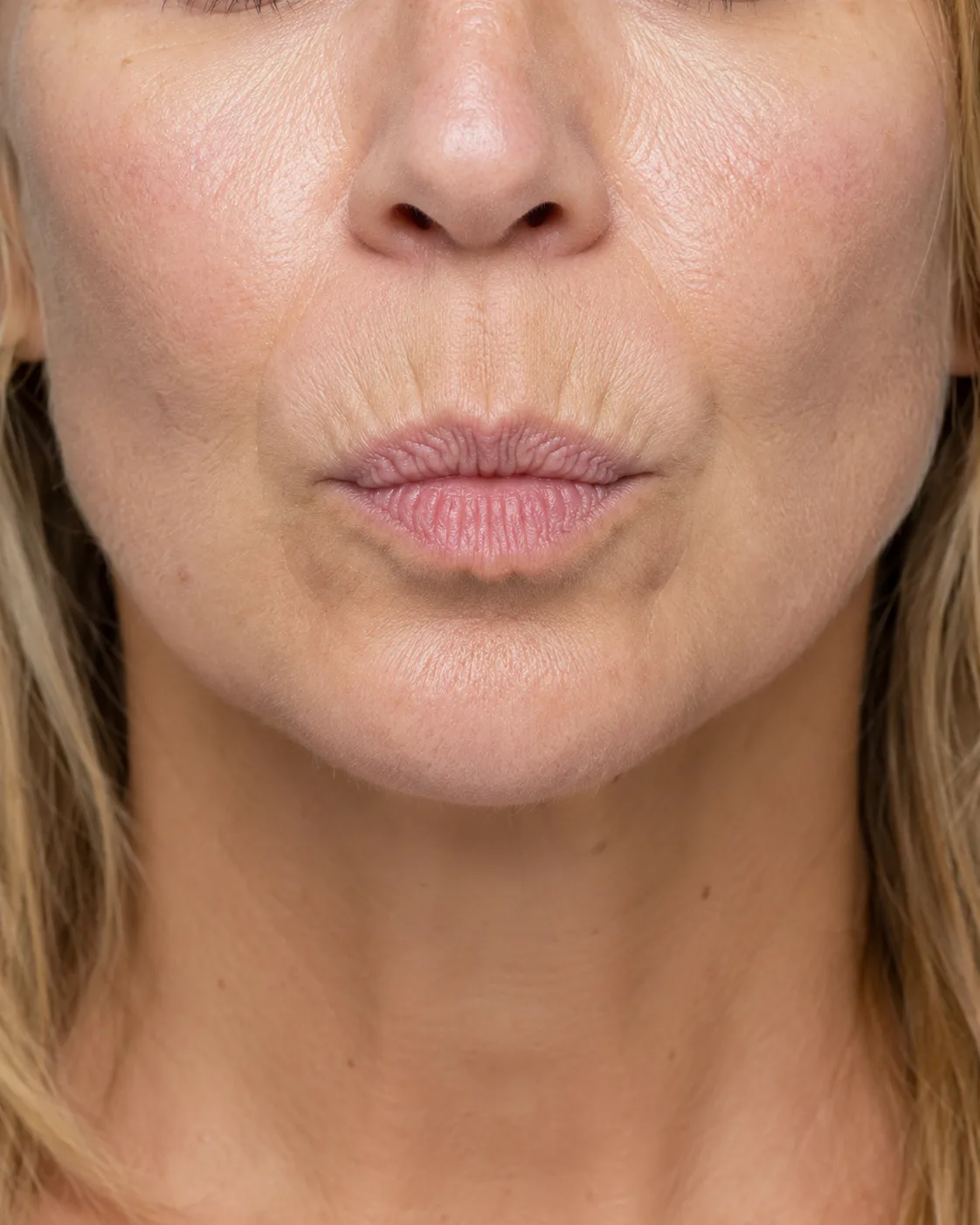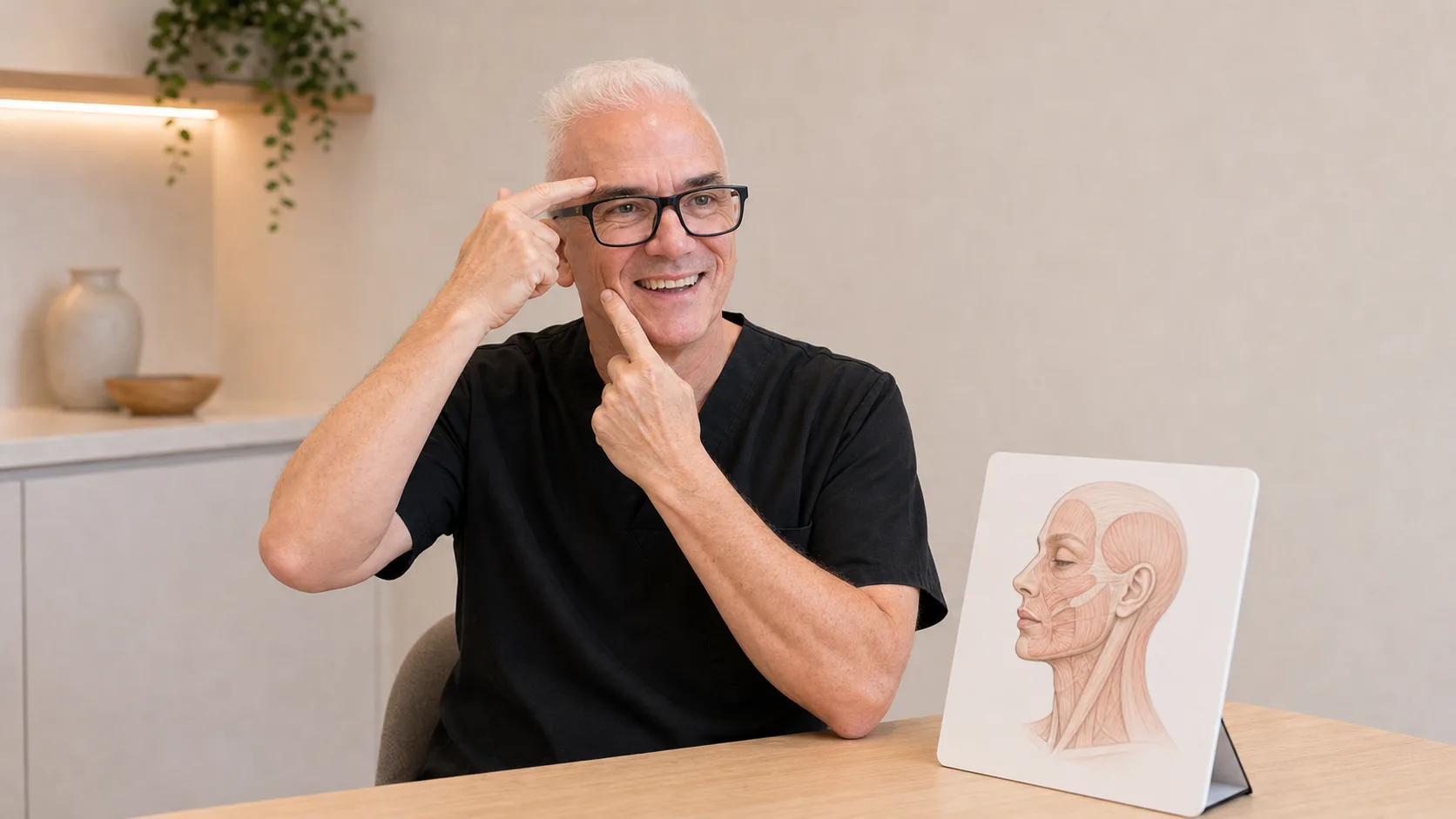
A lip flip uses a small dose of prescription neuromodulator placed superficially in the orbicularis oris muscle of the upper lip. The reduced muscular tone allows the upper lip to rest in a slightly more everted position, which can soften an inwardly rolled appearance during smiling. Treatment is performed at Core Aesthetics in Oakleigh by Corey Anderson, Registered Nurse (AHPRA NMW0001047575). Results vary between individuals.
Patients who arrive asking specifically about a lip flip have usually done their reading. They know the difference between filler and a flip. They know that the result is subtle. They know that the duration is short by injectable standards. They are usually looking for the most conservative possible adjustment to upper lip presentation, often because they have ruled out filler for clinical or personal reasons or because their upper lip rolls inward during animated smiling in a way they would prefer it did not.
This is a small, well defined indication. It is not the right intervention for a patient who is hoping for visible volume change. The honest version of the consultation begins with naming that distinction clearly.
The orbicularis oris and what a flip actually does
The orbicularis oris is a complex, multi layered ring of muscle that surrounds the mouth and serves as an attachment site for many of the muscles that contribute to expression around the lips. Its primary function is closure of the oral aperture. Its tone, particularly the tone of the upper portion, contributes to the position of the upper lip at rest and during animated expression.
A lip flip uses small amounts of prescription neuromodulator placed superficially in defined positions along the upper portion of the orbicularis oris. Reduced muscular tone in those positions allows the lip to rest in a slightly more everted position, exposing a fraction more of the vermilion (the visible red portion of the lip) and softening any tendency for the upper lip to roll inward during smiling.
What it is not
A lip flip does not add volume to the lip. The visible change is the result of an existing lip resting in a slightly different position, not the introduction of new substance. Patients who want a fuller lip are looking for filler, not a flip. Patients who specifically want to avoid filler but find their upper lip rolls under during smiling may find that a flip addresses what they actually wanted without volume change. The two interventions are sometimes combined where the indication supports both, but the indications are distinct.
Who this treatment is for
The clinical indication is most often a patient with a relatively short upper lip vermilion at rest, with a tendency for the upper lip to disappear under the teeth during smiling, who would like the lip to rest in a slightly more everted position without volume change. Patients with adequate vermilion at rest who simply want fuller lips are not the right indication. Patients with significant gummy smile may benefit from a different muscle being treated (the levator labii superioris alaeque nasi) and a flip alone will not address that.
The right candidate is sometimes a patient who has previously had filler and dissolved it, having decided that filler was not the right intervention but still wanting some adjustment. Sometimes it is a younger patient who is curious about subtle change without commitment. Sometimes it is an older patient seeking the smallest possible intervention.
The dose and the placement
Conservative dosing for a lip flip is two to four units of prescription neuromodulator, typically distributed across two to four superficial injection points along the upper border of the upper lip. The placement is precise and superficial. The dose is among the smallest used in any cosmetic neuromodulator indication, and the technique requires care because the muscle is thin and the surrounding lip anatomy is functionally important.
Going beyond conservative dose has predictable trade offs. Higher doses produce more visible eversion but also affect speech, lip closure, drinking from a cup or straw, kissing and the small movements that the orbicularis oris coordinates throughout the day. Patients who experience these effects find them inconvenient until they wear off, which can take six to twelve weeks at higher doses. The case for staying conservative is strong.
Duration and maintenance rhythm
The duration of a lip flip is shorter than most other neuromodulator indications because the orbicularis oris is a high use muscle. Six to ten weeks is typical, sometimes shorter, occasionally longer. This means a maintenance plan involves more frequent retreatment than the three to four monthly rhythm of upper face muscles. Patients who find the rhythm sustainable continue. Patients who find the rhythm impractical sometimes decide that the intervention is not worth the maintenance commitment.
The conversation about duration is part of consultation. A patient who expects three to four months of effect and gets six weeks may feel disappointed even if the result was technically correct. Naming the realistic duration up front sets accurate expectations.
What treatment involves
The treatment is brief. After consultation and consent, the practitioner identifies the placement positions along the upper lip border and places small volumes of prescription neuromodulator superficially. Discomfort is minimal because the volumes are tiny. There is no swelling in the conventional sense and no practical downtime. Patients return to normal activity immediately.
Onset is gradual. Most patients begin noticing softer upper lip tone within five to seven days, with full effect at around two weeks. The visible change is subtle. Patients sometimes remark that they can feel the difference more than they can see it, which is precisely the conservative outcome the treatment is designed for.
Side effects and what we monitor
Local side effects are minimal because of the tiny volumes involved. Possible effects include brief tenderness at injection points, a small lump that resolves over days, and rarely a small bruise. Specific to this region, over dosing or asymmetric placement can produce difficulty with lip closure, speech changes (particularly affecting words that require firm lip apposition), difficulty drinking from a straw, and asymmetric smiling. Conservative dosing substantially reduces these risks.
If functional effects do occur after a lip flip, they typically resolve over six to twelve weeks as the neuromodulator effect wears off. There is no specific reversal agent for neuromodulator (unlike hyaluronidase for hyaluronic acid filler), so the management is supportive and the timeline is the timeline.
AHPRA September 2025 considerations
The AHPRA guidelines for nonsurgical cosmetic procedures that came into force in September 2025 require an in person or video consultation with the prescribing practitioner each time a cosmetic injectable is prescribed. For a lip flip, with its shorter duration and consequent more frequent retreatment rhythm, the consultation requirement applies to each treatment cycle. Suitability assessment must explicitly address motivations and expectations.
For lip flip specifically, this matters because the gap between what some patients hope a flip will achieve (visible volume change) and what it actually achieves (small change in resting position) can be significant. The September 2025 framework formalises the conversation that consultation based practices were already having.
Why we do not name the prescription product
Australian regulation prohibits the advertising of Schedule 4 prescription medicines to the public. That includes brand names, abbreviations and hashtags. The TGA has been increasingly active in enforcing this provision in the cosmetic injectables sector. We can talk in clinical detail about the mechanism, dose ranges and response profile. We do not name brands or otherwise identify products to the public, because the law explicitly prohibits us from doing so.
How a lip flip fits with lip filler
Patients sometimes ask whether a flip and lip filler can be combined. The clinical answer is sometimes yes, but the conversation is more nuanced than a quick yes. A flip alone changes resting position. Filler alone changes shape and proportion. Combining the two is appropriate where the indication supports both, but neither should be a default add on to the other. Each is assessed on its own clinical merits.
For patients who are not sure whether they want a flip, a filler or both, the consultation typically starts with separating what they actually want to change. Once that is clear, the right intervention (or combination) becomes more obvious. Sometimes the answer is one. Sometimes both. Sometimes neither.
Conservative dosing as the default
The C.O.R.E. Method approach in this region is to start with the lowest end of the conservative dose range, with structured review at two weeks, and the option to add small additional dose if response has been insufficient. The opposite approach (a higher first dose) is sometimes used in higher throughput practices and is not necessarily wrong, but it carries higher risk of functional side effects without offering proportional aesthetic benefit. The conservative approach errs in favour of preserving function at the cost of an occasional second visit.
Working with Corey
Corey Anderson is the only practitioner at Core Aesthetics. Registered with the Nursing and Midwifery Board of Australia since January 1996 (AHPRA NMW0001047575), Corey runs a one practitioner, low volume clinic in Oakleigh. For small, precise indications like a lip flip, the consistency of practitioner technique across years of repeated visits supports the kind of calibrated dosing that produces stable, predictable results without functional compromise.
Patients see Corey at every visit. Treatment notes carry the dose, the placement detail and the response duration forward across years.
Cost framing
Pricing is straightforward. A lip flip is priced on the actual product and time involved, quoted in writing as part of the consultation. There is no surge pricing, no time limited promotional pricing and no loyalty discounting. Because the duration is shorter than most other indications, patients receive a written treatment plan that includes the realistic anticipated frequency of maintenance and the cumulative cost across the first twelve months.
A note on lip related anatomy
Lip aesthetics involves more than the orbicularis oris alone. The Cupid bow is a feature of the upper lip vermilion border. The philtral columns descend from the base of the nose to the Cupid bow. The vermilion border itself defines the visible red lip. The depressor anguli oris pulls the corners of the mouth downward. The mentalis at the chin contributes to lower lip projection. A consultation about lip aesthetics looks at all of these together rather than focusing only on one muscle. A lip flip treats one specific component of this system. Where other components are contributing to the patient concern, the planning conversation acknowledges that and considers whether other interventions are part of a broader plan.
On reading the result honestly
Patients sometimes return at the two week review uncertain whether the treatment has worked. The change is small enough that, without the comparison photographs, it can be difficult to identify. Reviewing the standardised pre and post photographs side by side at the same magnification is part of the standard review process. The lip looks slightly softer in animation, the upper lip vermilion is slightly more visible, and the change is exactly what was planned. The honest reading of a conservative result requires the documentation that goes with it.
A note on patient population
The patients who tend to find lip flips genuinely satisfying share certain characteristics. They tend to be people who have done their reading and arrived with a defined, modest goal. They tend to be people who are comfortable with subtle change rather than visible transformation. They tend to be people who can plan around the shorter maintenance rhythm. They are often patients who have either ruled out filler for personal reasons, or have had filler in the past and decided that the next intervention would not involve adding more volume. Lip flips suit a particular kind of patient very well, and suit other kinds of patient less well. The conversation in consultation is partly about working out which group the patient fits into.
This is not a value judgment about either group. Patients who want visible lip volume change have legitimate goals that are well served by lip filler. Patients who want a smaller, subtler intervention have legitimate goals that are well served by a flip. The treatment that fits the patient is the right treatment, and the consultation is the right place to work out which is which.
On combining lip flip with broader lip planning
For patients considering both flip and filler over time, the sequencing matters. Where the priority is shape and proportion change, filler typically comes first and any flip question is reconsidered later. Where the priority is small change in resting position, the flip is its own intervention. Where the patient is uncertain, the conservative path is to address one component at a time, evaluate the result at the structured review, and decide whether further intervention is warranted in light of how the first one settled. This is a slower path than single session combined treatment but produces results that are easier to evaluate and easier to adjust.
Booking a consultation
Lip flip consultation is most often part of a broader conversation about lip and lower face goals. The consultation is a clinical assessment in its own right, with no obligation to proceed in the same session. If treatment is appropriate, it can be performed in the same visit. Results vary between individuals. The plan is built around the specific anatomy and goals of the person in front of us, including realistic discussion of the maintenance rhythm.
Core Aesthetics operates from 12A Atherton Road, Oakleigh, in Melbourne south east. Booking is direct online or by contacting the clinic.
A note on patient experience
Patients who choose a lip flip and find it suits them often describe the result in modest terms. The lip looks slightly softer in animation. The tendency for the upper lip to disappear under the teeth during smiling is reduced. Friends and family sometimes do not notice the change at all, which is a feature of the conservative result, not a failure. Patients who find the result too subtle for the maintenance commitment often decide after the first treatment that the intervention is not for them, and that is also a clinically reasonable outcome.
Is this for you?
Consider booking a consultation if
- You have a relatively short upper lip vermilion that rolls inward during animated smiling and want a subtle change in resting position
- You specifically want to avoid lip filler but would like a small softening of upper lip tone
- You can accommodate a six to ten week maintenance rhythm rather than the longer intervals of other neuromodulator indications
- You are 18 or older and otherwise in general good health
This may not be for you if
- You are pregnant, trying to conceive, or breastfeeding
- You have a neuromuscular condition that contraindicates neuromodulator treatment, or a known allergy to the active ingredient
- You are looking for visible volume change in the lips (filler is the appropriate intervention for that)
- You have significant gummy smile (treatment of a different muscle may be more appropriate)
Suitability is confirmed at consultation. This list is general guidance, not a substitute for clinical assessment.
Frequently asked questions
How is a lip flip different from lip filler?
A lip flip uses a small dose of prescription neuromodulator to reduce tone in the orbicularis oris muscle, allowing the upper lip to rest in a slightly more everted position. It does not add volume. Lip filler uses a different category of prescription product to add volume and modify shape and proportion. The two interventions are clinically distinct and address different concerns.
How long does a lip flip last?
Six to ten weeks is typical, sometimes shorter, occasionally longer. This is shorter than most other neuromodulator indications because the orbicularis oris is a high use muscle. The shorter duration means a more frequent maintenance rhythm than upper face treatments, which is part of the consultation conversation.
Will a lip flip make my lips look fuller?
Not really. The visible change is the result of an existing lip resting in a slightly more everted position, not new volume. Patients who want fuller lips are looking for filler, not a flip. Patients who specifically want to avoid filler but want their upper lip to roll under less during smiling are the right indication for a flip.
What is the typical dose?
Conservative dosing is two to four units of prescription neuromodulator, distributed across two to four superficial injection points along the upper border of the upper lip. This is among the smallest doses used in any cosmetic neuromodulator indication. Going beyond this carries trade offs in lip function, speech and the small movements that the orbicularis oris coordinates throughout the day.
Can a lip flip affect my speech?
At conservative dose, no. At higher doses, yes. The orbicularis oris coordinates lip closure for speech, and over dosing can affect words that require firm lip apposition. Functional effects, when they occur, typically resolve over six to twelve weeks as the neuromodulator wears off. There is no specific reversal agent. Conservative dosing substantially reduces these risks.
Can I have a lip flip and lip filler together?
Sometimes yes, where the indication supports both. The two interventions are clinically distinct. A flip alone changes resting position. Filler alone changes shape and proportion. Each is assessed on its own merits and neither should be a default add on to the other. The consultation typically separates what the patient actually wants to change before deciding which (or both) is appropriate.
How quickly does a lip flip take effect?
Most patients begin noticing softer upper lip tone within five to seven days, with full effect at around two weeks. The change is gradual rather than immediate. The visible change is subtle. Patients sometimes remark that they can feel the difference more than they can see it, which is the conservative outcome the treatment is designed for.
Is a lip flip suitable for everyone?
No. The indication is specific: patients with relatively short upper lip vermilion at rest, with the lip rolling inward during animated smiling, who want a small adjustment to resting position without volume change. Patients with adequate vermilion who want fuller lips are looking for filler. Patients with gummy smile may benefit from treatment of a different muscle. Suitability is determined at consultation.