Facial aesthetics is often discussed in gendered terms. Men’s treatment versus women’s treatment. While there are observable differences in facial structure and ageing patterns on average, these differences do not define clinical decision making. What defines treatment is not gender. It is facial structure, movement patterns, and desired balance outcomes. However, there are patterns in how concerns are expressed and how treatment is approached that require careful clinical interpretation. Results vary between individuals and are reviewed at a follow up consultation.
How male facial anatomy differs from female anatomy
Male and female facial anatomy differ in several ways that are directly relevant to injectable treatment planning. Male facial structure is generally larger, with greater bone mass, more prominent brow ridges, a stronger and wider jaw, and more defined angular features.
Male skin tends to be thicker and has more sebaceous activity. This affects how the skin responds to injectable treatment and how lines develop over time, thicker skin can mask some fine lines but may also make deeper lines more resistant to treatment.
The muscle mass driving expression lines is typically greater in male patients. This affects dosing, male patients often require higher doses of anti-wrinkle product to achieve equivalent movement reduction compared to female patients of similar age and build.
Fat distribution in the male face also differs. The mid face tends to have less discrete fat compartmentalisation, and volume loss patterns present differently. These differences affect how filler placement is approached in male patients compared to female patients.
What male patients typically seek
Male patients presenting at Core Aesthetics most commonly seek treatment for one of several concerns. Expression lines, forehead lines, frown lines, and crow’s feet, are frequently the primary motivation, particularly for men who feel that upper face lines are making them appear older or more stern than they feel.
Jaw and masseter concerns are also common. Some male patients present with significant masseter hypertrophy that creates a widened lower face appearance they are not happy with. Others present with bruxism related jaw discomfort. Masseter treatment is highly effective for both concerns.
Volume changes, hollow temples, reduced mid face fullness, periorbital hollowing, are increasingly common presentations as men become more aware of how structural changes affect facial appearance. Male patients in this group often present with concerns framed as looking tired rather than as aesthetic concerns per se.
A smaller proportion of male patients present for lip or perioral treatment, though this group exists and their concerns are treated with the same assessment-first approach as any other presentation.
The importance of natural outcomes for male patients
The most common concern expressed by male patients considering injectable treatment is that they will look treated, that colleagues, friends, or family will notice that something has changed and conclude they have had cosmetic treatment.
This concern is valid and shapes the treatment approach for male patients. Outcomes that read as obviously treated, frozen forehead, overly smooth expression, or changed facial proportions, are particularly noticeable in men because the social expectation of male cosmetic treatment is still less established than it is for women.
Natural outcomes for male patients prioritise subtle improvements that read as looking well or refreshed rather than as having had treatment. This means conservative dosing in expression areas, appropriate preservation of expression range, and volume work that supports structure rather than changing proportion.
The consultation for male patients includes an explicit discussion of what a natural outcome means for the individual and how the approach will be calibrated to achieve it.
Anti-wrinkle treatment for men
Anti-wrinkle treatment for male patients addresses the same muscle groups as for female patients, forehead, frown, crow’s feet, and other areas, but dose calibration is adjusted for male muscle mass.
In the forehead, male patients often have a heavier brow position and a more prominent brow ridge. Treatment must be calibrated to avoid brow heaviness while achieving meaningful line reduction. The assessment at consultation identifies individual brow position and anatomy.
Frown treatment is often highly effective for male patients, reducing the permanently frowning appearance that some men develop over time. The frown area responds well in most patients when appropriately dosed.
Crow’s feet treatment requires awareness that male patients often prefer to retain some expression, significant reduction of lateral eye movement can appear unnatural in male patients who are used to a full expression range. Conservative initial dosing with review is the appropriate approach.
Dermal filler for men
Dermal filler in male patients is approached with a focus on structural support rather than augmentation. Male facial proportions differ from female proportions, and treatment that would be aesthetically appropriate in a female patient may produce an unnatural result in a male patient.
Mid face volume support for men emphasises maintaining the structural integrity of the cheek and temple without adding obvious fullness. The goal is to restore or maintain the structural framework, not to create defined cheekbones in the way that might be sought in a female patient.
Jawline and chin support for male patients focuses on maintaining angular definition as bone density reduces. Subtle structural support along the mandibular line or at the chin can maintain the lower face proportions that characterise a well defined male face.
Periorbital treatment, particularly tear trough support, can be very effective for male patients who appear fatigued due to periorbital hollowing. The result is a more rested appearance that reads as health rather than as cosmetic treatment.
Masseter treatment for male patients
Masseter treatment is one of the most commonly performed injectable treatments in male patients at Core Aesthetics. Enlarged masseter muscles, either from habitual grinding or from constitutional factors, create a widened lower face profile that some male patients are not happy with.
The masseter treatment reduces muscle bulk gradually over six to eight weeks following injection. The lower face becomes proportionally slimmer, and the jaw angle is less prominent. For male patients with very prominent masseter hypertrophy, this can be a significant change to facial proportions.
For male patients with bruxism, masseter treatment also provides functional benefit, reduced jaw muscle tension, reduced tooth grinding force, and associated relief from headaches and jaw discomfort associated with nocturnal grinding.
Male masseter muscles are typically larger than female masseters and may require a higher dose to achieve equivalent volume reduction. The review appointment at six to eight weeks is important to assess the response and determine whether a top up dose is warranted.
consultation based practice for male patients
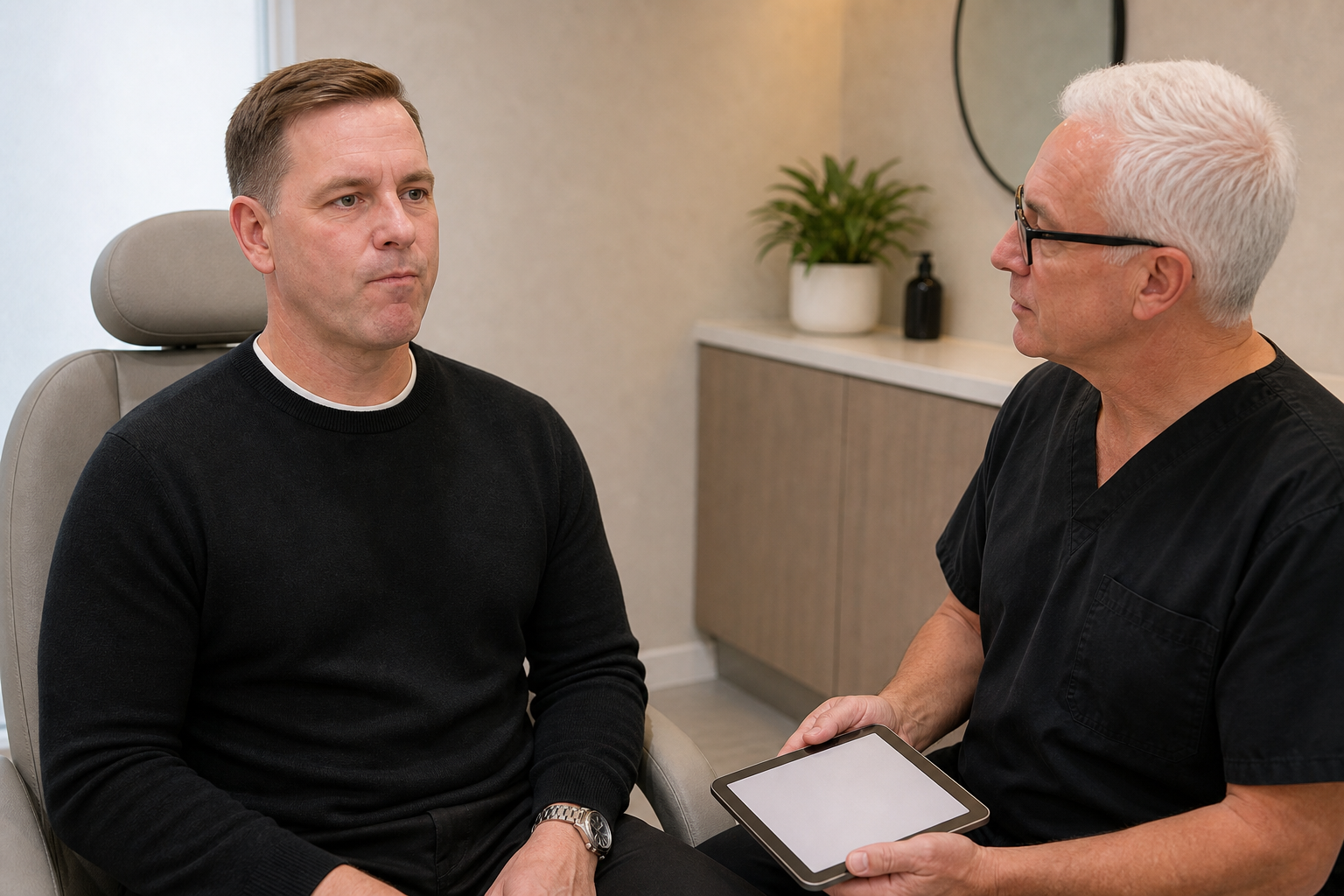
Core Aesthetics operates as a consultation based clinic for all patients, including men. The consultation is a separate appointment from any treatment, allowing the individual to discuss their concerns, ask questions, and make a considered decision before committing to any procedure.
For male patients who are new to injectable treatment, the consultation is particularly important. Many arrive with limited knowledge of what injectable treatments involve, what realistic outcomes look like, and what the process entails. The consultation is designed to answer these questions thoroughly and honestly.
Male patients are not pressured to proceed with any treatment. The consultation may conclude with the practitioner recommending a different treatment approach, suggesting deferral, or concluding that treatment is not indicated for the individual’s presentation. This is part of what it means to take a patient first approach.
Privacy and discretion
Many male patients seeking injectable treatment place a high value on privacy and discretion. The consultation only appointment model at Core Aesthetics means that treatment decisions are made in a private clinical setting, without the social pressure or observation that can occur in higher volume clinical environments.
The low volume, one practitioner model at Core Aesthetics means that patients interact with the same practitioner at every visit. This continuity supports trust and allows the practitioner to develop a thorough understanding of the individual’s anatomy, preferences, and treatment history over time.
Booking is managed online through Square. New patient consultations are available for all men considering injectable treatment. The consultation is the appropriate starting point regardless of whether the patient is certain they want to proceed or is simply seeking information.
How Men Typically Describe What They Are Looking For
In consultations with men, the language used tends to be indirect at first. Many clients describe not a specific treatment but a general dissatisfaction, they look tired, they look older than they feel, or someone in their life has commented on their appearance. The framing is often about wanting to look like themselves again rather than wanting to look different. That distinction matters.
Other men come in with a specific concern: deep frown lines that make them look angry in photographs, jaw tension that causes headaches, or underarm sweating that affects their professional and social confidence. These are concrete, functional concerns with clear treatment options, and they tend to be straightforward consultations because the starting point is well defined.
A smaller group of men come in with no specific concern at all, but with a general curiosity about what is available and what might suit them. These consultations take longer and are, in many ways, the most valuable, because the work of figuring out what a person actually wants and what is actually achievable is done properly at the start, rather than retrospectively at a review appointment when the outcome has already been set.
Timing, Recovery, and Fitting Treatment Around Work
One practical concern that comes up in many men’s consultations is timing. Men who work in client facing roles, who are attending events, or who simply prefer not to explain anything to colleagues want to know when they can return to their normal routine after treatment.
For anti-wrinkle injections, the treatment itself takes ten to fifteen minutes and involves a series of small injections using very fine needles. There is typically no significant downtime. Small marks at injection sites may be visible for a few hours; occasional minor bruising can occur and typically resolves within a few days. Most men return to work the same day.
For dermal filler, swelling in the treated area is common in the first twenty four to forty eight hours, and bruising is possible. Planning treatment before a quiet period, a long weekend, or at least forty eight hours before a major event, is sensible. This is not unique to men; it applies to all clients.
Hyperhidrosis treatment for underarm sweating has a similarly low recovery profile. The injections are administered in the underarm area; most men can resume normal activity the same day, though strenuous exercise for twenty four hours post treatment is generally avoided. Results typically take one to two weeks to develop fully.
All timing questions are discussed at consultation, where the practitioner can give guidance based on the specific treatment being planned and the individual’s circumstances.
Understanding Cost, Value, and What Guides Treatment Decisions
A practical question that comes up in men’s consultations is how treatment is priced and what determines the cost. At Core Aesthetics, treatment cost is based on the clinical assessment of what is appropriate for a given individual, the dose, the areas being treated, and the complexity involved. There are no package prices, no add on upsells, and no time limited offers. What is quoted at consultation is based on what has been assessed as clinically appropriate, not on a promotional structure.
For men who are coming in for the first time, the initial consultation is the right place to have this conversation. The practitioner will assess the areas of concern, explain what treatment options are appropriate, and provide a clear outline of what is involved, including cost, before any decision is made. There is no obligation to proceed at the consultation appointment.
Value in injectable treatment is not straightforward to assess from price alone. A lower cost treatment administered without proper assessment, in the wrong dose, or in the wrong anatomical location can produce outcomes that require correction, which costs more, not less, in the long run. A consultation based model, with careful dose selection and a scheduled review, is designed to produce consistent outcomes that avoid the need for correction. For men who are investing in their appearance for the first time, understanding this is part of making an informed decision.
Clinical accountability and how this page is reviewed
The clinical content in “Facial Aesthetics for Men in Oakleigh and Melbourne East” is written and reviewed by Corey Anderson, AHPRA registered nurse (NMW0001047575). Core Aesthetics operates as a one practitioner, consultation based, low volume clinic in Oakleigh, Melbourne, which means every recommendation on this page reflects the same clinical perspective rather than a copywriter’s interpretation of it. Results vary between individuals, and any guidance written for the general reader has to acknowledge that variance, what the published evidence supports for the average patient may not be what the assessment supports for a specific patient.
Specific to mens aesthetics oakleigh: this page describes the typical clinical picture for a healthy adult patient at the time of writing. Individual circumstances, medical history, current medications, prior cosmetic treatment, skin type, age, hormonal state, lifestyle, can shift any of the timelines and recommendations described here. The information is provided to help patients arrive at consultation already familiar with the underlying clinical reasoning, not to replace the consultation itself. Results vary between individuals; this page describes the centre of the distribution, not the edges. The mens aesthetics Melbourne page covers an adjacent topic in more depth.
Patients reading this page who want to verify Corey Anderson’s AHPRA registration can do so directly on the AHPRA public register at ahpra.gov.au using registration number NMW0001047575. The Core Aesthetics clinic operates from 12A Atherton Road, Oakleigh VIC 3166, Tuesday to Saturday, by consultation appointment. All new patient treatment at Core Aesthetics follows a structured clinical consultation, consistent with the September 2025 AHPRA cosmetic procedures guidelines. Treatment may be scheduled for the same day as consultation or at a subsequent appointment, depending on clinical assessment and individual circumstances. Patients with questions about the content on this page can raise them at consultation; the practitioner is happy to walk through any clinical reasoning that the written content does not fully capture. Results vary between individuals, and the consultation is the appropriate place to discuss what those individual variations mean for a specific person’s treatment plan.
One closing point worth making: the content on this page is intended to inform the consultation rather than replace it. Patients arrive at consultation with different baseline knowledge, different goals, and different prior experiences with cosmetic treatment, and the consultation is calibrated to the individual rather than to the average reader of this page. The written content does its job if it helps the patient ask better questions and understand the answers they receive. Patients researching the topic in more depth may find the consultation guide Melbourne page and the filler bruising timeline page useful as further reading; both are written and reviewed under the same clinical accountability framework as this page.
Is this for you?
Consider booking a consultation if
- You are 18 or older and in good general health
- You are researching cosmetic injectable treatments and want a clinical assessment of your options
- You prefer a one practitioner, consultation based environment
- You understand that treatment decisions are made individually, not based on a standard menu
This may not be for you if
- You are pregnant, trying to conceive, or breastfeeding
- You have an active skin infection or unhealed wound in a potential treatment area
- You are under 18 years of age
Suitability is confirmed at consultation. This list is general guidance, not a substitute for clinical assessment.
Frequently asked questions
Is injectable treatment different for men than for women?
Yes. Male facial anatomy differs from female anatomy in muscle mass, bone structure, fat distribution, and skin thickness. Dosing and treatment approaches are adjusted accordingly. The goals also differ, male patients typically seek natural, discreet improvements rather than obvious change.
Will people be able to tell I have had treatment?
The goal is natural outcomes where you look well or refreshed, not obviously treated. Conservative dosing, appropriate preservation of expression, and structural volume work that supports rather than changes proportions are central to achieving this. The consultation discusses what natural means for your specific goals.
What are the most common treatments for male patients?
Anti-wrinkle injections for forehead and frown lines, masseter treatment for jaw muscle bulk or bruxism, and structural filler for periorbital hollowing or mid face support are the most common. The appropriate treatment for each individual is determined at consultation.
Do men need higher doses than women?
Often yes for anti-wrinkle treatment, male facial muscles are typically larger and may require higher doses to achieve equivalent movement reduction. Filler dosing depends on individual anatomy rather than gender specifically.
Can masseter treatment reduce jaw grinding symptoms?
Yes. Anti-wrinkle treatment in the masseter reduces the force of jaw muscle contraction, which can provide meaningful relief from bruxism associated jaw pain, tension headaches, and dental wear. The functional benefit is often as significant as the cosmetic effect for patients with symptomatic bruxism.
Do I need a consultation before treatment?
Yes. All treatment at Core Aesthetics, for men and women, begins with a consultation appointment. No treatment is planned or performed at the first visit. The consultation is where the assessment is made, treatment options are discussed, and a plan is established.
Is the clinic environment appropriate for male patients?
Core Aesthetics is a one practitioner clinic that sees both male and female patients. The clinical environment is professional and the consultation based model supports a private, low pressure experience appropriate for male patients regardless of their prior experience with aesthetic treatment.
Who writes and reviews the clinical content on this page?
The clinical content is written and reviewed by Corey Anderson, an AHPRA registered nurse (NMW0001047575) and the practitioner at Core Aesthetics in Oakleigh, Melbourne. Core Aesthetics operates as a one practitioner, consultation based, low volume clinic, which means the recommendations on this page reflect the same clinical perspective patients encounter at the consultation itself. Results vary between individuals, and personalised guidance is provided at consultation.