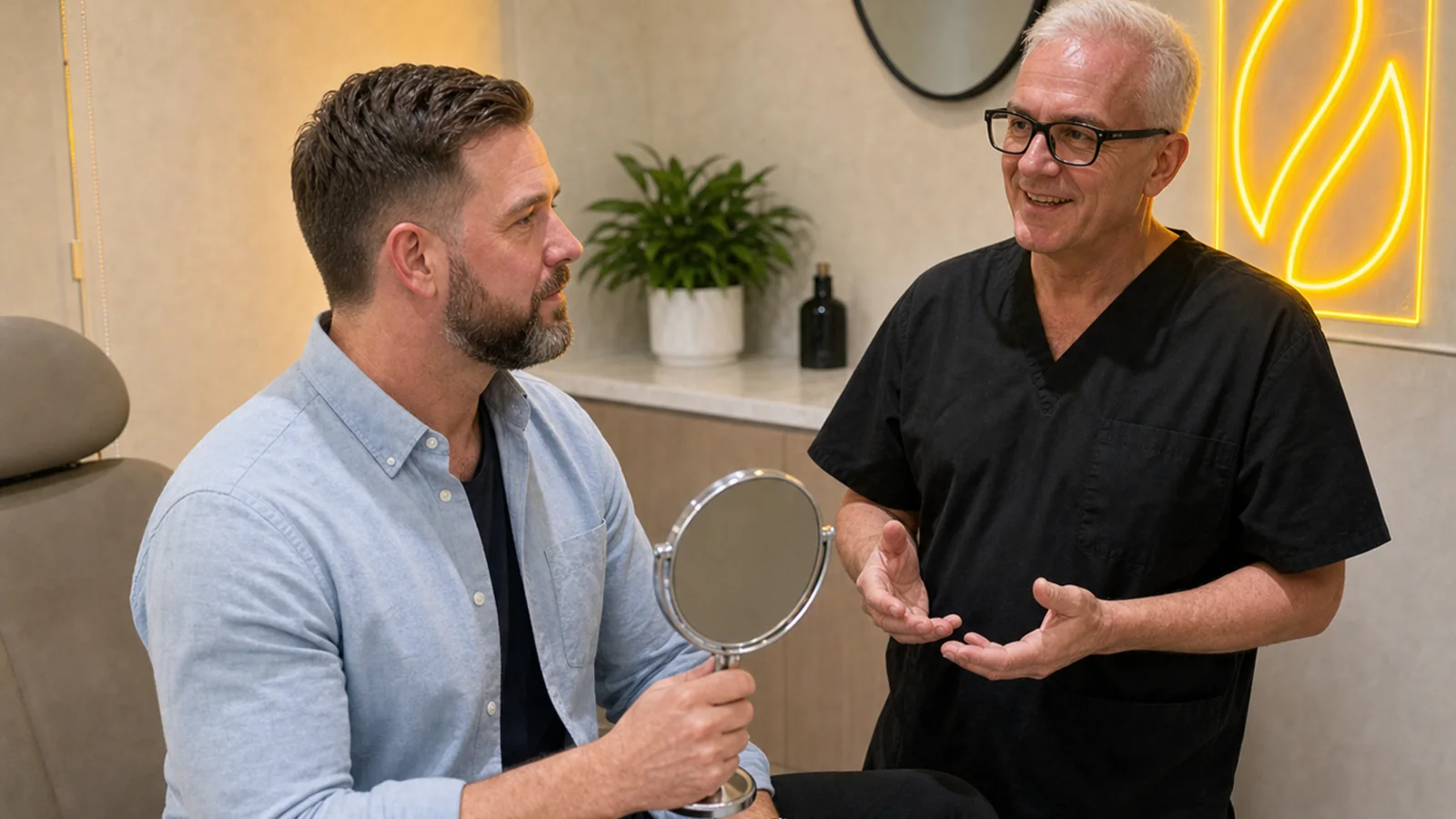
For men, a subtle lip plan starts by defining what should stay recognisable: natural speech and smile movement, familiar facial balance and a result that does not become the focus of the face. Corey assesses those priorities in person before discussing whether a restrained option is suitable, whether more time would help or whether no treatment is the better decision.
Start with what you want to keep
Subtle is personal. For one man it means keeping a familiar smile. For another it means not sharpening the lip border, changing the profile or drawing attention away from facial hair, the chin or jawline. You do not need clinical language to explain it.
Bring the ordinary words you would use with someone you trust: what feels slightly out of balance, what still feels like you and what would be too much. Corey can translate those preferences into an assessment of proportion, movement and suitability without turning them into a promise.
Subtle is a brief, not a measurement
Keep speech and smiling familiar
Describe any movement you want to preserve, including how your upper lip sits when you speak, smile or laugh.
Keep the lips in context
The upper and lower lips are read with the chin, profile, teeth, facial hair and the rest of the lower face.
Name what would feel unlike you
Photos can help illustrate a preference, but your own features and comfort set the discussion.
Plan around privacy and timing
Work, sport, travel, events and access to review all matter when deciding whether now is a sensible time.
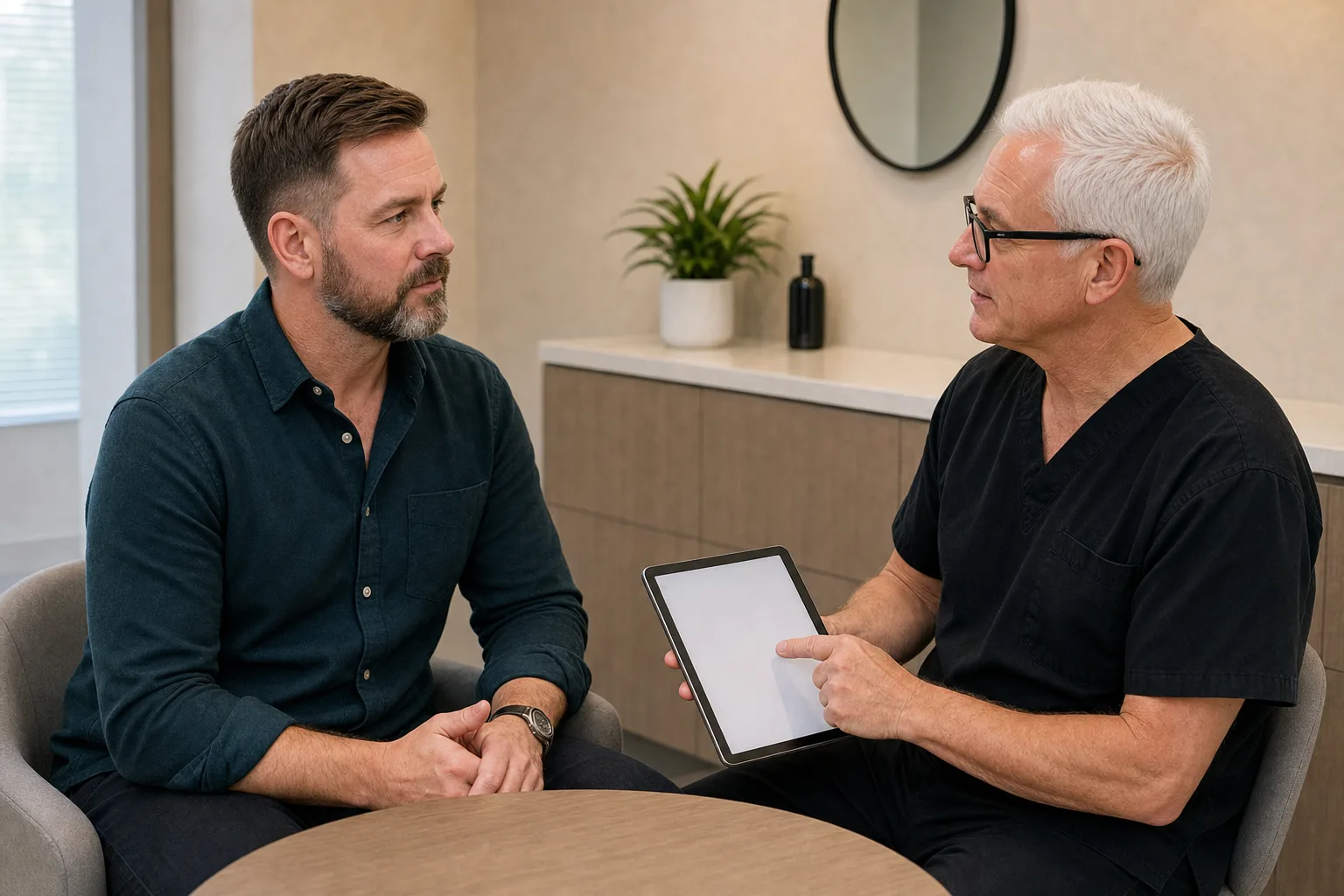
Turn your preference into useful words
Instead of asking for an amount or a copied look, describe what you notice at rest, in profile and when your face moves. You might say that the upper lip disappears when you smile, that one side catches your eye in photos, or that you want the lips to sit more comfortably with the chin and jaw.
Then name your boundary. Tell Corey if a sharper edge, a fuller profile, a change in smile movement or a recovery period visible at work would not feel right. That gives the consultation a clear, personal brief before any option is considered.
Choose the page closest to your question
You want to define restraint
This guide is for men deciding what subtle should mean for their expression, identity, balance and day-to-day life.
Your main worry is looking obvious
Read what can make lip changes noticeable for the limits of prediction and visibility planning.
You want the complete service journey
Use the men’s lip consultation page for the broader assessment, visit and treatment decision pathway.
You can come in with one sentence
Try: I want to understand whether a small, balanced change can be discussed without losing the way I look when I speak and smile. Corey can ask the next questions from there. If this is your first appointment, the first men’s lip consultation guide covers the visit step by step.
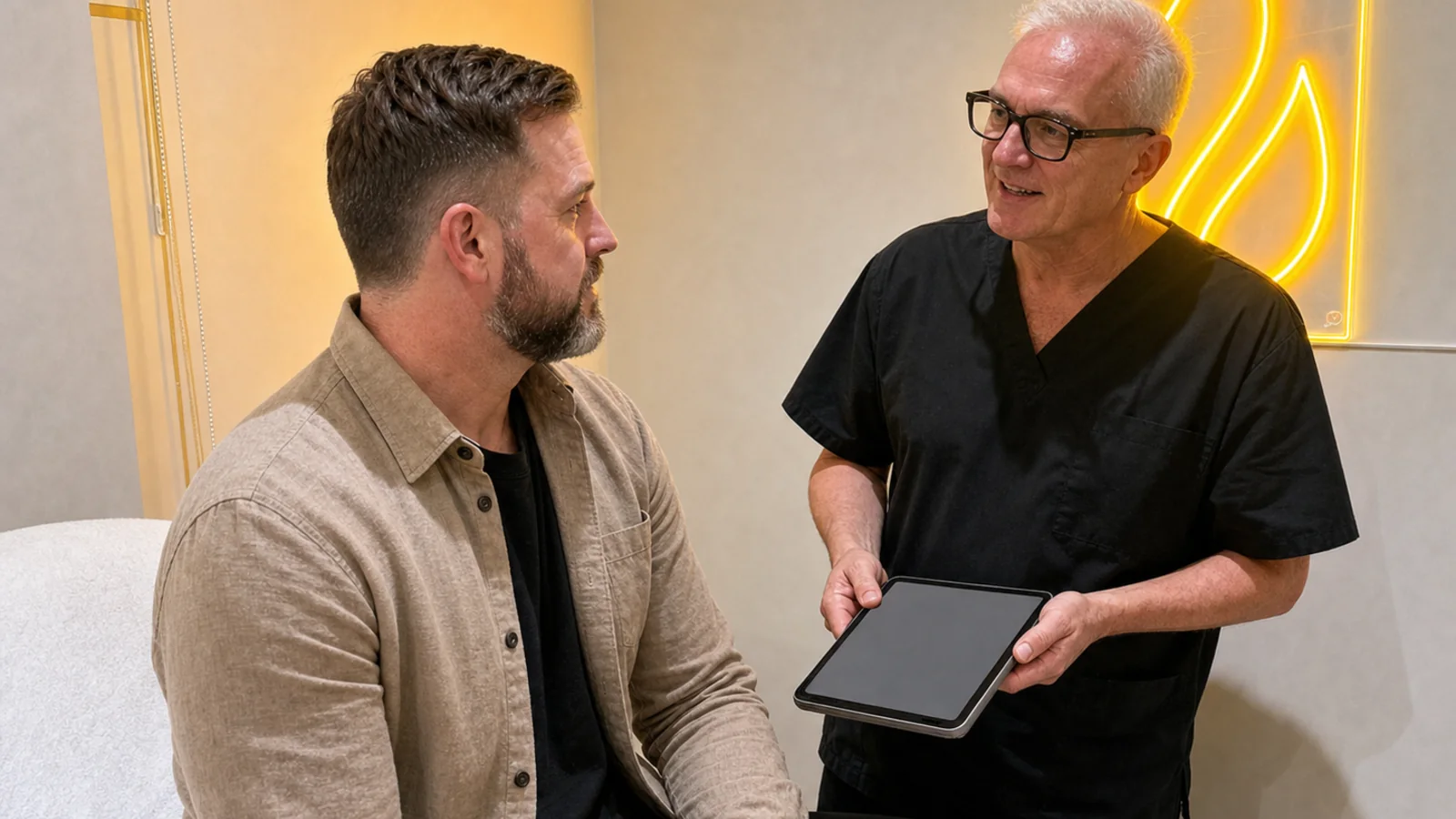
Your whole lower face sets the context
Corey looks at the lips at comfortable rest and through natural speech and smiling. He considers the relationship between the upper and lower lips, existing asymmetry, dental and bite context where relevant, the chin, jawline, profile, skin and facial hair.
He also asks about previous cosmetic care, cold sore history, current medicines, allergies, health changes and what you expect other people to notice. The purpose is not to chase a standard male shape. It is to decide whether your brief can be approached safely and whether it suits your own face.
Bring three details from real life
| Bring or notice | What to share | Why it helps |
|---|---|---|
| The moment you notice it | Whether the concern is clearest at rest, in profile, while speaking, when smiling or only in certain photos | It connects the discussion to your everyday expression rather than a fixed pose. |
| The feature you want to keep | The expression, profile relationship, facial-hair context or familiar character that should remain central | It gives Corey a clear boundary for a restrained conversation. |
| Your practical limits | Work, sport, travel, event and privacy constraints, plus whether you can return for review if needed | Timing and review access can change whether now is a sensible time. |
When waiting or another review makes more sense
Another clinical pathway should come first for unexplained pain, a new lump or ulcer, active infection, unhealed skin, sudden swelling, dental symptoms or another change that needs diagnosis. Waiting may also be sensible when previous care has not settled, important health information is missing, an event or travel would limit follow-up, or the decision feels pressured.
If a cosmetic option remains suitable, Corey discusses the material risks, likely limits, temporary changes, alternatives, costs and review plan before you decide. A restrained preference does not remove uncertainty, and no treatment remains a valid outcome.
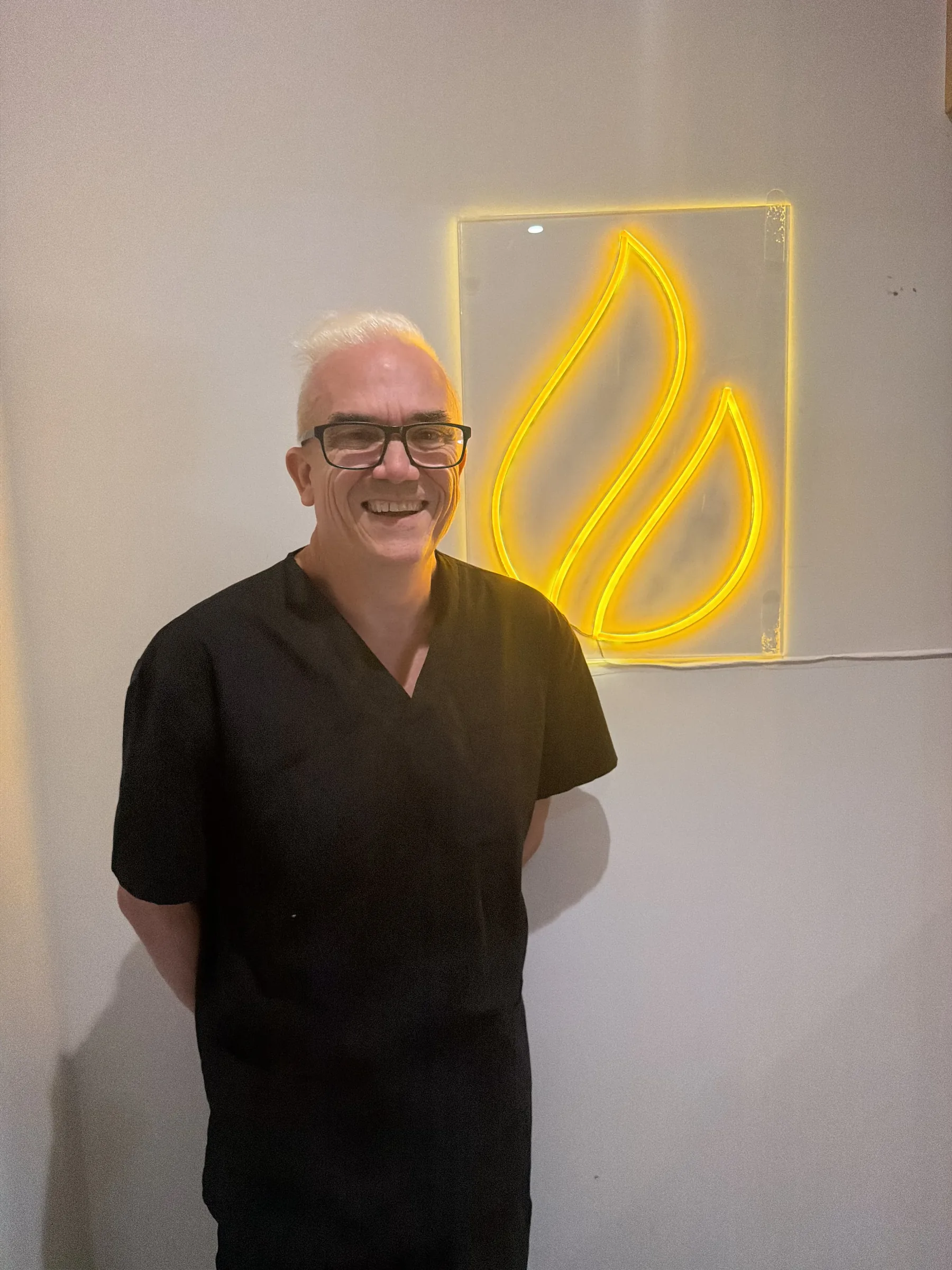
What to expect at your visit
You will meet directly with Corey for a calm, private conversation about what you notice and what a subtle approach means to you.
Corey listens first, observes the lips and lower face at rest and in movement, and explains whether treatment discussion, waiting, another opinion or no treatment makes sense. Same-day treatment is never assumed.
Bring the version of you that you want to keep
Corey can help turn a subtle preference into clear questions about proportion, expression and whether any next step feels right.
Is this for you?
Consider booking a consultation if
- You are an adult man who wants to define what a subtle lip preference means for your own face
- You want expression, profile and lower-face balance considered before any option
- You value a private discussion about timing, visibility, risk and review
- You are comfortable with treatment discussion, waiting, another opinion or no treatment as possible outcomes
This may not be for you if
- You need certainty that nobody will notice a change
- You want a copied look or a treatment decision without individual assessment
- You have active infection, unhealed skin, unexplained pain, a new lump or ulcer, sudden swelling or dental symptoms that need another clinical pathway first
- You are being pressured by another person or an event to decide quickly
Suitability is confirmed at consultation. This list is general guidance, not a substitute for clinical assessment.
Frequently asked questions
What does subtle lip treatment mean for men?
Subtle usually means a restrained discussion that respects facial balance, lip movement, privacy, timing and what the patient wants to avoid. It does not mean treatment is automatically suitable or invisible.
Can a subtle plan still be noticeable?
Yes. A subtle plan can still involve temporary swelling, bruising or a change that feels visible to the patient. Corey discusses what can and cannot be predicted before any decision is made.
Can Corey make it certain no one will notice?
No. No page or consultation can make invisibility certain. Corey can discuss visibility, timing, restraint, risks and whether waiting or no treatment is safer, but individual response and social notice cannot be predicted with certainty.
How is this different from the obviousness guide?
This page focuses on restraint, privacy and low visibility planning. The obviousness guide focuses more directly on what might make treatment visible, what cannot be predicted and when waiting may be safer.
What should I tell Corey if privacy matters?
Tell Corey where visibility would worry you most: work, photos, social events, speaking, smiling, travel or temporary recovery. Also bring relevant medical history, medicines, allergies, previous treatment dates and upcoming events.
Could Corey recommend no treatment?
Yes. No treatment, waiting, referral or review later may be recommended if a subtle plan is not realistic, timing is poor, expectations are unsettled, information is incomplete or risk outweighs likely benefit.
What risks affect subtle lip planning?
Risks depend on individual assessment and may include swelling, bruising, tenderness, asymmetry, dissatisfaction, delayed issues, altered expression or balance and rare urgent complications that need prompt review. Subtle planning still needs the same careful consent and review discussion.
Are product names used to advertise subtle lip treatment?
No. Public pages should not promote regulated products. Private consultation is where Corey can discuss whether product details are relevant to subtlety goals, risks, alternatives and consent.
Clinical references
- TGA: Advertising health services that involve therapeutic goods
- TGA: Advertising health services and cosmetic injections, frequently asked questions and answers
- Ahpra: Guidelines for advertising higher risk non-surgical cosmetic procedures
- Ahpra: Guidelines for registered health practitioners who perform non-surgical cosmetic procedures
- Ahpra: Register of practitioners