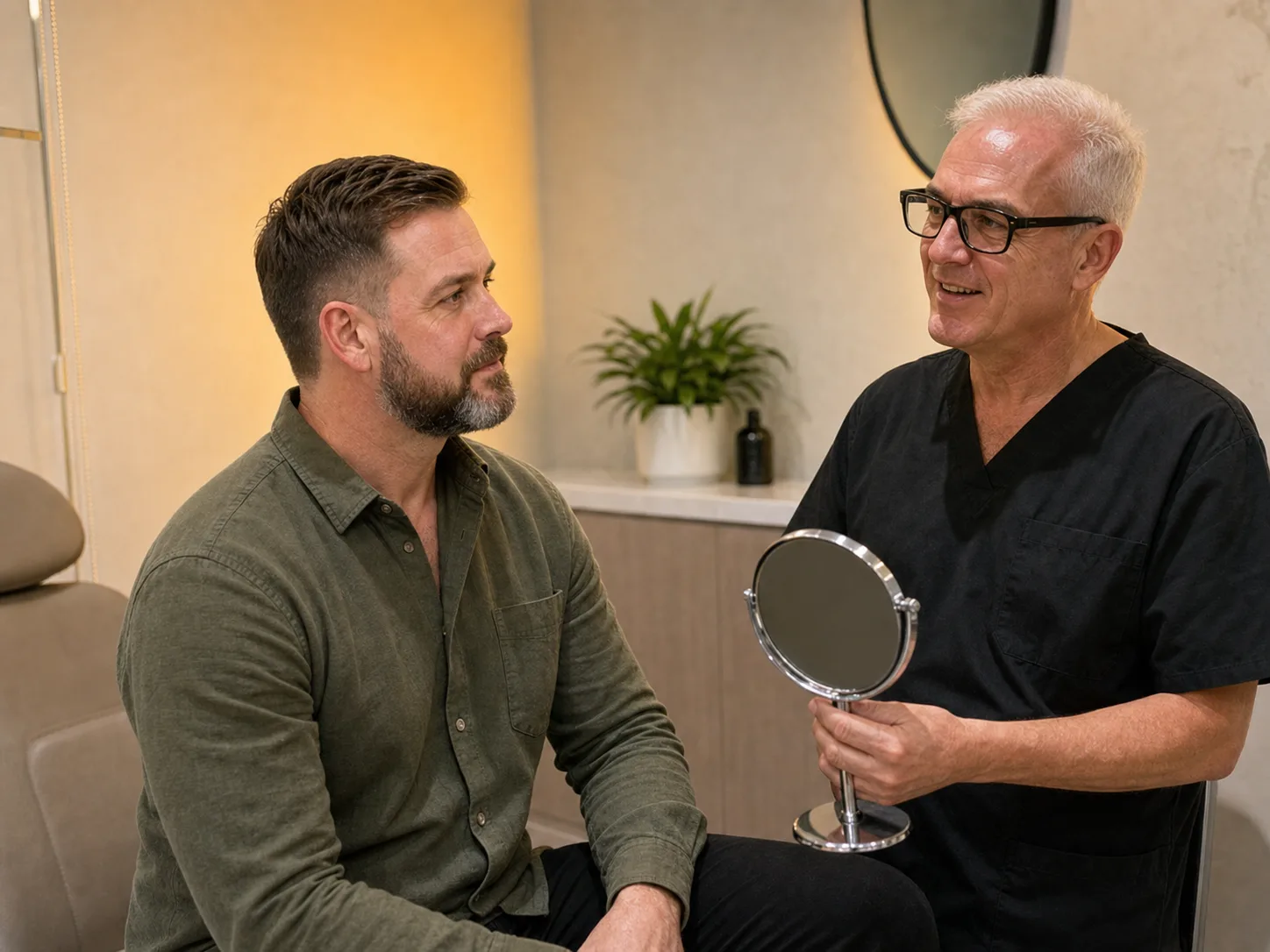
Avoiding overfilled lips requires a clinical approach that prioritises structure and proportion over volume, uses conservative and staged treatment planning, and reassesses the full face before adding further product At Core Aesthetics, individual assessment guides every treatment decision.
What overfilled lips actually means clinically
Overfilling is not simply a measurement of size. It refers to a specific set of structural changes: loss of clear lip border definition, disruption of the natural proportion between upper and lower lips, flattening of the lip’s natural curvature, reduced movement fluidity during expression, and excess projection relative to the surrounding facial structure.
These changes occur when the natural anatomy of the lips is displaced by volume rather than supported by it. The result is lips that look treated, not because they are larger, but because the features that make them look natural have been altered. In many cases, patients who present with overfilled lips are not aware of exactly when the shift occurred. It is rarely a single session. It is a cumulative process.
Why overfilling tends to develop gradually
The most common pathway to overfilled lips involves repeated small additions across multiple sessions without reassessment of cumulative effect. Each individual treatment may have seemed reasonable, a touch more volume here, a little more border definition there. But without stepping back to evaluate the lips in the context of the whole face, the cumulative result can gradually move away from natural proportion.
Other contributing factors include treating the lips in isolation from facial structure, attempting to correct natural asymmetry beyond what the anatomy will support, and focusing on symmetry in a static photograph rather than how the lips move during expression. Over time, these patterns compound.
Why more volume does not improve shape
A common assumption is that adding more product will improve lip shape. In reality, lip shape is determined primarily by border definition, the structural distribution of support within the lip body, symmetry, and proportional balance, not by volume alone. Adding volume without attending to these structural elements can actually reduce definition rather than improve it.
This is why the most refined lip results are often produced with less product than patients expect, placed with more precise structural intention, rather than high volumes distributed broadly. The goal is to support and define structure, not to fill space.
How facial proportion shapes the appearance of the lips
Lip structure must always be assessed in relationship to the surrounding face. A weak chin can make lips appear more prominent than they actually are. Mid face flattening can reduce the perceived support beneath the lips. Jawline imbalance alters the lower face proportion in which the lips sit. Nasal base structure shapes the distance between nose and upper lip border.
This means that in some cases, the most effective way to improve the perceived appearance of the lips is not to add volume to them directly, but to address a structural imbalance elsewhere in the face. A full facial assessment makes these relationships visible. Treating the lips in isolation does not.
The clinical role of restraint and staged treatment
Restraint in lip treatment means using the minimum effective volume to achieve a structural goal, not the minimum possible for its own sake, but the minimum that is genuinely appropriate for this face. It means prioritising structure over size, preserving natural border definition, avoiding unnecessary corrections of features that are part of normal anatomy, and staging treatment in small increments with review between sessions.
Staged treatment is often more predictable and safer than single session high volume approaches. It allows observation of how the lips respond and settle, enables adjustment based on how the result integrates, and significantly reduces the risk of overcorrection. The small additional time investment of a staged approach tends to produce better long term outcomes than the alternative.
Why natural lips are not perfectly symmetrical
Natural lips have inherent variation, subtle asymmetry, differences in movement between sides, natural irregularities in volume distribution, slight differences in border thickness between upper and lower lips. These variations are part of what makes a face look natural rather than constructed.
Attempting to eliminate all asymmetry in lip treatment often produces outcomes that look artificial, because a face with no variation looks unlike any naturally occurring face. Preserving natural variation is part of maintaining realism. Good treatment works with the existing anatomy rather than trying to override it entirely.
How the C.O.R.E. method prevents overfilling at Core Aesthetics
The C.O.R.E. framework, Consult, Organise, Refine, Evaluate, is directly relevant to preventing overfilled outcomes. Consult establishes patient goals and helps identify whether expectations are consistent with realistic, natural outcomes. Organise assesses the lips in the full facial context, structural anatomy, proportional balance, movement patterns, and cumulative treatment history. Refine determines whether treatment is appropriate, what conservative approach is justified, and whether staged treatment is the right plan. Evaluate makes a final clinical decision ensuring no treatment proceeds without structural justification.
This process is designed to catch cumulative risk before it materialises. It treats every appointment as a reassessment of the whole face, not a continuation of a previous treatment plan on autopilot.
Understanding Natural Lip Proportions
Natural lip proportions are determined by the underlying skeletal structure, the quantity and distribution of lip tissue, and the muscular dynamics of the perioral area. There is considerable individual variation in what constitutes a proportionate result, which means that any treatment plan should begin with an assessment of your specific anatomy rather than an application of a generic template.
The commonly cited golden ratio guidelines for lip proportions (upper lip to lower lip, lip projection to nasal tip) are useful reference points for practitioners, but they are not absolute rules. Applying them rigidly without accounting for individual facial structure produces results that look technically correct on a measurement chart but wrong on an actual face. The assessment at consultation maps your specific proportions and identifies the range of treatment that would produce a balanced, natural looking result for you, not a standardised outcome.
The Incremental Approach and Why It Protects You
The most reliable protection against overfilled lips is an incremental treatment approach, beginning with a conservative volume, allowing the product to settle fully over several weeks, and then assessing at review whether any addition is appropriate. This process may feel slower than a single, definitive treatment session, but it produces outcomes that are consistently more natural and easier to manage over time.
The reason incremental treatment works is anatomical. Lip tissue responds to volume treatment by swelling for the first week or two, then settling as the initial inflammatory response resolves. What looks swollen at day three looks different at week four. A practitioner who treats to a finished visual outcome immediately after injection is treating to a swollen intermediate state rather than the settled result, which frequently leads to more product being used than is actually appropriate.
At Core Aesthetics, the conservative first treatment model is a clinical standard, not an option. The review appointment at four to six weeks is where the settled result is assessed and any further addition is considered from a position of full information.
Why Some Patients End Up Overfilled
Overfilling is rarely the patient’s original intention. It typically develops through a combination of factors: incremental additions that each seemed modest at the time, but that accumulated across multiple sessions without adequate assessment of the cumulative total; a tendency for practitioners to add volume when patients express dissatisfaction, rather than assessing whether the concern is actually a volume issue; social pressure from before and after imagery that normalises treated appearances; and, in some cases, a practitioner business model that is structured around volume of product used rather than quality of outcome.
Recognising the pattern is the first step to interrupting it. If you are attending a clinic where each visit involves adding product without a thorough assessment of what you currently have, or where the conversation about your result always ends with a recommendation for more treatment, those are signals that the clinical approach may not be prioritising your long term outcome.
For patients who have accumulated volume over time and are unhappy with how their lips look, the pathway forward begins with an honest consultation. This may involve a recommendation for dissolution before any new treatment is considered.
Signs of a Conservative Practitioner
Identifying a practitioner who will approach your treatment conservatively requires looking beyond before and after photography. Some indicators that a practitioner is operating with a conservative, anatomy first approach: they schedule the consultation as a separate visit from the treatment; they take detailed photographs and a full medical history before making any recommendation; they explain not just what they are recommending but why, including why they are not recommending certain things; they are willing to say that you do not need treatment yet, or that a particular area is not the right priority; and they have a structured review process rather than treating at every visit.
At Core Aesthetics, the consultation based model, one practitioner consistency, and review based treatment approach are specifically designed to support conservative, anatomy appropriate outcomes. The practitioner’s approach to lip treatment in particular is guided by the principle that the best result is the one that looks like you at your best, not a version of you that has been modified to match a trend.
How Facial volume treatment Is Used as a Structural Tool
Facial volume treatment is often described in terms of volume, adding more to make something look bigger. This framing misrepresents how volume treatment functions in skilled clinical practice. Volume treatment is a structural tool. It can restore lost support in areas where facial volume has diminished with age. It can define a contour that was never clearly pronounced. And in some cases it can shift the proportional relationships between facial regions in a way that changes how the face reads overall.
Volume, in the sense of visible fullness, is sometimes a goal. But the mechanism is anatomical. Volume treatment placed in the right tissue plane, at the right depth, with an understanding of the surrounding anatomy, produces a different result than volume treatment placed superficially to fill a surface irregularity. This is why technique, placement, and clinical knowledge matter far more than product selection.
At Core Aesthetics, treatment decisions are based on a full facial assessment. Corey evaluates the face as a whole before deciding whether volume treatment is appropriate, where it would be most effective, and what volume would be consistent with a proportionate outcome. This assessment may lead to a recommendation not to treat, and that outcome is equally valid.
Understanding Facial Volume Loss and Why It Matters
The face changes with age through a combination of processes: bone resorption, fat pad redistribution, muscle changes, ligament laxity, and skin quality decline. These processes do not happen uniformly or at the same rate in different people. Two people of the same age may present very differently because of genetics, lifestyle, sun exposure, and individual anatomical variation.
Volume loss is one of the most clinically significant contributors to an aged appearance. When the structural support provided by subcutaneous fat and bone diminishes, the overlying skin is no longer held in place by the same framework. Features that once appeared well defined become less distinct. The relationship between facial thirds can shift. Hollowing in specific areas, the cheeks, the temples, the under eye region, creates shadows and contours that are often interpreted as tiredness or loss of vitality.
Understanding the underlying anatomy is essential to treating it appropriately. Volume treatment placed to address a surface concern without accounting for the structural deficit beneath it will produce a less effective and less enduring result. The consultation process at Core Aesthetics focuses on identifying the anatomical contributors to the concerns you have raised, not just addressing the surface appearance.
The Assessment Process Before Any Volume treatment
At Core Aesthetics, the consultation for facial volume treatment is a structured clinical appointment, not a sales conversation. Corey assesses the face in three dimensions, at rest, during movement, and from multiple angles. The goal is to understand the structural landscape of your face before deciding where, how much, and whether volume treatment is the right approach.
Key aspects of the volume treatment assessment include evaluating facial symmetry and identifying natural asymmetries that should be preserved or addressed; assessing the depth and distribution of any volume deficit; reviewing skin quality to determine how volume treatment would integrate; and discussing your goals in the context of what is anatomically achievable. For some concerns, volume treatment alone is sufficient. For others, a combination of treatments, or a different approach entirely, may be more appropriate.
You will leave the consultation with a written treatment plan that documents the assessment findings, the proposed approach, and the expected outcomes. Treatment is scheduled at a separate appointment, allowing time to consider the plan, ask further questions, and make an informed decision without any time pressure.
Dissolution, Complications, and Revision
Hyaluronic acid volume treatments are reversible. If a complication arises, if the result is unsatisfactory, or if a patient wishes to return to their baseline, hyaluronidase enzyme can be injected to dissolve the volume treatment. This is an important safety feature that distinguishes hyaluronic acid products from permanent or semi permanent volume treatments, which cannot be dissolved.
Dissolution does not always produce an immediate return to the pretreatment state. The process requires time, and in some cases more than one dissolution treatment. Swelling from the dissolution procedure can temporarily alter appearance. Corey will explain this clearly at consultation so that patients understand what reversal involves before they commit to treatment.
At Core Aesthetics, only hyaluronic acid formulations are used for facial volume treatment, the reversibility of these products is a deliberate clinical choice. Emergency protocols for vascular occlusion, the most serious potential complication of volume treatment, are maintained at the clinic. Patients are briefed on the signs of this complication and given emergency contact instructions as part of every treatment appointment.
Managing Expectations and the Follow-Up Process
One of the most important conversations at a volume treatment consultation is about what the treatment can and cannot do. Volume treatment can address anatomical concerns related to volume, structure, and proportion. It cannot reverse all signs of ageing, change skin quality, alter bone structure, or produce a different face. Approaching treatment with an accurate understanding of its scope produces better outcomes than approaching it with the expectation of transformation.
After volume treatment, a follow up appointment at four to six weeks is standard practice at Core Aesthetics. This allows Corey to assess how the product has settled and integrated, to evaluate the result against the treatment plan, and to determine whether any refinement is appropriate. Minor asymmetries or areas where volume distribution could be adjusted are addressed at this review, not at the initial appointment where swelling and bruising can obscure the final result.
Results are always reviewed. Treatment at Core Aesthetics is not a transactional event, it is the beginning of a clinical relationship aimed at supporting your facial health over time.
Is this for you?
Consider booking a consultation if
- You are 18 or older and in good general health
- You want to understand how facial volume treatment may address a specific anatomical concern, volume, structure, or proportion
- You are prepared to attend a standalone consultation before any treatment decision is made
- You understand that injectable treatment is a medical procedure with individual risks and outcomes
This may not be for you if
- You are pregnant, trying to conceive, or breastfeeding
- You have an active infection, cold sore outbreak, or unhealed skin in a potential treatment area
- You have a documented allergy to hyaluronic acid or to local anaesthetic (lidocaine)
- You are taking anticoagulant medication or have a bleeding disorder, without clearance from your treating doctor
- You have had recent facial surgery, trauma, or dental procedures in the treatment area
- You are under 18 years of age
Suitability is confirmed at consultation. This list is general guidance, not a substitute for clinical assessment.
Frequently asked questions
What does an ‘overfilled’ lip actually look like?
Overfilled lips typically show: loss of the natural lip border (vermillion becomes blurred into surrounding skin), exaggerated projection that sits too far forward of the face, absence of the philtrum definition above the upper lip, or a shape that looks puffy rather than sculpted. The key is that the lips no longer match the patient’s facial proportions or age, and natural anatomy (like the subtle peaks of the upper lip border) is obscured by volume.
Is overfilling about the amount of product or the technique?
Both. Volume is one factor, too much product creates puffiness. But placement matters equally. If volume treatment is injected in the wrong plane (too superficially or too centrally), even modest volume can look overdone. If it is placed thoughtfully along the natural contour, with preservation of the lip border and strategic use of depth, the same amount of product can look balanced and natural. Technique determines outcome more than volume alone.
How much volume treatment is actually needed for a natural result?
This varies enormously based on the patient’s starting anatomy, age, and what they are seeking. For some patients, 0.5 mL (half a syringe) creates meaningful change. For others, 1 mL is appropriate. The question is never ‘how much is typical’ but ‘what does this patient’s face need to look balanced and natural for them.’ Conservative starting doses allow the result to settle and be reviewed before deciding if more is desired.
Does the choice of treatment product affect how natural the result looks?
The treatment type, rheology (firmness), and cross linking pattern all influence how the product sits in tissue and how it moves with expression. A very firm, highly cross linked volume treatment can look and feel less natural than a softer, less cross linked option. Softer volume treatments integrate more naturally with tissue and deform with facial expression rather than holding a static shape. The product choice is part of the technique.
Can overfilled lips be corrected without starting over?
It depends on the extent and the treatment type. If the volume treatment is hyaluronic acid, selective dissolution with hyaluronidase can be used to remove excess product from specific areas. This allows for refinement: removing volume from areas that are too full while keeping definition where it is good. If the issue is placement rather than volume, dissolving and re treating is an option. Starting completely fresh with a new approach is also valid.
How does lip treatment look different from natural lip fullness?
Natural fullness (from youth, genetics, or slight puffiness) has soft borders, variation in colour and texture, and moves naturally with expression. Volume treatment can create the same appearance if placed correctly, but there are subtle differences: the border can be too sharply defined, the colour uniformity can be too perfect, and sometimes the product feels slightly firmer than natural tissue. The skill is in minimising these tells.
Why do some lips look unnatural immediately after volume treatment?
Post injection swelling is significant and distorts the true result. The lips may appear dramatically fuller for 24 to 48 hours due to the inflammatory response from needle trauma and the injection itself. The product is also settling into tissue, absorbing fluid, and taking its final position. The ‘settled’ result, after 1 to 2 weeks, looks substantially different (and almost always better) than the immediate post treatment appearance.
What is the best approach to avoid overfilling in your own treatment planning?
Begin with a detailed conversation about what ‘natural’ means to you. Bring reference images of lips you find beautiful and proportional. Discuss your face shape, age, and how lips suit your other features. Start conservatively, it is far easier to add more product on a follow up visit than to remove what is already placed. Plan for a 2-week review before deciding if additional volume treatment is wanted. This staged approach almost always produces better results than attempting to achieve the final look in a single session.
Should I proceed with treatment if I am unsure whether it is right for me?
Uncertainty is a reasonable reason to defer rather than proceed. A clinical assessment can clarify whether treatment is appropriate, what approach would be suitable, and what realistic expectations are for your situation. Treatment is only recommended when clinical suitability is clearly established.
Is it safe to have aesthetic treatment for the first time?
Aesthetic treatments involve prescription medicines and carry clinical risks including bruising, swelling, asymmetry and, in rare cases, more serious complications. Safety is directly influenced by practitioner qualifications, assessment quality and technique. A thorough consultation is the starting point to understand the risks specific to your situation.