Deep forehead lines cannot be promised to disappear. Lines that remain while the face is relaxed may reflect repeated folding, skin quality, sun exposure and individual tissue characteristics as well as current movement. Forehead assessment should also include brow position, eyelid context and ordinary eye opening because the frontalis muscle both raises the brows and creates horizontal skin folds. Corey observes the face at rest and in movement, compares the two sides and asks about heaviness, vision, previous care and health history before discussing suitable options, timing or another clinical pathway.
Start With The Trade Off
The forehead is unusual because the muscle that produces the visible horizontal folds also raises the eyebrows. A person may want softer looking lines while still relying on that upward pull for brow position, eye openness or familiar expression.
The useful question is not simply how strong the lines look. It is what the forehead is doing for the person before any change is considered. That requires observation in motion, a health history and an honest discussion about which feature matters more.
Can Deep Forehead Lines Be Completely Removed?
No page or photograph can confirm that a deep forehead crease will be completely removed. A line that remains while the face is relaxed can reflect repeated folding, skin quality, sun exposure and individual tissue characteristics as well as current movement.
| What you notice | What it may suggest | What consultation needs to clarify |
|---|---|---|
| Lines mainly appear when the brows lift | Active forehead movement is contributing to the fold | Whether that movement also supports brow position, eye opening or familiar expression |
| Lines remain while the face is relaxed | An established crease or skin quality factor may also be involved | What may reasonably change, what may remain and whether another skin focused discussion is relevant |
| A new one sided change, eyelid symptom or visual concern | The issue may sit outside routine cosmetic assessment | Whether medical, eye or another appropriate clinical review should come first |
The forehead lines explainer gives more detail about movement and resting creases. It cannot replace an individual assessment.
What Should Be Observed In The Room?
A still selfie captures one fraction of the assessment. Corey looks for changes across several ordinary actions.
| Observation | What it can clarify | Why one photograph misses it |
|---|---|---|
| Face relaxed | Resting creases, baseline brow height and visible asymmetry | A posed face may still be holding the brows up |
| Gentle eye opening | Whether the forehead activates during an everyday task | The effort may be subtle or habitual |
| Deliberate brow raise | Range, line pattern and movement on each side | Maximum movement is absent from a neutral image |
| Frown | Interaction between brow elevators and depressors | Forehead and frown movement do not act independently |
| Eyes closed, then reopened | Whether the brows resume an elevated position | A single frame cannot show the transition |
| Conversation and expression | How movement contributes to recognition and communication | A rehearsed pose can hide normal expression |
Why Does The Frontalis Matter?
The frontalis is the only facial muscle that raises the eyebrows. Other upper face muscles pull in different directions, and their balance contributes to brow position and shape. When the frontalis contracts, the skin does not move in one identical pattern across every person.
That makes line counting a poor substitute for assessment. Two people with similar horizontal creases may use the muscle differently, have different baseline brow positions or value different parts of their expression.
Watch The Brows, Not Only The Lines
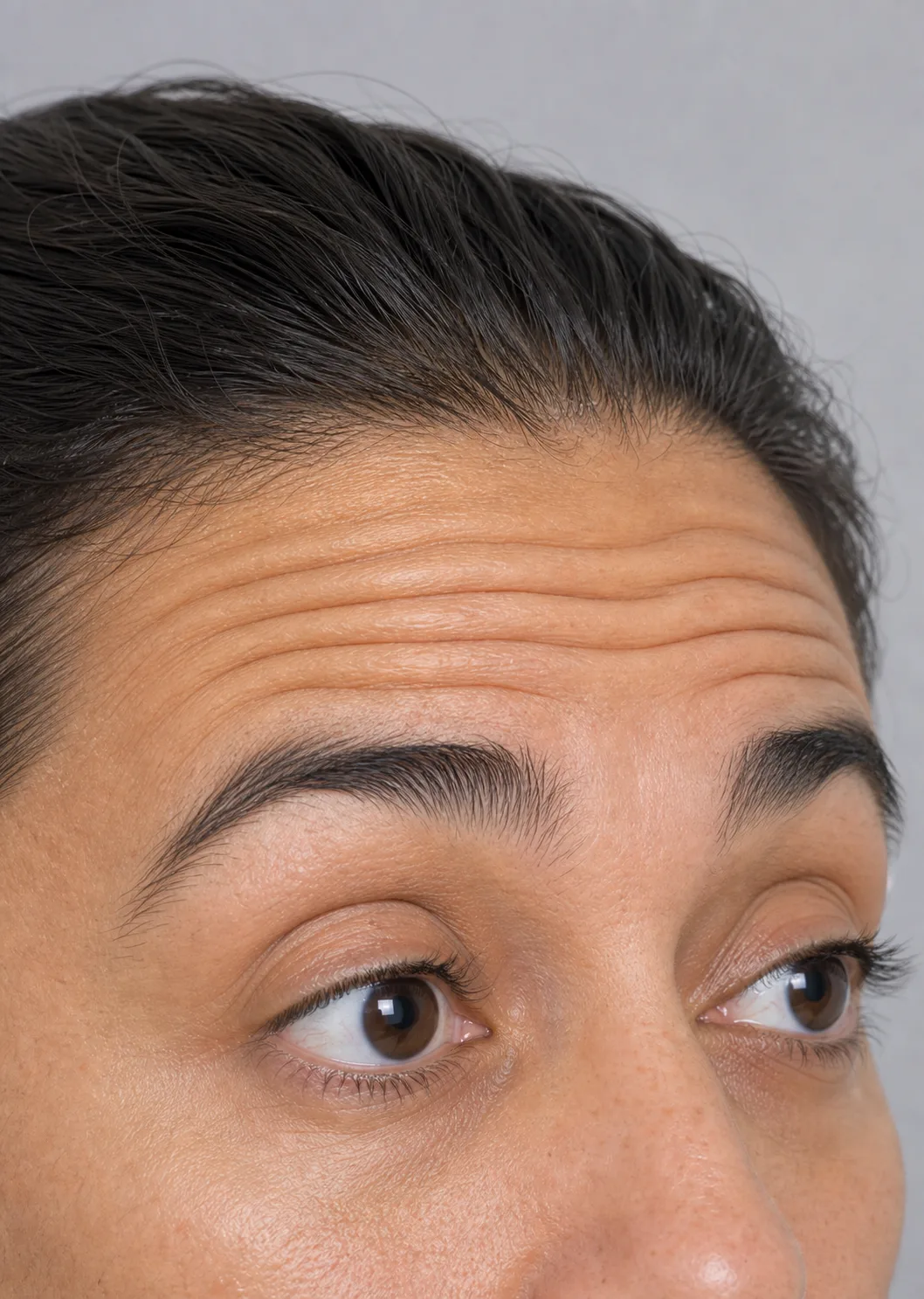
Corey compares the medial, central and lateral brow rather than treating each eyebrow as one point. One segment may rise more than another, and one side may recruit earlier or travel further.
A three dimensional study of 30 healthy adults found that asymmetric skin displacement during frontalis contraction was common. The study is not a treatment rule, but it supports documenting a person’s existing pattern before attributing later asymmetry to any one cause.
What Does Compensation Look Like?
Some people lift the brows during ordinary eye opening without consciously choosing to do it. The forehead may remain active while they read, drive or speak. This can be a response to brow or upper lid heaviness, but a cosmetic consultation cannot assume the cause from appearance alone.
Ask the person to relax, close the eyes briefly and reopen them naturally. If the brows rise immediately, or if relaxing them changes eye openness or comfort, that observation deserves caution. Persistent or functional symptoms may need assessment by a GP, optometrist, ophthalmologist or another suitable clinician.
What Questions Reveal Functional Context?
Useful questions sound ordinary: Do your eyelids feel heavy late in the day? Do you raise your brows to read or drive? Has one side changed recently? Does relaxing the forehead affect your view, comfort or familiar expression?
These answers do not diagnose a condition. They identify when a request about lines may overlap with eye or brow function and when cosmetic care should wait for appropriate medical assessment.
How Are Lines At Rest Different?
A line visible only during a deliberate brow raise is not the same as a crease that remains while the face is relaxed. Resting creases reflect more than current muscle movement. Repeated folding, skin quality, sun exposure and individual tissue characteristics can all contribute.
This distinction matters for expectations. Changing movement cannot promise that an established resting crease will disappear, and a skin quality concern may require a different conversation from a movement concern. The facial ageing by decade guide gives wider context without predicting how one forehead will change.

Why Does Skin Quality Change The Discussion?
Dryness, texture, pigmentation, sun damage and loss of elasticity can make forehead lines appear more prominent without changing brow mechanics. A person may also be using active skin products or receiving care elsewhere.
Corey should separate what can be observed within cosmetic consultation from lesions, rashes, new pigmentation or other changes that need a GP or skin clinician. A cosmetic line assessment is not a skin cancer check or dermatology diagnosis.
Is Asymmetry Automatically A Problem?
No. Unequal brow height, muscle recruitment and line direction are common. The important step is to identify what is already present, whether it changes with expression and whether it matters to the person.
Mirror observation and consistent documentation can prevent a normal difference from being mistaken for a new one. A sudden or progressive change on one side is different and may require medical assessment, especially when accompanied by visual, neurological or severe headache symptoms.
How Does Frowning Change The Picture?
The forehead elevator works against muscles that draw the brows inward or downward. A strong frown pattern can change the apparent brow shape and where the forehead recruits during expression.
This page owns the horizontal line and brow support question. The frown line consultation page owns inward and downward movement between the brows. Both areas may need observation, but one should not be treated as a shortcut for the other.
What Does Previous Cosmetic Care Change?
Previous care can temporarily alter movement, brow position and the line pattern visible on the assessment day. Bring the date, area, provider and any records you have, including what felt comfortable or uncomfortable afterwards.
If earlier care is still changing, allow it to settle so the assessment has a clearer baseline. Corey should not guess the product, amount or technique used elsewhere from appearance alone.
What Health Information Belongs In The Assessment?
Provide current medicines and supplements, allergies, pregnancy or breastfeeding status where relevant, neurological or eye conditions, facial weakness, prior surgery or injury, current skin problems and any recent change in brow or eyelid position.
Do not stop prescribed medicine because a website or cosmetic appointment suggests it. Questions about an existing medicine belong with the practitioner responsible for prescribing or managing it.
Which Trade Offs Should Be Discussed?
A plan that changes forehead movement may also change brow height, brow shape, symmetry, eye area heaviness and the way expression feels. The degree and relevance of those risks depend on the individual assessment and the care being considered.
The discussion should cover what improvement is realistically possible, what may remain, how normal expression could change and how leaving the area unchanged fits among the alternatives. You should have space to decide at your own pace.
What Should Be Written In The Assessment?
The record should describe the person’s concern in their own terms, brow position at rest, movement pattern, visible asymmetry, lines during movement and at rest, relevant eye or health symptoms, prior care, information supplied and the agreed next step.
Photographs can support that record when consent and privacy are handled appropriately. They should document the starting pattern for care, not be treated as public advertising material or evidence that a future appearance is certain.
How Is The Right Timing Chosen For Forehead Care?
Timing is matched to the movement pattern, previous care, important events and your ability to follow aftercare and review advice. Bring dates and records when earlier care may still be influencing brow position so Corey can understand the baseline.
When the movement assessment is clear and informed consent supports a suitable option, Corey can discuss a proportionate plan and its timing. If settling time, records or another clinical review would improve the decision, he explains the specific checkpoint rather than leaving you with an indefinite delay.
What Will A Forehead And Brow Movement Assessment Resolve?
The assessment shows whether the visible line appears mainly with brow elevation or remains at rest, how much each brow segment moves, whether the forehead helps with comfortable eye opening and which existing asymmetries belong to the baseline.
Corey then relates those findings to what you want to change. You should leave knowing which suitable options can be discussed, what trade offs apply to brow support and expression, and what timing and follow up would keep the plan proportionate.
What Risks And Limits Need Plain Language?
The exact risks depend on the option being considered and must be explained before consent. For a forehead movement discussion, material concerns can include altered expression, brow heaviness or position change, asymmetry, discomfort, an unsatisfactory appearance and the need for review.
No page can confirm likelihood for an individual. Ask which risks are common, which are serious, what can be managed by the clinic, what needs another clinician and how aftercare contact works if something changes.
What Does This Page Own In The Forehead Family?
This is the main service page for the relationship between horizontal forehead lines, brow support and eyelid context. The forehead consultation guide explains the appointment sequence and what to bring. The forehead lines explainer covers why movement and skin folding create visible lines.
For broader upper face choices, use the Melbourne wrinkle consultation hub. For outer eye movement, read the crow’s feet consultation page. Each page answers a different decision rather than repeating the same assessment script.
Check The Named Practitioner Before Sharing Health Information
Corey Anderson is a Registered Nurse with Ahpra registration NMW0001047575. Core Aesthetics is at 12A Atherton Road, Oakleigh VIC 3166. Phone 0491 706 705.
Use the Core Aesthetics verification page, then check the Ahpra public register independently. Confirm the clinic contact details before sharing health information or paying.
Which Evidence Supports This Page?
Current Ahpra guidance requires holistic suitability assessment, realistic expectations, informed consent, risk information, scope awareness and responsible care after a procedure. TGA guidance requires public health service advertising to avoid direct or indirect promotion of prescription medicines.
Anatomy references support the role of the frontalis in brow elevation and the balance of upper face muscle forces. Published dynamic imaging and eyelid studies support observing asymmetry and possible compensatory brow elevation. These sources guide the questions on this page; they do not determine suitability for an individual.
Which Questions Help You Decide With Confidence?
Ask Corey to show what happens to brow position when the forehead relaxes, identify existing asymmetry, separate movement lines from resting creases and explain the trade off most relevant to your concern.
Also ask which options are suitable, how expression and eye-area comfort may be affected, what degree of change is realistic, which material risks apply and how review works. If symptoms need another clinician’s input, ask how that step connects to reconsidering the cosmetic concern.
Questions About Forehead Lines And Brow Support
Why does brow position matter when assessing forehead lines?
The frontalis raises the brows while creating horizontal forehead folds. Corey needs to see whether that movement supports brow position or comfortable eye opening, because a suitable plan must balance line softening with the expression and support you value.
How can Corey tell whether I lift my brows to open my eyes?
Corey can observe the face at rest, during gentle eye opening, after briefly closing the eyes and during deliberate brow elevation. The observation is considered with symptoms and history. It does not replace medical assessment when eye or eyelid function is a concern.
Are forehead lines during movement different from lines at rest?
Yes. Movement lines appear as the brows rise and the skin folds. Resting creases remain when the face relaxes and may also reflect repeated folding, skin quality, sun exposure and tissue characteristics. They require different expectation and planning discussions.
Is unequal eyebrow movement always caused by previous care?
No. Existing differences in brow height, muscle recruitment and skin movement are common. A consistent baseline assessment helps identify them. A sudden, progressive or symptomatic change on one side may need medical assessment rather than cosmetic planning.
Can a photograph confirm whether forehead cosmetic care is suitable?
No. A photograph cannot reliably show everyday muscle recruitment, effort when opening the eyes, movement range, changing asymmetry, health history or the person’s priorities. Images can support documentation, but suitability requires a real assessment and informed consent.
Could changing forehead movement affect expression?
It may. The forehead and brows contribute to recognition, eye-area openness and nonverbal communication. Corey assesses which movement you rely on, explains what may change or remain, and discusses proportionate options so you can decide whether the trade off fits your priorities.
When should forehead or eyelid symptoms be assessed elsewhere?
Medical review is appropriate when there is functional eye or eyelid concern, a new or progressive change, visual symptoms, facial weakness, severe headache, a suspicious skin change or another issue outside cosmetic scope. Acute neurological symptoms need urgent assessment.
Can cosmetic care happen on the consultation day?
It may be possible when Corey has completed the movement and health assessment, a suitable option is clear, material risks and alternatives have been discussed, and informed consent supports proceeding. Timing remains individual, so bring previous-care dates, important events and your questions.
How is this different from the forehead consultation page?
This service page owns the clinical trade off between forehead lines, brow support and eyelid context. The forehead consultation page explains how the appointment runs and what information to bring. The forehead lines explainer focuses on why lines form.
Can deep forehead lines be completely removed?
No complete removal can be promised. A deep line that remains at rest may involve established creasing and skin quality as well as muscle movement. Corey assesses what is contributing, what may reasonably change, what may remain and whether another clinical pathway is more appropriate.
Is this for you?
Consider booking a consultation if
- Adults concerned about horizontal forehead lines who want brow support assessed
- People noticing unequal brow movement or lines that remain at rest
- Adults wanting to understand expression and heaviness trade offs before cosmetic care
- People comparing consultation, adjusted timing, review with another health professional and another appropriate care pathway options
This may not be for you if
- Anyone seeking diagnosis of an eyelid, neurological or skin condition
- People with sudden droop, visual disturbance, facial weakness or acute neurological symptoms
- Anyone seeking a fixed online plan or certainty about appearance change
- People expecting care simply because an appointment has been booked
Suitability is confirmed at consultation. This list is general guidance, not a substitute for clinical assessment.
Clinical references
- Ahpra: Performing non-surgical cosmetic procedures
- Ahpra: Guidelines for registered health practitioners who perform non-surgical cosmetic procedures
- TGA: Advertising health services involving therapeutic goods
- Pessino et al: Anatomy of the frontalis muscle
- Dynamic evaluation of skin displacement during frontalis contraction
- Upper Eyelid Ptosis Correction with Levator Advancement Using the Levator Musculoaponeurotic Junction Formula in White Patients
- Ahpra: Public register of practitioners