Forehead lines are horizontal creases that commonly become clearer when the frontalis muscle lifts the brows. Some soften when the face relaxes; others remain visible at rest. Corey Anderson RN compares both states with brow position, side-to-side movement, eyelid context, skin, health history and previous care. He then explains suitable choices, material risks, timing and review, with attention to what you want to preserve.
What Should You Bring To A Forehead Line Consultation?
Forehead lines are horizontal creases that commonly become clearer when the frontalis muscle lifts the brows. Some soften when the face relaxes; others remain visible at rest. Corey Anderson RN compares both states with brow position, side-to-side movement, eyelid context, skin, health history and previous care. He then explains suitable choices, material risks, timing and review, with attention to what you want to preserve.
This changes the opening question from “how many lines are there?” to “what matters about this moving area, and what should the decision protect?” Your preference is not a promised outcome, but it gives Corey useful context for explaining limits, alternatives and a proportionate plan.
Why Is A Cropped Forehead Image Incomplete?
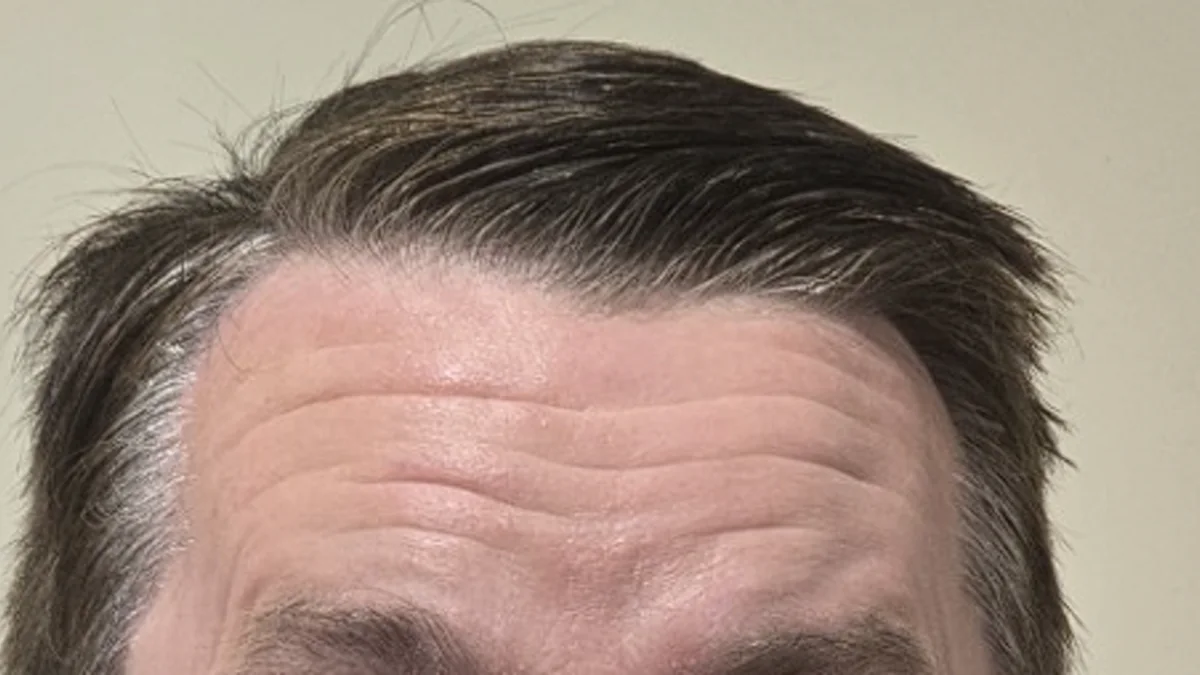
The hero image deliberately crops the forehead closely. It shows horizontal folding clearly, but most of the brows and the rest of the upper face are missing. That makes it useful for seeing a line and poor for understanding the system around it.
The wider image below restores the eyebrows, yet it is still only one moment. A responsible assessment needs the face at rest and in ordinary movement, viewed directly rather than inferred from one crop, one light source or one camera angle.
What Work Does The Forehead Perform?
The frontalis muscle contributes to eyebrow elevation. In Kwon and colleagues’ 3D study of 30 healthy adults, forehead skin moved vertically or obliquely during a requested strong brow lift, and most participants showed differences between sides. This small, predominantly female Asian group was studied for movement, not treatment outcomes. The findings help explain why Corey compares rest with movement, but do not establish an individual’s suitability or predict a result.
In practical terms, Corey watches where the brows begin, how the forehead recruits during an ordinary lift and whether the two sides behave alike. The question is not simply whether movement creates lines. It is how that movement fits the person’s brow position, eyelid context and preferences.
How Do You Write A Concern, Preserve And Avoid Brief?
Use one sentence for each part. Do not diagnose yourself and do not nominate a medicine. Plain language gives the consultation a better starting point.
| Part | A useful sentence | What it does not mean |
|---|---|---|
| Concern | “I notice horizontal folding most when I lift my brows, and one side catches my attention first.” | That asymmetry is abnormal or requires correction. |
| Preserve | “I want my brow position and ordinary expression considered in any discussion.” | That the preference will necessarily be achievable. |
| Avoid | “I would not accept a plan without discussing heaviness or an unfamiliar brow position.” | That every risk can be removed. |
Add dates and records if the concern changed after earlier cosmetic care. If the wording feels hard to write, bring the unfinished version; uncertainty is useful clinical information.
How Does Corey Read The Brief?
Corey tests each statement against four different information sets. A mismatch is a reason to slow down, not a reason to force the concern into a treatment category.
| Information set | What is assessed | Why it can change the next step |
|---|---|---|
| Lines | Where folding appears during ordinary brow lift and what remains at rest. | Movement and resting skin changes may not have the same limits or relevance. |
| Lift | Starting brow position, movement range and how the forehead participates. | The visible line cannot be separated from the lifting role of the area. |
| Balance | Side to side difference, nearby brow movement and eyelid context. | A symmetrical crease pattern does not prove symmetrical movement, and normal asymmetry does not automatically need intervention. |
| History | Medicines, health changes, skin status, previous care, prior heaviness, timing and review access. | Missing records, symptoms or poor timing may support adjusted timing, review with another health professional or no procedure. |
Why Is This Not The Same As A Frown Line Question?
Horizontal forehead lines usually become obvious when the brows lift. Frown lines sit lower and more centrally, becoming prominent when the brows draw together. Calling both “upper face lines” hides the different movement questions a consultation needs to examine.
If the main concern is between the brows, use the frown line consultation guide. If several areas move together and you are unsure which observation matters, use the broader Melbourne wrinkle consultation guide. This page remains focused on the relationship between forehead lines and brow lift.
When Can A Still Photograph Mislead?
A photograph may exaggerate or hide lines through overhead light, focal length, camera height, cropping and a deliberately held expression. It also freezes the face before the viewer can see how the brows arrived at that position or how they return during conversation.
Bring an ordinary older photograph only if it helps date a change. Avoid repeatedly checking, filtering or recreating an expression to make the line look stronger. The appointment is for direct assessment, not for proving that the concern is severe enough.

Which Details Can Change The Consultation?
Tell Corey about current medicines, allergies, relevant medical conditions, pregnancy or breastfeeding where applicable, skin inflammation, recent procedures, earlier cosmetic care and any previous brow or eyelid heaviness. Include the date, treated area and records when available rather than guessing what was used.
Routine cosmetic discussion should pause if there is sudden eyelid or facial drooping, weakness, altered vision, severe headache, new neurological symptoms, significant pain or another urgent change. Those concerns need an appropriate medical pathway. Incomplete history, active skin problems, rushed consent, unrealistic expectations or no workable review plan can also lead to waiting or no procedure.
What Decision Should The Appointment Produce?
A sound decision is one you can explain without relying on sales language. You should know what Corey observed, which parts of your brief were clinically relevant, what remains uncertain, what risks and alternatives were discussed and why the next step is reasonable.
The consultation should clarify the line pattern, any records that would help, suitable options, practical timing and whether input from another clinician would be useful. You should leave understanding the reasoning, relevant risks and next step.
What Do The Research And Advertising Rules Support?
The clinical anatomy statement on this page is grounded in the published study The Anatomy of the Frontalis Muscle Revisited. Its findings support careful attention to forehead movement and brow elevation; they do not determine personal suitability.
The Therapeutic Goods Administration advises clinics to focus public advertising on the consultations offered rather than prescription medicines. Ahpra and National Boards’ guidelines require responsible information and prohibit advertising that glamorises a procedure, minimises complexity or overstates outcomes. That is why this guide explains assessment and decisions without naming a prescription medicine or implying a result.
Questions About Forehead Line Assessment
What is the three part brief for a forehead line consultation?
Write one sentence about what you notice, one about the brow position or expression you want considered, and one about a possible compromise you would not accept without further discussion. The brief supports assessment and consent; it does not select a procedure or mean the preference will necessarily be achievable.
Why is counting forehead lines not enough?
A crease count leaves out brow position, movement strength, asymmetry, eyelid context, skin surface and previous cosmetic care. The same number of lines can sit within very different movement patterns and priorities.
Why does brow movement belong in a forehead assessment?
The frontalis is involved in eyebrow elevation, so the forehead and brows cannot be assessed as unrelated areas. Corey observes how the brows sit and move before deciding whether any cosmetic discussion should continue.
How is this different from a frown line consultation?
This page concerns horizontal forehead folding and the lifting relationship between the forehead and brows. A frown-line consultation focuses on the central brow region and the movement that draws the brows inward or downward. Nearby areas still interact, so Corey may assess both without treating them as the same question.
Should I bring filtered selfies or comparison photographs?
No special image set is required. If an older, ordinary photograph helps explain when a change began, you may bring it, but camera distance, lighting, expression and editing can alter what is visible. Clinical assessment should not be reduced to matching a photograph.
What if I previously noticed brow or eyelid heaviness?
Record when it occurred, what area was involved, how long it lasted, whether it resolved and whether records are available. Previous heaviness is relevant history and may support waiting, records review, referral or no forehead procedure.
Can suitable care be discussed on the consultation day?
Yes. Consultation comes first, and suitable care may be discussed on the day when the assessment, health history, timing and informed consent support proceeding. You can also take more time before deciding. Corey will explain the purpose, material risks, limits, aftercare and review plan for any option considered.
When should a forehead concern use a medical pathway first?
Sudden eyelid or facial drooping, weakness, altered vision, severe headache, new neurological symptoms, significant pain or another urgent change should receive appropriate medical assessment rather than waiting for a routine cosmetic consultation.
Is this for you?
Consider booking a consultation if
- Adults seeking assessment for forehead lines or brow movement concerns
- Patients who want brow position, movement, suitability, risk and consent reviewed first
- Patients with previous forehead treatment, brow heaviness or uncertainty about timing
- Adults who value a measured plan and want time, movement and brow position considered before deciding
This may not be for you if
- People asking for a predetermined plan without assessment, consent or risk discussion
- People seeking a promised cosmetic outcome before consultation
- People wanting public prescription product advice or product led recommendations
- People with urgent medical, eye, infection, pain, vision or neurological symptoms who need appropriate medical care
Suitability is confirmed at consultation. This list is general guidance, not a substitute for clinical assessment.