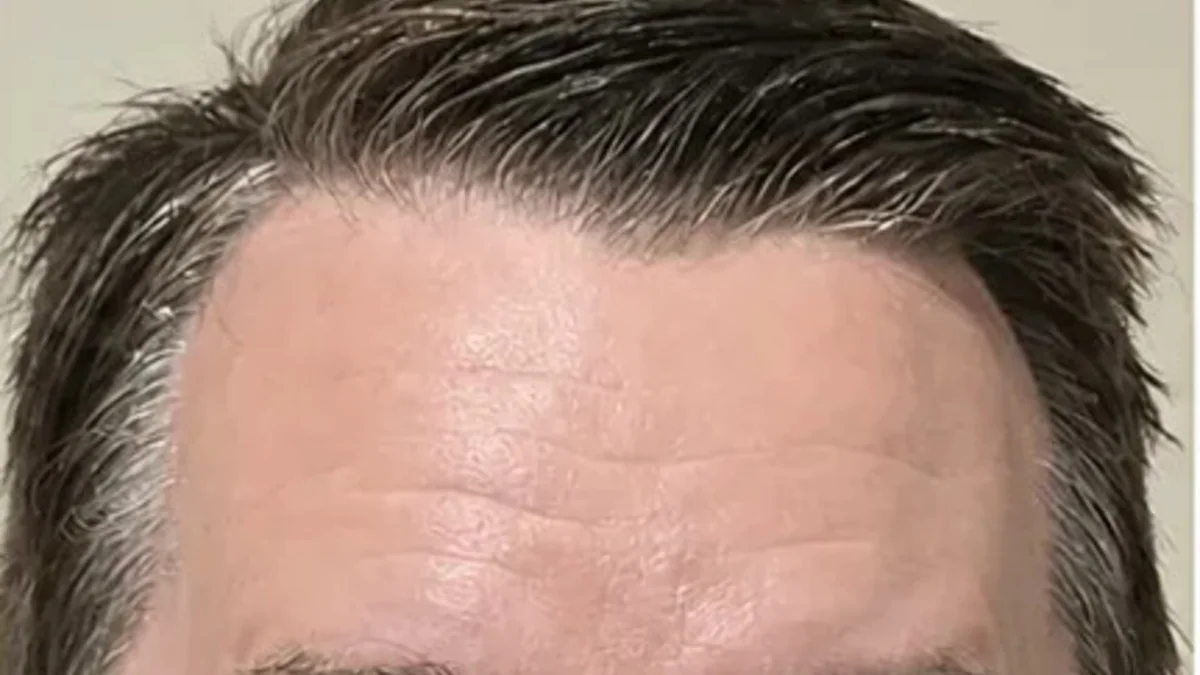
Frown line treatment at Core Aesthetics targets the glabellar complex (corrugator, procerus and depressor supercilii) at conservative starting doses, with assessment of the whole upper face and a planned two week review. Results vary between individuals.
The frown lines that develop between the brows are the most expressive lines on a face that is otherwise at rest. Anatomically they are produced by a small group of muscles, the glabellar complex, that pull the brows inward and downward in response to bright light, concentration, frustration, or close work. The lines themselves are vertical, often two parallel creases that earn the colloquial nickname of the 11s, sometimes joined by a horizontal crease across the bridge of the nose where the procerus lifts.
What people notice in the mirror is rarely the lines themselves. It is the impression the lines leave behind: a face that looks tense, irritated or worried even when none of those feelings are present. Where forehead lines tend to suggest tiredness, glabellar lines tend to suggest annoyance, which is why patients often describe the same conversation: people keep asking me if I am alright, and nothing is wrong.
At Core Aesthetics in Oakleigh, the glabellar complex is one of the most clinically straightforward areas to treat well, but only when it is assessed in the context of the whole upper face. The frontalis lifts the brow. The glabellar complex pulls it down. Brow position at any moment is the live balance between them, and softening one without considering the other is the most common cause of an unsatisfying result.
The anatomy of the glabellar complex
Three muscles, sometimes four depending on individual anatomy, produce the vertical lines between the brows. The corrugator supercilii originates on the bone above the inner brow and inserts into the skin laterally; when it contracts, it pulls the brow inward and slightly downward. The procerus is a small triangular muscle on the bridge of the nose that pulls the medial brow downward and produces the horizontal line across the upper nose. The depressor supercilii sits beneath the corrugator and contributes additional medial brow depression. Together this group is referred to clinically as the glabellar complex.
The complex works as a coordinated depressor system, in opposition to the frontalis above. Treatment of frown lines therefore alters not only how the lines look, but how the brow rests, how it lifts during expression, and how the upper face balances overall. This is why the assessment cannot be limited to the lines you are looking at. The whole upper face determines the safe and appropriate dose.
What Anti-wrinkle treatment does at the cellular level
Anti-wrinkle injection uses a prescription form of botulinum toxin type A, delivered in small calibrated doses to specific points within each muscle of the complex. The medication does not act on muscle directly. It works at the synapse between the nerve and the muscle, where the nerve signals contraction by releasing acetylcholine. A protein on the inside of the nerve terminal, SNAP-25, helps acetylcholine vesicles fuse with the membrane and release their contents. Botulinum toxin enters the nerve terminal by endocytosis, cleaves SNAP-25 enzymatically, and prevents that fusion. Without acetylcholine release, the muscle does not receive the contraction signal, and the skin above it folds less.
The effect is local, dose dependent and temporary. Onset begins at three to five days. The settled result is generally apparent at the two week review. Over the following months, the original nerve terminals recover the ability to release acetylcholine, helped by the temporary growth of small axonal sprouts that form new synaptic contacts. As the original terminal returns to function, the sprouts retract. For most clients the settled effect on glabellar lines lasts in the region of three to four months, sometimes longer in clients who have been treated consistently over years.
Why the glabellar area must be assessed alongside the forehead
The frontalis lifts the brow. The glabellar complex pulls it down. Reduce the activity of the depressor system, and the brow naturally settles a fraction higher and rests with less tension. For many clients this is the most satisfying part of glabellar treatment: not just softer lines, but a face that looks less held, less braced.
The catch is that the same effect runs in reverse. If glabellar treatment is performed in someone whose frontalis is already lifting the brow heavily to compensate for upper eyelid heaviness, the resulting brow elevation can be more than expected, producing the so called quizzical or arched look. In other clients, the issue is the opposite: a brow that already sits low, where glabellar treatment is welcome but where careful technique is needed to prevent further compensation by the frontalis. Assessment looks at brow position at rest, brow lift during expression, the relative strength of the elevators and depressors, and any history of upper eyelid surgery or eyelid laxity that might change the calculation.
When frown line treatment is not the right option
Frown line treatment is not appropriate when realistic expectation cannot be aligned at consultation, or when the visible problem is dermal rather than muscular. Lines that have been carved into the skin by decades of contraction may always be visible to some extent at rest, even with consistent treatment. Botulinum toxin softens the muscle activity that creates new folding; it does not remove preexisting creases from the dermis. A patient who is asking for a flat, lineless glabella regardless of starting condition is asking for an outcome that conservative dosing will not deliver, and that heavy dosing would only deliver at the cost of a frozen, masked appearance.
Other clinical reasons to defer or decline include pregnancy, breastfeeding, active infection or inflamed skin in the glabellar area, neuromuscular disease for which botulinum toxin is contraindicated, and a current course of medication that materially alters bleeding risk. The 2025 AHPRA guidelines for nonsurgical cosmetic procedures, which came into effect on 2 September 2025, formalise the practitioner’s obligation to consider whether the procedure is in the patient’s best interest, including circumstances where it is not. A consultation that recommends deferring or declining treatment is doing the work the guideline expects.
A typical consultation presentation
A patient in her late thirties presents with deepening vertical lines between the brows that her partner has commented on, and that she now notices in unflattering photographs. She has not had previous treatment. Her concern is partly cosmetic and partly social: people at work have begun asking her if she is upset.
At consultation Corey assesses the glabellar complex at rest and during animation, brow height and symmetry, and the relationship between the elevators and depressors. The corrugators are dominant on the left side, producing a slight asymmetry in the resting frown. Brow position is normal. There is no history of eyelid surgery and no suggestion of eyelid laxity. The recommendation is conservative bilateral treatment of the glabellar complex with a slight asymmetric adjustment, and a two week review with photographs. Forehead is not treated at first appointment; the assessment will be reviewed at follow up to see whether the brow has lifted on its own once the depressors are softened, and whether any forehead activity remains that the patient finds bothering. Many patients in this profile do not require forehead treatment at all in the first cycle.
Conservative dosing and the two week review
The glabellar complex is treated at the lowest reasonable starting dose at first appointment. Botulinum toxin can always be added two weeks after the initial treatment, when the response is settled. It cannot be removed once placed. A dose that lands somewhat under treated at two weeks can be topped up. A dose that lands somewhat over-treated has to be lived with for the duration of effect, which is months.
The two week review is therefore not optional. It is photographed in repose and during expression. Brow position is compared to the consultation baseline. Any small adjustment, including small additional doses where the placement did not fully cover a stubborn fibre or where one corrugator has responded more than the other, is made then. The session is short and is included in the cost of the original treatment. Subsequent treatment intervals are planned individually rather than scheduled at a fixed cadence.
What results can and cannot do
Anti-wrinkle treatment is effective at softening dynamic glabellar lines, the lines that appear during expression. With consistent treatment over several cycles, many clients also see a reduction in the depth of the lines visible at rest, because the skin has been given periods of reduced mechanical folding to recover. This is not the same as removal, and it does not happen at the first appointment. It is a gradual change visible at the six- to twelve month mark.
What treatment cannot do is restore lost volume, change the quality or thickness of the skin, or reverse deeply etched static lines that exist independently of muscle activity. It also cannot remove all expression. A successful glabellar result still allows the brows to draw together when the patient is concentrating, frustrated or surprised. The aim is to soften the resting impression, not to silence the face.
Safety, complications and clinical oversight
Anti-wrinkle treatments are among the most extensively studied injectable medications in clinical aesthetics. Serious adverse events are rare when treatment is performed by a registered practitioner working within a clinical framework that includes individual assessment, documented consent, conservative starting doses and a planned review. The most common side effects are minor: pinpoint bruising at injection sites, mild redness, transient tenderness, and a mild headache for the first day or two in some clients. Headache after glabellar treatment is variable: most clients have none, a minority have a self limiting headache for one to three days, and a smaller minority of clients with long standing tension type headache report a reduction over the cycle of treatment.
Less common complications are dose- and placement related. The recognisable patterns are eyelid ptosis, where the upper lid sits lower; brow asymmetry; or the unintended brow elevation pattern that produces a quizzical appearance. These are managed at the two week review where possible, although some require simply allowing the effect to wear off. At Core Aesthetics, every treated patient receives a written aftercare summary, a direct contact for post treatment concerns, and a booked review.
long term planning and treatment intervals
Glabellar treatment is rarely a single appointment. The medication wears off, dynamic activity returns, and most clients who continue treatment find a rhythm that suits them. For some, this is three to four months. For others who have been treated consistently over years, intervals lengthen to four to five months as the resting tone of the depressor complex settles. There is no single correct cadence. Repeat treatment is reviewed at each visit and adjusted to the actual settled response, not to a calendar.
Consistent, conservative treatment over years is associated with a slow reduction in the depth of resting lines, because skin that is folded less develops less etching. The change is gradual and individual, and is the kind of result that becomes most obvious in retrospect rather than from one visit to the next. Photographs at consultation, two week review and annual review provide the comparison that day to day mirror checks cannot.
Photography, documentation and the case for review
Photographic documentation is part of the clinical infrastructure of consistent injectable treatment. At consultation the face is photographed in repose and during a standard set of expressions. The same images are repeated at the two week review and at every subsequent visit. Without that record, comparison is left to the patient’s mirror and to memory, both of which are inaccurate at the time scales over which glabellar treatment changes a face.
The reason this matters is that the most common form of dissatisfaction at six and twelve months is not over-treatment but loss of perspective. Lines that genuinely softened over a year of treatment can feel, in the mirror, like they were never as deep as the consultation photograph shows they were. The photographic comparison is the corrective. It is also the basis on which subtle adjustments are made at each cycle: a slight dose change where the corrugator response has been stronger on one side, a small placement shift where a residual asymmetry remains, no change at all where the result has settled symmetrically. Photographs are stored under the same medical record framework as the rest of the consultation documentation and are not used for marketing.
The clinical reasoning behind serial photography is also why same day before and after imagery is not produced for marketing in cosmetic injectables in Australia. The first useful comparison comes at two weeks, by which point the patient has left the clinic. The settled six month and twelve month comparison is more useful again. Australian regulation under the Therapeutic Goods Advertising Code prohibits the use of patient endorsement imagery for cosmetic procedures involving prescription medicines, and the photographic process at Core Aesthetics reflects that framework.
After treatment: aftercare and what to watch for
The injection itself is brief, ordinarily five minutes after the assessment is complete. Most clients leave the clinic immediately afterwards and resume usual activity. Conservative aftercare guidance applies for the rest of the day: avoid lying flat for several hours, avoid vigorous exercise that elevates heart rate sharply, avoid massaging the treated area, and avoid heat exposure (saunas, hot yoga, very hot showers). The reasoning is to allow the medication to bind locally rather than diffusing into adjacent muscle, particularly the upper eyelid levator complex, where unintended diffusion is the mechanism behind eyelid ptosis. After the first day, ordinary activity resumes without restriction.
Bruising at injection points is the most common short term effect and resolves over a few days. Mild headache for the first one to three days occurs in a minority of clients. Concerns that warrant prompt contact include sudden onset of upper eyelid drooping, marked asymmetry that develops in the first week, persistent localised pain or unusual swelling, or any signs of skin infection at an injection point. The aftercare summary provided at treatment includes a direct contact for these situations and the booked review date.
The consultation at Core Aesthetics
Corey Anderson, Registered Nurse, AHPRA NMW0001047575, is the sole treating practitioner at Core Aesthetics. Every client is seen by Corey personally for every appointment, from initial consultation through to ongoing review. His registration is publicly verifiable at coreaesthetics.com.au/verify.
The glabellar consultation covers how the corrugator, procerus and depressor supercilii contribute to your particular pattern, brow height and symmetry, prior treatment history, medication history, and what the realistic outcome of treatment looks like for the lines that are bothering you. A conservative first dose with a two week review is the structural standard. Treatment is not performed on the day of consultation as a default. Many consultations end with a treatment plan to be performed at a subsequent appointment, or with a recommendation to defer.
Serving Melbourne from Oakleigh
Core Aesthetics is at 12A Atherton Road, Oakleigh VIC 3166. The clinic serves clients seeking glabellar line treatment from across Melbourne’s south east and inner suburbs. Open Tuesday to Saturday by appointment.
For related reading: anti-wrinkle treatment in Melbourne, forehead line treatment, crow’s feet treatment, the C.O.R.E. Method and about Corey.
Is this for you?
Consider booking a consultation if
- You are noticing vertical lines between your brows that bother you and want to understand what anti-wrinkle treatment can and cannot do
- You are eighteen or older, in general good health, and not currently pregnant or breastfeeding
- You want an individual consultation, a written plan and a planned two week review rather than a same day fixed dose
- You are open to being told that the depressor complex should be treated alone first, with the forehead reviewed at follow up rather than treated on day one
This may not be for you if
- You are pregnant, trying to conceive, or breastfeeding
- You have an active infection or inflamed skin in the glabellar area
- You have a neuromuscular condition for which botulinum toxin is contraindicated
- You are seeking a flat, lineless glabella regardless of starting anatomy or skin condition
- You are seeking a fixed dose or a fixed outcome on the day of consultation, without a personalised assessment
Suitability is confirmed at consultation. This list is general guidance, not a substitute for clinical assessment.
Frequently asked questions
Which muscles produce frown lines?
Vertical glabellar lines are produced by the corrugator supercilii, procerus and depressor supercilii, working together to pull the brows inward and downward. The corrugator pulls medially, the procerus pulls the medial brow down (and produces the horizontal nasal bridge line), and the depressor supercilii adds further medial brow depression. Results vary between individuals.
Why is the glabellar area assessed alongside the forehead?
Brow position is the live balance between the frontalis (which lifts) and the glabellar complex (which pulls down). Softening the depressors lets the brow settle a fraction higher; softening the elevators settles it lower. Treating one without considering the other is the most common cause of unsatisfying results, including the so called quizzical lift.
How does the injection actually soften the line?
The medication blocks acetylcholine release at the nerve to muscle junction by cleaving a synaptic protein called SNAP-25. The targeted muscle does not receive the contraction signal, so the skin above it folds less. The effect develops over three to five days, settles at two weeks, and lasts in the region of three to four months in the glabella.
How quickly do frown line results become visible?
Onset begins at three to five days. The settled result is generally apparent at the two week review, which is when the treatment is photographed and assessed. Adjustments are made then rather than within the first week, because the muscle response is still developing. Results vary between individuals.
Are static frown lines (visible at rest) different from dynamic ones?
Static lines are visible without any expression and reflect long standing skin folding plus dermal change. Dynamic lines appear with movement and disappear or fade at rest. Anti-wrinkle treatment is most effective on dynamic lines. Static lines may soften gradually over months of consistent treatment but rarely disappear entirely; the residual depth is dermal and is not addressed by botulinum toxin.
How long does the effect on frown lines last?
Most clients see settled effect for three to four months in the glabellar area. Individual metabolism, baseline muscle activity, and dose all influence duration. Intervals tend to lengthen slightly in clients who have been treated consistently over years, as the resting tone of the depressor complex settles. Results vary between individuals.
Can frown line treatment cause headaches, or relieve them?
Both occur. A minority of clients experience a self limiting headache for one to three days after treatment. A smaller minority of clients with long standing tension type headache report a reduction in headache frequency or severity over the treatment cycle. Neither outcome is reliably predictable and the treatment is not provided for headache management; any therapeutic indication for botulinum toxin in chronic migraine is a separate medical pathway.
Will I still be able to make expressions after frown line treatment?
A successful glabellar result allows the brows to draw together when you are concentrating, frustrated or surprised, but reduces the resting tension between them. Conservative dosing aims at softening rather than silencing. A frozen or masked appearance is the result of over-treatment, which conservative dosing with a two week review is structured to avoid.