
Jawline filler at Core Aesthetics is structural placement at the mandibular border, decided after whole face anatomical assessment by Corey Anderson, registered with the Nursing and Midwifery Board of Australia since 1996. Most jawline results last twelve to eighteen months. Results vary between individuals.
Definition in the jawline does not need to be dramatic. A well defined jaw does not need to look sharp or sculpted. It just needs to frame the face, support proportions and create the subtle structure that makes everything else look more balanced.
“I just want a cleaner line. Not a dramatic change.”
That is exactly where jawline filler works well. Subtle definition. Structure without looking sculpted.
What Jawline Filler Does
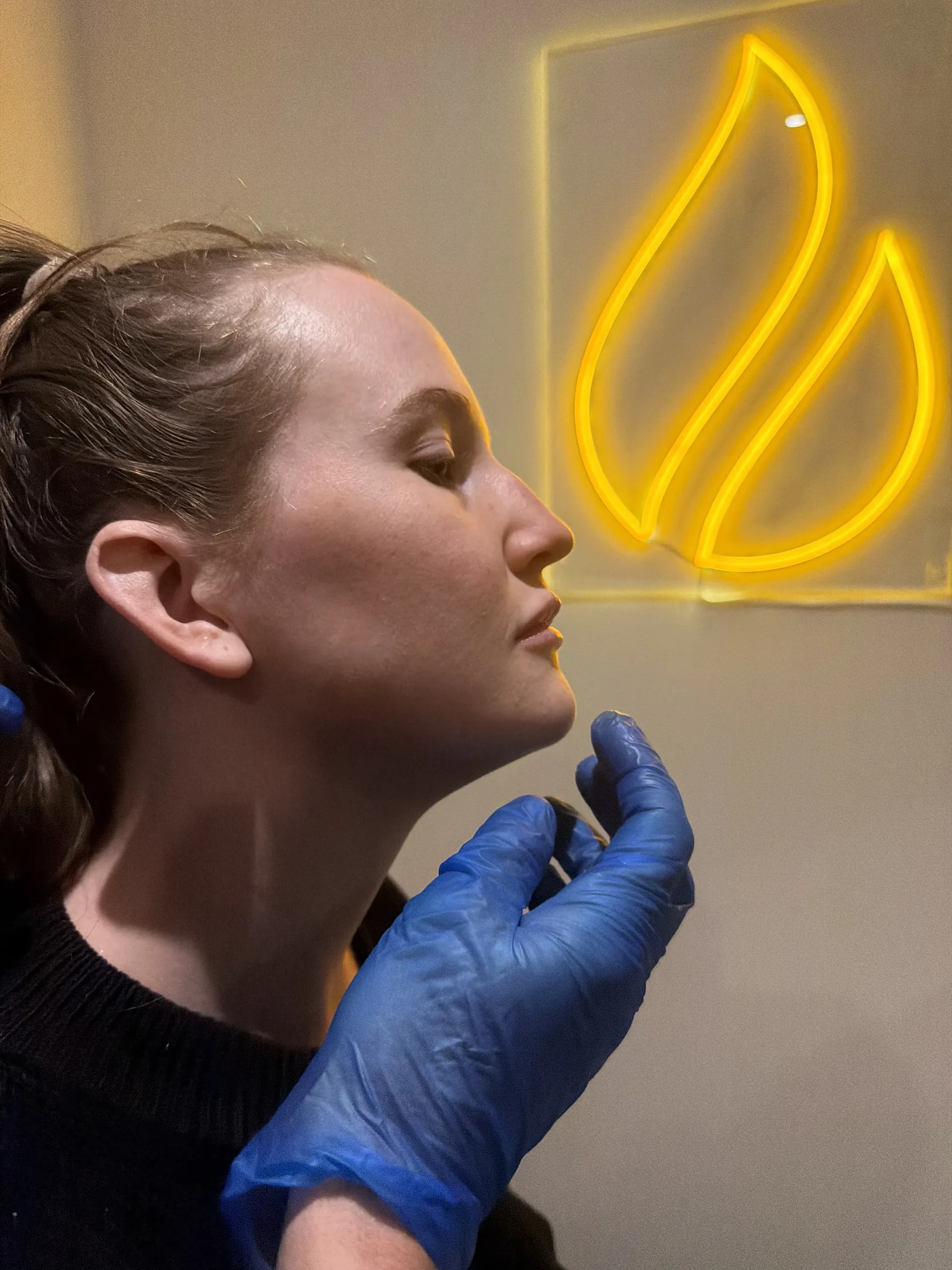
Jawline filler uses prescription hyaluronic acid based product to improve definition and structural clarity along the jaw border. It can sharpen a softened jaw angle, improve lower face definition and enhance the overall proportional balance between the jaw, chin and mid face. When placed appropriately, the result is structure that reads as natural anatomy rather than obvious treatment.
Why Assessment Is the Most Important Step
The jaw’s appearance is affected by multiple factors that interact with each other. Bone structure sets the underlying framework. Soft tissue changes affect how clearly the bone structure is expressed on the surface. Masseter muscle size can either add or detract from jaw definition. Mid face volume affects how the jaw is framed from above. And skin laxity affects the realistic scope of what nonsurgical treatment can achieve.
What the assessment covers
A recommendation that ignores this context and simply places filler along the jaw border often produces results that look technically treated rather than naturally defined. The assessment at Core Aesthetics covers the full lower face picture before any recommendation is made.
A good result
- Improved lower face definition
- Structure that reads as natural anatomy
- Better proportional balance between jaw, chin and mid face
- Frame that complements the full face
A less than ideal result
- Overly sharp or sculpted
- Definition that looks placed rather than natural
- Asymmetry from uneven placement
- Treated appearance that draws attention
Too much and the result looks harsh. Too little and nothing changes. The goal is structure without looking sculpted.
The Assessment at Core Aesthetics
Corey Anderson, AHPRA registered nurse, is the sole treating practitioner at Core Aesthetics. Every client is seen by Corey personally for every appointment, from initial consultation through to ongoing treatment and review. His registration is publicly verifiable at coreaesthetics.com.au/verify.
The assessment covers jaw width, jaw angle definition, chin projection, mid face volume and the realistic scope of nonsurgical treatment for the individual anatomy. Corey will discuss what is achievable and what is not with honest specificity. There is no obligation to proceed. Read about the jawline filler consultation process and about nonsurgical jawline definition options in Victoria.
Serving Australia from Oakleigh
Core Aesthetics is at 12A Atherton Road, Oakleigh VIC 3166. The clinic serves jawline filler clients from across the area’s south east and inner suburbs. Open Tuesday to Saturday by appointment.
Related Reading
Why the Jaw Border Changes Over Time
The jaw border becomes less defined over time through several concurrent processes. The mandible loses density and volume gradually, altering the underlying structural scaffold. The fat compartments of the lower face undergo redistribution, with some deflating and others descending. As skin elasticity diminishes, it no longer adheres as tightly to the underlying structures.
One of the most frequently overlooked contributors to a softer looking jaw is mid face volume loss. When the cheeks lose support, tissue that was once higher in the face descends into the lower face. This can make the jaw border look less defined and the lower face look heavier, not because of any specific change in the jaw itself, but because of changes that originated in the mid face. This is why assessing the mid face is often the clinically appropriate starting point before any lower face treatment is considered.
What Jawline Filler Treatment Involves
Jawline filler uses prescription hyaluronic acid based dermal filler placed along the jaw border to improve its definition, sharpen the jaw angle or restore a cleaner transition between the lower face and the neck. Placement, product choice and volume are entirely determined by your individual anatomy assessed during your consultation.
Jawline treatment is often considered alongside chin filler as part of a coordinated lower face approach, since the jaw provides lateral definition while the chin provides forward projection. You can read our full overview of how we approach lower face treatment on our jawline and chin filler page.
If you are considering treatment and unsure whether it is appropriate for your concerns, a consultation is the right first step. Book a consultation at Core Aesthetics, Oakleigh.
When Jawline Filler Is Not the Right Option
Jawline filler works by adding structure at the mandibular border. It is effective for specific presentations and not for others. Part of the assessment is identifying which category a client falls into.
When skin laxity is the primary driver
Where the softening of the jaw border is primarily driven by skin laxity rather than structural volume loss or bone resorption, adding filler to the jaw can worsen the appearance of heaviness in the lower face rather than improve it. The product adds projection at the bone level but the lax skin above it remains. The assessment identifies whether the structural or the skin quality issue is dominant.
When the mid face needs to be addressed first
A significant proportion of clients presenting with jawline concerns actually have mid face volume loss as the primary driver. Descending mid face tissue creates jowling and softens the lower face border regardless of what the jaw itself looks like. In these cases, treating the jaw without first addressing the mid face produces an imbalanced result. The recommendation at consultation may be to start with the cheeks before or instead of the jaw.
When the concern is beyond nonsurgical correction
Significant jowling, pronounced skin laxity, or a jaw concern that is primarily bone structural will not be adequately addressed by filler. Where this is the case, Corey says so clearly and may suggest consultation with a surgical practitioner is a more appropriate path.
A Typical Presentation
“He came in for his jaw. The jaw was fine. The cheeks were not.”
A client in his mid forties notices his jawline has become less defined over the past few years. He is considering jawline filler. At consultation, Corey assesses the full lower face including the cheeks, the jaw and the skin quality at the jaw border. The jaw structure is actually well preserved. The issue is mid face descent that has created the appearance of a softer jaw by adding volume in the wrong place.
The recommendation is cheek filler to restore the mid face support, which will indirectly improve the apparent jaw definition by lifting the descending tissue. The client is told the jaw itself may not need to be treated at all once the mid face is addressed.
This is a very common clinical pattern in men, who often notice the jaw before they notice the cheek, and who respond well to being told the most natural result starts higher rather than lower.
Being Honest About the Limits of Nonsurgical Treatment
Where jowling is mild, strategic filler placement can improve lower face definition. Where jowling is moderate to significant, or where there is substantial skin laxity in the lower face and neck, the degree of improvement achievable with filler alone is genuinely limited. At Core Aesthetics, your practitioner will tell you this clearly and may suggest a surgical consultation if that is a more appropriate pathway for your situation.
Filler at the mandibular border versus masseter contouring
Two different lower face concerns are sometimes confused. A wider lower face, where the angle of the jaw appears bulky and the contour of the cheek into the jaw lacks definition, is often a masseter muscle issue. The masseter is one of the muscles of mastication. Habitual clenching, bruxism, or simply individual muscle bulk can produce significant hypertrophy of the masseter, and the cosmetic effect is a squarer, fuller lower face. The treatment for this is neuromodulator placed into the masseter, which over weeks reduces the muscle activity and, with repeated cycles, results in muscle atrophy and lower face contour change.
An undefined jawline, where the boundary between the jaw and the neck has lost crispness, is a different concern. This is usually a structural issue: bony resorption at the mandibular border, fat redistribution, and skin laxity have collectively softened the jaw’s edge. The treatment for this is filler placed structurally along the mandibular border, anchoring the angle of the jaw and the chin to re establish the line that runs between them. The two treatments are not interchangeable. Some patients benefit from both. The assessment determines which is doing what work.
How the jaw changes with age, and what filler can and cannot do
The mandible is one of the more dynamic facial bones. Posterior remodelling at the mandibular angle, gradual loss of vertical height in the body of the mandible, and remodelling at the chin all contribute to changes in the shape of the lower face from the third decade onwards. These bony changes are part of what produces the appearance of jowling, the deepening of the labiomental fold, and the sense that the lower face has lost its definition. The soft tissue changes that follow, fat redistribution and skin laxity, are partly a consequence of the bony platform changing beneath them.
Filler can address the structural component of this change. It restores support at the mandibular border, re establishes definition at the angle and the chin, and can soften early jowling by repositioning the tissue that has draped across a remodelled platform. What filler cannot do is reverse significant skin laxity. Where the skin envelope has loosened materially, filler placed beneath it produces a tighter look only marginally and risks creating bulk where definition was sought. The honest conversation, at consultation, is about which patients are candidates for filler and which are at the limits of what nonsurgical treatment can credibly offer.
Patients in the latter category are sometimes better served by stopping the consultation, deferring treatment, and considering surgical assessment as a separate pathway. The clinic’s preference is to be straight about this rather than to attempt nonsurgical treatment in cases where the result will disappoint. Disappointed patients are not a marketing problem. They are a clinical signal that the wrong intervention was chosen.
How the jawline assessment looks at the rest of the face
The jaw is read in the context of the cheek and the chin. A defined jaw with an underdeveloped chin reads differently from a defined jaw with a strong chin. A defined jaw with an over-treated cheek reads differently again. The first part of the consultation looks at the proportions across the lower two thirds of the face and identifies what is actually doing the work in the appearance the patient is responding to. Treating only the jaw, where the underlying issue is mid face support or chin projection, produces a result that looks effortful rather than considered.
Some patients arrive concerned about a jawline that has lost definition through soft tissue change. Others arrive concerned about a jawline that was never as defined as they would have wished. The two situations are different clinical conversations. The first is about preserving or restoring what the face has produced over time. The second is about whether structural enhancement of an underlying anatomy is the right intervention, and whether the result will read as proportionate rather than added. Both can be appropriate. Both require honest assessment.
For patients whose primary concern is masseter bulk producing a wider lower face, the right entry point is masseter treatment with a neuromodulator, not filler. The two treatments interact: a course of masseter treatment over several cycles produces gradual muscle atrophy, and the apparent contour of the jaw can change without any structural product being placed. Patients who would benefit from both sequencing matters, with masseter work usually preceding any structural filler placement so that the platform is stable before product is added. The clinic’s broader documentation on the jawline and chin filler guide sets out how the two interact in detail.
For patients whose primary concern is jowling at the lower face, the conversation is more cautious. Mild early jowling can sometimes be improved with strategic filler placement. Established jowling, where skin laxity has progressed materially, is at the limits of what nonsurgical treatment can credibly address. Patients in this category sometimes leave the consultation without a treatment booking, having been advised that surgical assessment is the better next step. That conversation is part of clinical honesty, not a marketing failure. Being turned away rather than treated is sometimes the right outcome.
Jawline treatment at Core Aesthetics is staged rather than complete in a single session. The first treatment is anchored at the angle of the jaw and the chin, and the result is reviewed at four to six weeks. Where additional work is appropriate, it is added in a second session that builds on the first rather than rebuilding it. Patients who arrive expecting a finished outcome on day one are reset on this rhythm at consultation. There are clinical reasons for it: the lower face responds to small structural changes more obviously than to large ones, and a result that looked accurate immediately after treatment may need slight refinement once swelling has settled and the product has integrated. Reviewing this is part of the work, not an optional extra. The clinic’s broader documentation on the jawline and chin filler approach sets out the staged framework in detail for patients planning treatment. The right outcome for some patients, after the first session, is to stop and let the result hold rather than continuing to add. That decision is made at review, not at the original treatment.
Patients reviewing options for lower face contouring sometimes ask whether the right place to start is filler, masseter treatment, or both. The right answer is determined at consultation, not in advance. The two treatments do different things, address different concerns, and combine usefully in some patients but not all. The assessment looks at masseter bulk under voluntary clench, at the resting contour of the lower face, at the projection of the chin, and at the proportions of the cheek above the mandibular border. The recommendation that follows is structured around what the lower face actually needs rather than around which treatment the patient arrived asking about. The clinic’s approach is consistent: the assessment leads, the plan follows, and the patient leaves with a clear written understanding of what the recommended next step is and why. This is the same standard the clinic applies to any other treatment area, and it is part of why patients return for the longer term plan rather than the single appointment.
Chin Filler Melbourne and Jawline Planning
Chin filler and jawline filler are closely related because the chin influences how the lower face reads in profile and from the front. A weak or recessed chin can make the jawline appear less defined even when the mandibular border itself is not the main issue. Conversely, a patient asking for chin filler may actually be responding to jowling, lower face descent, or masseter shape.
At Core Aesthetics, chin filler Melbourne enquiries are assessed as part of lower face structure. The consultation looks at chin projection, labiomental fold depth, jaw angle, mandibular border, dental and skeletal proportions, and whether filler is a suitable option. Some patients need chin support, some need jawline definition, and some are better served by no filler or medical referral.
Jaw Filler Melbourne: What Patients Usually Mean
Patients often search for jaw filler Melbourne when they mean several different things: a sharper jawline, a stronger chin, less visible jowling, a more balanced profile, or a straighter mandibular border. These are not the same treatment. The phrase is useful because it reveals the patient's concern, but the clinical plan needs to translate that concern into anatomy.
Filler can support selected areas of the lower face, but it cannot tighten significant skin laxity or replace surgical lifting where that is the more appropriate pathway. A careful jawline assessment explains what filler can support, what it cannot change, and whether the result would remain proportionate with the rest of the face.
Jawline Filler Melbourne: Matching The Lower Face To The Whole Face
Jawline filler should not be planned as an isolated border. The lower face sits in relationship to the cheeks, chin, lips, neck, and masseter muscles. Adding structure to one area without considering the rest of the face can make the jaw look heavy or disconnected.
Core Aesthetics uses a full-face assessment before recommending jawline filler. That assessment may identify chin support, cheek structure, masseter activity, weight-related facial change, or ageing-related tissue descent as part of the picture. The aim is not a standardised sharp jawline. It is a proportionate lower face plan that respects the patient's anatomy.
Areas We Service
Core Aesthetics in Oakleigh provides jawline filler for clients from across Victoria’s south east and inner suburbs. Click your suburb below to find out more.
- Carnegie
- Chadstone
- Murrumbeena
- Bentleigh
- Clayton
- Cheltenham
- Moorabbin
- Notting Hill
- Mount Waverley
- Glen Waverley
- Bentleigh East
- Clarinda
- Highett
- McKinnon
- Dingley Village
- Malvern
- Caulfield
- Brighton
- Camberwell
- Glen Iris
- Toorak
- South Yarra
- Elwood
Book a Consultation
Is this for you?
Consider booking a consultation if
- You are researching dermal filler and want to understand whether it is appropriate for your individual situation
- You are 18 or older and in general good health
- You want an individual clinical assessment and a written treatment plan tailored to your own anatomy, not a standardised template
- You understand that dermal filler is a prescription medical procedure that carries risks, which will be reviewed with you in consultation
This may not be for you if
- You are pregnant, trying to conceive, or breastfeeding
- You have an active infection, inflammation, cold sore outbreak, or unhealed skin in a potential treatment area
- You have a history of severe allergic reaction to hyaluronic acid or to local anaesthetic (lidocaine)
- You have an autoimmune condition, bleeding disorder, or are taking a medication that increases bleeding risk, without clearance from your treating doctor
- You are under 18 years of age
Suitability is confirmed at consultation. This list is general guidance, not a substitute for clinical assessment.
Frequently asked questions
What does jawline filler structurally define?
Jawline filler can define the line from the angle of the jaw to the chin, support the jawline contour against age related descent, and create more definition between the lower face and the neck. The visible effect depends on the underlying bone structure and surrounding soft tissue.
How does jawline filler differ from masseter treatment?
Jawline filler adds structural definition to the jaw line itself; masseter treatment reduces the activity of the masseter muscle which affects lower face width. They address different anatomy and are sometimes used together. The assessment determines which is appropriate.
How long do jawline filler results typically last?
Jawline filler typically lasts between twelve and eighteen months in most clients, sometimes longer in areas with limited daily mobility. The settled duration is influenced by the volume placed, individual metabolism, and the dynamic of the surrounding muscles.
Can jawline filler address a sagging or undefined jawline?
Filler can support the underlying jawline contour and add definition; it does not lift sagging skin. For clients where the dominant issue is skin descent rather than volume loss, the appropriate intervention may be closer to what surgical lifting addresses. The consultation distinguishes.
Is jawline filler painful?
Most clients describe mild to moderate discomfort during placement, lasting seconds per injection point. Topical numbing is offered, and most filler products contain a small amount of local anaesthetic. The angle of jaw area is usually less sensitive than the lip or under-eye area.
What recovery should be expected after jawline filler?
Mild swelling and possible bruising for 24 to 72 hours; most clients return to normal activities the same day. Avoiding intense exercise, alcohol, and heat exposure for the first day is generally recommended. Sleeping on the back for the first night reduces post treatment asymmetry.
When is jawline filler not the appropriate intervention?
When skin laxity rather than volume loss is the dominant issue; when the desired change is closer to what surgical contouring would achieve; or when the underlying anatomy means injectable treatment will not address the visible concern. Some consultations recommend deferring or referring.
How is symmetry achieved in jawline treatment?
Through individual side by side assessment at consultation. Most faces are naturally asymmetric to some degree; the goal of treatment is harmony rather than mathematical equivalence. The treatment plan accounts for the existing asymmetry rather than trying to eliminate it entirely.
Is chin filler part of jawline filler planning?
Often, yes. Chin projection affects the appearance of the jawline and lower face. Assessment determines whether the chin, jawline, both, or neither should be treated.
What does jaw filler mean?
Patients use jaw filler to mean chin support, jawline definition, mandibular border treatment, or lower face contouring. A consultation translates the concern into anatomical assessment.