Mens Aesthetic Treatments Melbourne, Oakleigh, consultation based treatment at Core Aesthetics, Oakleigh, Melbourne. Individually assessed. Suitability is always determined in an individual consultation, before any treatment is considered.
Cosmetic injectable treatments are no longer the exclusive territory of female clients, and they have not been for some time. Men across Melbourne are increasingly exploring anti-wrinkle treatment and dermal filler, not to transform their appearance but to address the specific visible changes that are affecting how they feel in photographs, on video calls or in day to day life.
At Core Aesthetics in Oakleigh, male clients receive the same thorough, honest consultation as every other client. The difference is in the approach. Masculine facial aesthetics require a different clinical framework, different structural goals, different dosing considerations and a different understanding of what natural looks like on a male face.
“Good information changes the quality of the decision.”
How Mens Aesthetic Treatment Differs
The fundamental difference between treating men and women aesthetically is in the structural goals. A natural result in a female face typically aims to restore or enhance softness, lift and proportion around softer features. In a male face, the goal is to preserve or restore characteristics like a defined jaw, heavier brow, flatter cheek plane and angular overall structure.
Treatment that looks natural and proportionate on a female face can look feminised or overly smooth on a male face if those differences in goal are not built into the treatment plan. This is why practitioner experience with male clients specifically matters.
Anti-wrinkle Treatment for Men
Men typically have stronger facial muscle activity than women, which means that standard dosing protocols may be insufficient to achieve the desired result. Conversely, over dosing in the forehead can create an unnaturally smooth appearance that looks inconsistent with the rest of the face. At Core Aesthetics, anti-wrinkle treatment for male clients is dosed and placed with masculine muscle dynamics in mind.
The most commonly discussed treatment areas for male clients are frown linesforehead linescrows feet and masseter treatment. Masseter treatment in particular has become increasingly relevant for male clients, addressing both jaw width and the discomfort associated with clenching and grinding.
Dermal Filler for Men
Volume loss affects men as it does women, and the changes it creates, a flatter mid face, a less defined jawline, hollowness beneath the eyes, can have a significant impact on how a male face reads. Dermal filler can address these changes in male clients, but the structural goals differ from female treatment.
For male clients, jawline and chin definition is frequently a primary goal. A cleaner jaw border and a more forward projecting chin can significantly improve facial proportion and profile in a way that looks masculine and natural. Mid face volume for male clients aims to restore structural support rather than create lift or softness, and the placement and product choices reflect this.
What to Expect at a Consultation
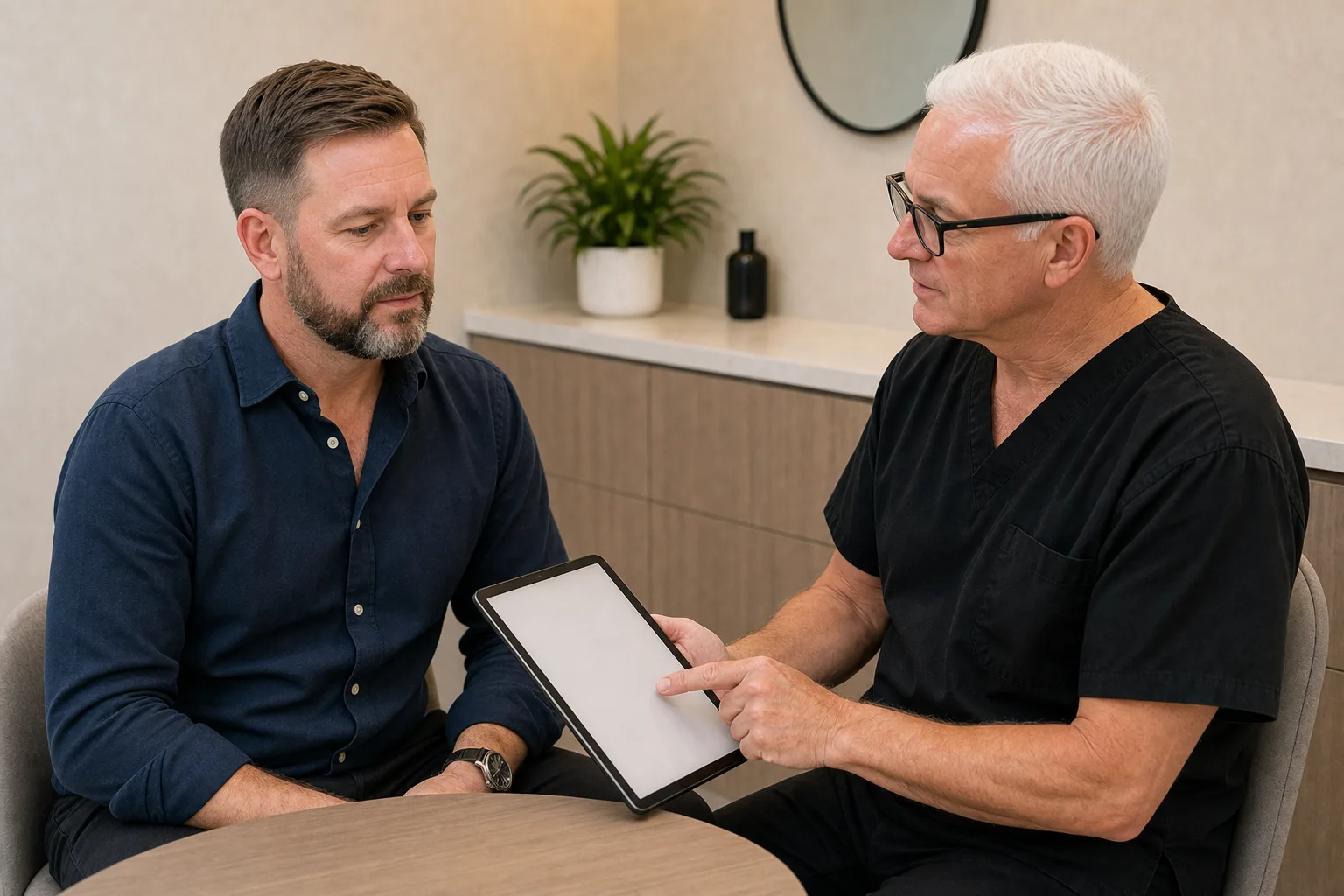
Your consultation at Core Aesthetics is a clinical conversation, not a sales process. Corey will assess your face, understand your goals in plain language and give you an honest view of what treatment can and cannot achieve for your individual situation. There is never any pressure to proceed and all treatment is optional. Read more about what happens at a cosmetic injectables consultation.
Located in Oakleigh, Serving Melbourne’s South East
Core Aesthetics is at 12A Atherton Road, Oakleigh VIC 3166. Accessible from Carnegie, Chadstone, Murrumbeena, Huntingdale, Bentleigh and Clayton. Open Tuesday to Saturday by appointment.
Ready to take the first step?
Book your consultation at Core Aesthetics, Oakleigh today.
Book online here
Safety, Suitability and Clinical Assessment
All cosmetic injectable procedures carry risk. The suitability assessment at consultation identifies any contraindications or relative risk factors specific to your circumstances, including medical history, current medications, previous procedures, and anatomical features that may affect the risk profile for a given treatment area. This information is reviewed before any treatment is planned.
For certain conditions and medications, injectable treatments are not appropriate, or require modification of technique or timing. For others, the treating practitioner may recommend that you consult with your primary healthcare provider before proceeding. These are clinical judgements that can only be made with accurate, complete medical history information, which is why the consultation history taking process is thorough.
Complication recognition and initial management are part of the clinical competency required of practitioners performing injectable treatments under AHPRA’s September 2025 guidelines for nonsurgical cosmetic procedures. The practitioner at Core Aesthetics holds current training in this area and maintains the relevant management supplies on site. Understanding that risk exists and is actively managed is more useful than assuming risk does not exist.
Review Appointments and Ongoing Care
A review appointment at four to six weeks is a standard part of every treatment cycle at Core Aesthetics. The review is not contingent on whether you have concerns, it is a clinical standard that applies to every patient. At review, the practitioner assesses the result across all treated areas, compares the outcome to the pretreatment clinical photographs, identifies any asymmetry or variation in response between sides, and determines whether any adjustment is appropriate within the same treatment cycle.
The review is also where longitudinal data about how your specific anatomy responds to treatment is recorded. Over multiple treatment cycles, this accumulated data allows the practitioner to refine the dosing and approach to better match your individual response pattern, which is one of the most significant advantages of maintaining a consistent treating practitioner rather than moving between clinics.
If you have any concerns in the period between your treatment and your review appointment, contact the clinic directly. The practitioner who treated you has the clinical context to respond accurately to any post treatment question, which is preferable to relying on general online information that may not reflect your specific situation.
What the Assessment Covers
The assessment at the consultation appointment is a face wide evaluation, not a focused review of only the area you have identified as a concern. This full face approach is deliberate: anatomical features interact with each other, and addressing one area in isolation, without understanding the broader facial context, can produce results that look disproportionate even when the individual area was technically treated well.
The practitioner evaluates facial symmetry, bone structure, soft tissue distribution, skin quality, and the dynamic movement patterns associated with each treatment area. The history taking covers your current medications, any previous injectable or surgical procedures, relevant health conditions, and any prior reactions or complications. From this assessment, the practitioner develops a treatment plan that reflects your specific anatomy and circumstances.
Results vary between individuals. What the assessment finds in one patient may be different from what it finds in another patient with a similar presenting concern, which is why templated treatment protocols are not used here. All treatments at Core Aesthetics are consultation based and individually assessed.
About This Information
The information on this page is provided for general educational purposes. It is not a substitute for clinical advice and does not constitute a recommendation that you proceed with any particular treatment. Cosmetic injectable treatments are prescription medical procedures. They carry risks that vary between individuals and that must be assessed and discussed in a clinical context before any treatment decision is made.
At Core Aesthetics, Corey Anderson assesses every patient individually. The consultation is the point at which your specific anatomy, medical history, and goals are evaluated together. No treatment is offered at a first appointment, and no treatment is appropriate for everyone. This page is a starting point, a way to understand what is involved before you decide whether a consultation is the right next step for you.
If you have questions about anything on this page or about whether treatment might be appropriate for your situation, you are welcome to call the clinic or book a consultation at no obligation.
This page provides clinical information about Mens Aesthetic Treatments Melbourne, Oakleigh. It is intended for adults aged 18 and over who are considering cosmetic injectable treatment and want to understand the clinical process, suitability factors, and what to expect from a consultation based practice. All treatment decisions at Core Aesthetics follow individual assessment, no treatment is offered at a first appointment without a separate consultation. Results vary between individuals and are reviewed at follow up.
The Role of Anatomical Assessment in Treatment Planning
Effective cosmetic injectable treatment begins with understanding individual facial anatomy. The same concern, loss of cheek volume, for example, may have different underlying structural drivers in different people. In one patient it reflects fat pad atrophy; in another it involves bony remodelling; in a third, skin laxity changes the way existing volume appears. These distinctions affect both whether treatment is appropriate and, if so, how it should be approached.
At Core Aesthetics, the consultation begins with a systematic assessment of facial structure, including symmetry analysis, skin quality assessment, treatment history review, and discussion of the patient’s specific goals. This anatomical baseline informs every treatment decision and helps ensure that proposed treatments address the actual underlying driver of a concern rather than a surface level presentation.
This is one of the reasons Core Aesthetics operates as a one practitioner clinic with a consultation based model. A consistent clinical relationship between patient and practitioner supports the kind of longitudinal assessment that is difficult to achieve in high volume, multi practitioner settings.
Treatment is performed by Corey Anderson, Registered Nurse, AHPRA NMW0001047575, who has been a registered nurse since January 1996. The one practitioner model means the practitioner who assesses your face is the practitioner who treats it, and the practitioner who reviews the result at the follow up.
How Male Facial Assessment Differs From Female Assessment
The clinical assessment of a male face is not the same as that of a female face, and treating it as if it were is one of the most common avoidable errors in cosmetic injectable practice. Male skeletal proportions, soft tissue distribution, and aesthetic conventions diverge from female norms in ways that matter at the consultation, regardless of how the individual patient identifies. The practitioner’s job is to assess the face in front of them and make recommendations that respect its starting point.
Skeletal differences include a typically broader and more angular mandible, a heavier supraorbital ridge, a more linear jawline, and a wider zygomatic arch. Soft tissue differences include relatively thicker dermis, denser facial musculature, and a different distribution of subcutaneous fat. These structural realities influence both what is achievable and what is appropriate. A treatment that reads as refinement on a female face can read as feminisation on a male face, and the reverse is also true. Anti-wrinkle dosing is generally higher in male patients because the targeted musculature is denser; filler placement strategies differ because the goal is usually structural reinforcement of an existing line rather than a softening of it.
The conversation at consultation also differs in pattern. Male patients often present with concerns that are framed in functional rather than aesthetic terms (looking tired in meetings, looking older than colleagues, recovering from a period of stress). The practitioner’s role is to listen for the underlying goal and to translate that into a structural conversation that respects how the patient wants to be perceived. Some patients want their face to read as more rested without anyone noticing the change. Others are comfortable with a more visible refinement. Both are valid.
Treatment plans for male patients tend to be conservative at first cycle and built up gradually if the response supports it. The C.O.R.E. Method’s conservative dosing principle is operationalised here. The two week review is where the actual response is documented and where the next step is planned. Results vary between individuals.
Common Treatment Patterns And What Drives Them
Several treatment patterns recur in male patients across the clinic’s caseload. None are universal; they are presented here as descriptive observations rather than as prescriptions for any particular face.
Glabellar treatment (the muscles between the brows that produce the vertical ‘eleven’ lines) is the most common entry point for male patients to anti-wrinkle treatment. The motivation is often functional rather than purely aesthetic: patients describe being misread as angry or stressed by colleagues, family, or strangers, and want to soften the visible static line that the chronic muscle activity has produced. Doses in male patients are typically higher than in female patients in this region because the corrugator and procerus complex is denser, and the assessment at the first appointment establishes the appropriate range for an individual.
Forehead treatment is approached more conservatively than glabellar treatment in most male patients. The frontalis is the primary lifter of the brow, and over-treatment in this region in patients who use frontal lift to support a heavy brow position can produce a sense of brow heaviness and visible forehead static lines that the patient may find more aesthetically problematic than the original dynamic lines. Conservative dosing here, with adjustment at the two week review, is the default.
Jawline and chin work in male patients is usually structural rather than reductive. Filler placement at the mandibular angle and along the jawline can reinforce a definition that has softened with age or that was never strongly defined skeletally. Chin treatment can address mild to moderate retrogenia or subtle asymmetry. The conversation at consultation establishes whether the patient’s goal is reinforcement of an existing structure or a more substantial reshaping, because the two require different approaches and produce different visible effects.
Hair loss treatment, scar work, surgical procedures, device based skin treatments, and prescription topical regimes all sit outside the clinic’s scope. Patients whose primary concern is in any of these categories are referred to the appropriate provider, and the cosmetic injectable conversation is paused or restructured around what is actually relevant to the clinic’s offered services.
How To Decide If Cosmetic Injectable Treatment Is Worth Pursuing
Patients who arrive uncertain whether cosmetic injectable treatment is the right path for them are usually well served by an exploratory consultation rather than a treatment booking. The exploratory conversation establishes what the patient is actually concerned about, what the realistic clinical options are, what the long term cadence and cost commitment looks like for someone considering ongoing treatment, and what the alternative of doing nothing entails. Many patients leave the exploratory consultation with a clearer sense of whether they want to proceed, when the appropriate timing might be, and which specific concerns are realistically addressable. Some leave with a recommendation to defer the decision for twelve months and reassess. The exploratory consultation is the same forty five minute appointment as a standard initial consultation; the structural difference is in the conversation rather than in the booking.
Logistics For Patients Working Around A Professional Schedule
Many male patients have schedules that constrain when they can attend appointments without disruption. The clinic accommodates this within the limits of one practitioner availability. Early evening appointments are sometimes available; lunch hour appointments are sometimes possible for established patients with shorter follow up appointments. The cooling off interval required for new patients under AHPRA September 2025 guidance applies regardless of scheduling preference, and the interval is observed without exception.
Is this for you?
Consider booking a consultation if
- You are researching cosmetic injectable options and want to understand the consultation and assessment process
- You are 18 or older and weighing your options
- You want an individual clinical assessment before any treatment decision
- You value a consultation based clinic model over same day treatment
This may not be for you if
- You are pregnant, trying to conceive, or breastfeeding and are considering injectable treatment
- You have an active infection or unhealed skin in a potential treatment area
- You are under 18 years of age
Suitability is confirmed at consultation. This list is general guidance, not a substitute for clinical assessment.
Frequently asked questions
What is the recovery time after dermal filler?
There is no formal recovery period. Swelling and occasional bruising are the most common post treatment effects, peaking at 24 to 48 hours and typically resolving within a week. The final settled result is visible at approximately two weeks.
What does filler feel like under the skin?
In structural areas, filler may be palpable as a slightly firmer texture beneath the skin, particularly in the first few weeks after treatment. This settles as the product integrates with surrounding tissue. In areas where product is placed superficially, firmness is more noticeable.
Is there a risk of migration with dermal filler?
Migration, meaning product moving from the intended placement to an adjacent area, is more associated with certain superficial treatment areas and can be caused by excessive volume, repeated pressure or incorrect placement. At Core Aesthetics, conservative dosing and anatomically appropriate placement are how migration risk is minimised.
Can dermal filler be combined with anti-wrinkle treatment in the same appointment?
Yes, and this combination is appropriate for many clients. The two treatments address different aspects of facial change and can be performed at the same appointment where the assessment supports it. Whether combining them makes sense depends on the areas being treated and is discussed at your individual consultation.
How do I know which areas to treat with dermal filler?
The most reliable approach is a clinical assessment by a qualified practitioner. Many clients arrive knowing a specific area they want addressed, but a thorough assessment often reveals that the concern originates elsewhere. Corey Anderson assesses the whole face and explains his findings before any recommendation is made.
What causes bruising after filler and how long does it last?
Bruising occurs when a small blood vessel is disrupted during injection. It is common in areas with a rich blood supply, particularly the lips and tear trough. Avoiding blood thinning substances beforehand reduces the risk.
Will I look overdone after dermal filler?
Not if treatment is conservative and individually assessed. The overdone look is almost always the result of too much product, product in the wrong plane, or treatment without accounting for how the face looks as a whole. At Core Aesthetics, the starting point is always the minimum amount needed to achieve a meaningful improvement.
How is a staged approach to filler different from treating everything at once?
For clients new to dermal filler, or those who have not had treatment for several years, a staged approach places conservative amounts across one or two appointments before assessing whether additional treatment is appropriate.