If you are planning an aesthetic consultation from Armadale, bring a page divided into four boxes: what you have noticed, what you have assumed, what boundary matters to you and what you still want to ask. Corey Anderson RN can use that note to understand your concern, clarify uncertainty and discuss a suitable next step without expecting you to arrive with a finished answer.
Start with what feels true to you
You do not need clinical language or a perfectly formed request. Fold a page into quarters and label the boxes noticed, assumed, boundary and unknown. One honest sentence in each box is enough.
This gives you a calm way to begin. It also gives Corey room to listen, ask useful questions and separate what you know from what still needs assessment. If you want the broader appointment overview first, visit the Melbourne aesthetic consultation guide.
Four prompts for a more useful conversation
Describe the moment
Write what you see or feel, when you notice it and whether it seems recent, longstanding or changeable.
Name the idea behind it
Include a label, social post, previous opinion or option that shaped your thinking, even if you are not sure it is right.
Say what matters to you
Record what you want left unchanged, what you are not ready to decide and what would make the conversation feel comfortable.
Bring the open question
Note what you want Corey to help clarify through history, examination, records or a separate health referral.
Turn certainty into a question
| If your note says | Try asking | Why it helps |
|---|---|---|
| I notice it most when I speak. | What should we look at while my face is moving? | It keeps the discussion connected to your everyday experience. |
| I saw a name for this online. | Does that description fit what you see in person? | It lets Corey test the label without dismissing what prompted you to ask. |
| I want any change to feel understated. | Which limits should we agree on before discussing options? | It makes your preferences part of the assessment from the beginning. |
| I am not sure whether my health history matters. | What information or records would help? | It turns uncertainty into a practical next step. |
What to expect when you meet Corey
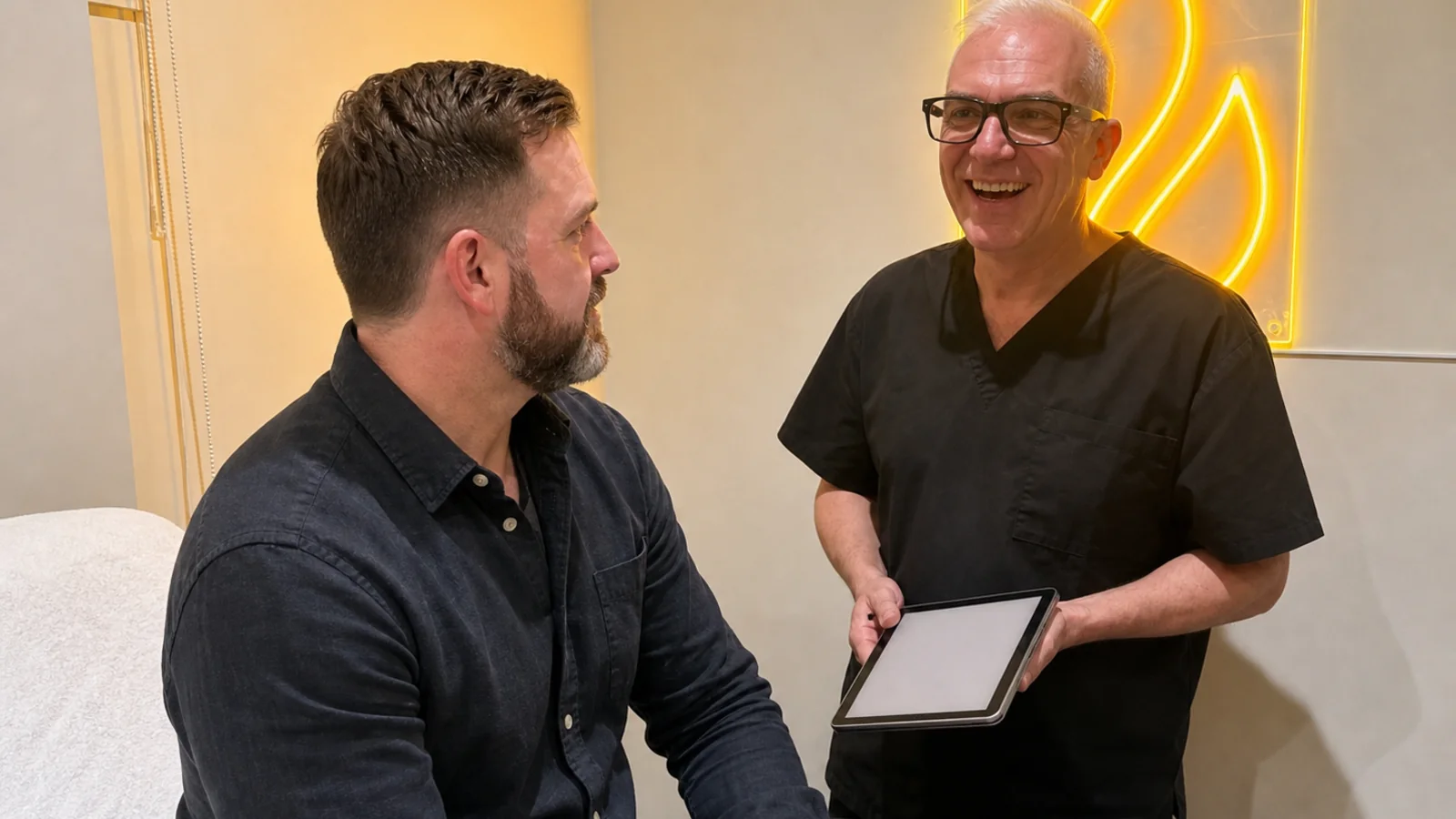
You will meet directly with Corey for a private conversation about what brought you in and what you would like to understand.
Corey reviews your concern, history, preferences and suitability, then explains what options, waiting or another pathway may make sense. You can use the appointment for information and questions only.
Plan the appointment around your day
If your day begins around High Street or Armadale Station, leave enough room for the Oakleigh visit to feel unhurried. Current routes, parking and travel conditions can change, so check an official journey planner before you leave.
Travel effort never commits you to treatment. Your four box note can help you keep the purpose of the visit clear, even when the appointment sits beside work, shopping or another commitment.
A photo can explain the question, not set the target
Show what caught your attention
A screenshot or older photograph can help identify an expression, angle or moment that is difficult to put into words.
Add one sentence of context
Write what the image helps you explain, rather than asking for another person’s appearance to be copied.
Let assessment lead
An image cannot diagnose a cause, confirm suitability or predict how an individual option would look.
Your brief is allowed to change
A useful consultation may make an observation more precise, correct an assumption or reveal that more information is needed. You do not need to defend the first version of your note, and you do not need to make a same day decision.
Pause and seek appropriate medical care for a sudden, painful, one-sided, persistent or otherwise unexplained change. For a routine aesthetic question, Corey can explain whether assessment should continue, wait or move to another health practitioner.
Is this for you?
Consider booking a consultation if
- Adults starting from Armadale who want a calm way to organise a concern before meeting Corey
- People bringing a screenshot, label or idea who want help turning it into a useful assessment question
- Readers who want their preferences, boundaries and unanswered questions heard before deciding what comes next
This may not be for you if
- Urgent, new, painful or worsening symptoms that need appropriate medical care
- A decision being driven by pressure from another person or a fixed deadline
- Requests for a diagnosis, predicted outcome or confirmation of suitability from a webpage
Suitability is confirmed at consultation. This list is general guidance, not a substitute for clinical assessment.
A useful consultation can end in several ways
You understand the concern better
The conversation identifies when it appears, which context matters and what information is still missing.
A suitable pathway can be discussed
If assessment supports it, Corey can explain appropriate choices, material risks, costs and what deciding would involve.
You leave the decision open
Records, another appointment or time to think may make the next conversation more useful.
Different care may fit better
Corey may recommend another health practitioner or explain why cosmetic care is not the right next step.
Sources for consultation and local context
City of Stonnington information supports the named High Street and Armadale Station context only. It does not say anything about an individual reader’s appearance, health, motivation or preferences.
- High Street, Armadale economic profile
Local evidence for the High Street retail, lifestyle, wellness and fashion context, and for street activity measured near Armadale Station. Used only to explain why a polished commercial brief may be familiar language, never to infer an individual reader’s goals.
- Guidelines for registered health practitioners who perform non-surgical cosmetic procedures
Holistic assessment, personal and external motivation, realistic expectations, alternatives, voluntary consent and the option of no procedure.
- Guidelines for advertising higher risk non-surgical cosmetic procedures
Factual advertising, patient interests and care with imagery, body image concerns and unreasonable expectations.
- Shared Code of conduct principles
Patient centred practice, partnership, evidence based care, clinical governance and risk minimisation.
- Advertising health services that involve therapeutic goods
Product neutral public health service advertising and restrictions on direct or indirect prescription medicine promotion.
- Ahpra public register of practitioners
Independent verification of practitioner registration.
Ahpra, NMBA and TGA sources guide assessment, consent, nursing conduct and public advertising. They do not endorse Core Aesthetics or determine an individual plan.
Questions about bringing a brief from Armadale
Can I bring a screenshot or photograph to the consultation?
Yes, if it helps explain what caught your attention. Label what the image demonstrates, such as an expression, angle, lighting condition or general preference. It is a communication aid, not a diagnosis, personal treatment plan, promised target or evidence that the same appearance is achievable or appropriate.
Should I write down the treatment I think I need?
You may record where that idea came from, but begin with the concern and question rather than a self selected product or procedure. Corey still needs to assess relevant history, anatomy, motivation, expectations, alternatives and risk before any individual options can be discussed.
What if I already know exactly what I want?
Certainty is useful information, but it is not a substitute for assessment. Put the request in the assumptions box and write what evidence would change your mind. Corey may agree with the concern, narrow the discussion, suggest another health pathway, recommend more time or conclude that cosmetic care is not appropriate.
What belongs in the boundaries box?
Record what you do not want changed, which questions you need answered, any budget or timing limit, whether you want information only, and what would make you stop. A boundary protects consent only when it remains yours and you feel able to repeat it during the appointment.
Will Corey look beyond the single feature in my brief?
Corey may explain relevant surrounding context where it affects assessment, proportion, movement, skin, function, risk or whether the concern sits within clinic scope. That wider assessment should inform the discussion, not turn one stated concern into permission for unrelated cosmetic suggestions.
Does High Street tell the clinic what Armadale patients want?
No. The City of Stonnington describes High Street as a retail, lifestyle, wellness and fashion destination. That is a fact about a commercial precinct, not a demographic treatment template. It cannot predict an individual person’s anatomy, health, motivation, boundaries, preferences or suitability.
Can treatment happen during the first visit?
It is not automatic. Some adults may be able to discuss same day care if assessment supports it, the option is within scope, material information has been understood, consent is voluntary and proceeding is appropriate. The appointment may instead remain informational, require records, lead to referral or end with no cosmetic care.
What if the brief changes during the conversation?
Change is allowed. A useful consultation can correct an assumption, reveal that a concern appears only in certain conditions, make a boundary firmer or show that more information is needed. You do not need to defend the first version of the brief or replace it with a same day decision.
Does travelling from Armadale make treatment more likely?
No. High Street or Armadale Station can describe where a trip begins, but distance and effort do not establish clinical need, suitability or consent. Allow enough time for information and assessment without treating travel as a reason that something must happen.
How can I verify Corey before sharing my brief?
Corey Anderson is a Registered Nurse with Ahpra registration NMW0001047575. Use the Core Aesthetics verification guide, then search the independent Ahpra public register and match his name, profession and current registration details.
Bring your notes and leave with clarity
Your four box brief is simply a starting point. Corey can help you understand the concern and choose a calm, informed next step.