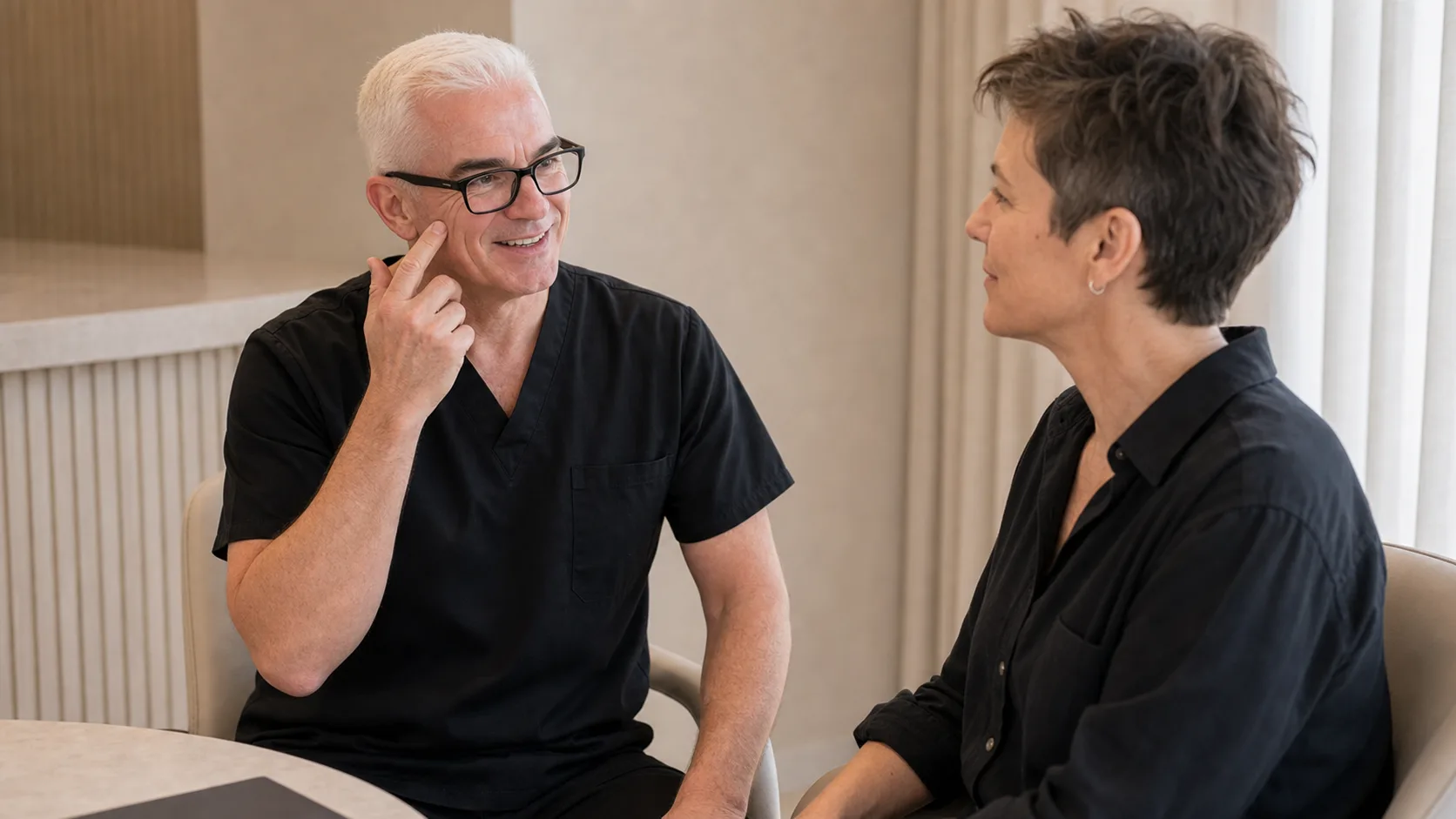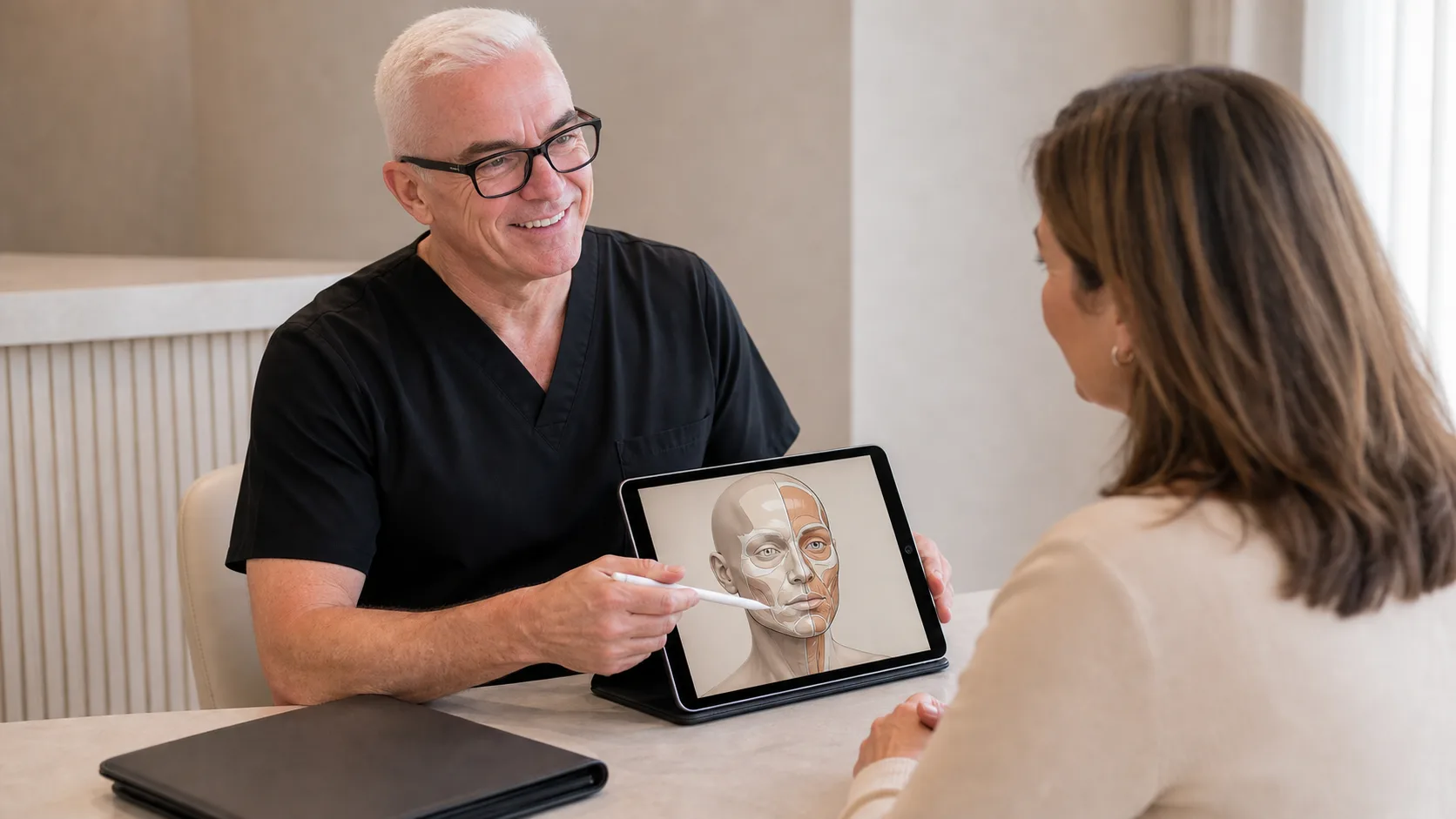
A men’s aesthetic consultation reviews facial structure, goals, medical history, suitability and risk with attention to proportion and restraint. The consultation does not assume a standard plan. Corey Anderson RN assesses whether treatment is appropriate, should wait, or should not proceed.
One of the most useful ways to understand aesthetic treatment is to think about how the goals, the relevant concerns and the appropriate clinical approach change across different decades of adult life. The person considering their first wrinkle treatment at 29 has a different clinical picture and a different set of goals to the person in their 48th year noticing significant mid face volume change. The treatment categories overlap, but what they are being used for and how they are planned differs meaningfully.
This article covers the typical themes of each decade from the clinical perspective of Corey Anderson, AHPRA registered nurse, at Core Aesthetics in Oakleigh. Individual assessments always override general patterns: these are tendencies, not protocols.
“Good information changes the quality of the decision.”
In Your Thirties: Prevention and Early Correction
Clients in their early to mid thirties who are considering aesthetic treatments for the first time are most commonly presenting with one of two situations. Either they have noticed that certain expression lines are beginning to persist at rest rather than disappearing when their face is relaxed, or they are interested in a preventative approach before lines become established at all.
The clinical basis for preventative wrinkle treatment is that reducing the frequency and force of muscular creasing may slow the progression of dynamic lines into static ones. Whether this is meaningful for a particular individual depends on how active their muscles are, how quickly their lines are deepening and how their skin quality is holding up. Not everyone in their thirties needs or benefits from preventative wrinkle treatment. Some do. Your practitioner can assess your individual muscle activity and give you an honest view of whether early treatment would be clinically worthwhile for your situation.
For clients in their thirties, facial volume treatment is less commonly the primary focus, though it is sometimes relevant for clients with naturally limited mid face projection or early structural concerns. Volume changes are generally earlier and less established at this stage. See our overview of preventative aesthetics in Melbourne for more on the principles that guide early treatment planning.
In Your Forties: Addressing Established Lines and Early Volume Change
Clients in their forties commonly present with a more complex clinical picture. Expression lines are more established, often visible at rest as static lines rather than only during expression. Volume changes in the mid face are beginning to produce visible downstream effects: the nasolabial folds are more prominent, the lower face may look heavier relative to the mid face and the under eye area may show increased hollowing.
Wrinkle treatment remains relevant for expression areas, but the response may be somewhat less complete than at an earlier stage for deeply established static lines. A combination of wrinkle treatment for expression areas alongside facial volume treatment for the mid face is often the most clinically coherent approach, addressing both the muscle activity driven and the volume driven aspects of the changes occurring. The whole face assessment principle is especially important at this stage: treating presenting concerns without understanding what is driving them upstream leads to results that look patchy rather than coherent.
See our overview of facial volume loss and our article on facial rejuvenation consultations for more on how the forties picture is typically assessed.
In Your Fifties: A Whole face Approach to Rejuvenation
By the fifties, volume changes are typically more pronounced, the relationship between mid face descent and lower face appearance is more significant and skin quality changes are more present as a factor in treatment planning. Clients at this stage often benefit most from a coordinated whole face treatment plan rather than a single area focus.
Why less is the starting point
The approach at this stage typically involves a full facial assessment covering mid face volume support with cheek and mid face volume treatment, lower face definition with jawline and chin treatment where appropriate, wrinkle treatment for expression areas, and in some cases tear trough assessment. The plan is staged rather than everything at once, and the starting point is always the area where addressing the cause rather than the symptom will produce the most coherent result.
Honest assessment of what is and is not achievable without surgery becomes more important at this stage. Where the degree of volume loss or skin laxity exceeds what injectable treatment can meaningfully address, your practitioner will say so. See our article on nonsurgical versus surgical facial rejuvenation for more on where the practical limits of nonsurgical treatment sit.
What Stays the Same Across All Ages
Regardless of age, the consultation first approach, the individual assessment and the honest recommendation based on your specific anatomy and goals are the constant. Conservative treatment, staged plans and the principle of treating causes rather than symptoms apply equally whether you are 29 or 59. A properly conducted cosmetic consultation at Core Aesthetics produces a recommendation grounded in what your face actually shows and what a proportionate, natural improvement looks like for you specifically. See our cosmetic consultation page for more on how this process works.
Ready to take the first step?
Book your consultation at Core Aesthetics, Oakleigh.
Book online at any time.
Related: Read more about wrinkle treatment at Core Aesthetics and book a consultation at Core Aesthetics, Oakleigh.
General Information Only. This article is general in nature and does not replace a consultation with a qualified health practitioner. Treatment outcomes, suitability and risks vary by individual. Any medical or prescription treatment options can only be discussed and provided where clinically appropriate following an individual assessment.
Safety, Suitability and Clinical Assessment
All aesthetic treatment procedures carry risk. The suitability assessment at consultation identifies any contraindications or relative risk factors specific to your circumstances, including medical history, current medications, previous procedures, and anatomical features that may affect the risk profile for a given treatment area. This information is reviewed before any treatment is planned.
For certain conditions and medications, injectable treatments are not appropriate, or require modification of technique or timing. For others, the treating practitioner may recommend that you consult with your primary healthcare provider before proceeding. These are clinical judgements that can only be made with accurate, complete medical history information, which is why the consultation history taking process is thorough.
Complication recognition and initial management are part of the clinical competency required of practitioners performing injectable treatments under AHPRA’s September 2025 guidelines for nonsurgical cosmetic procedures. The practitioner at Core Aesthetics holds current training in this area and maintains the relevant management supplies on site. Understanding that risk exists and is actively managed is more useful than assuming risk does not exist.
Review Appointments and Ongoing Care
A review appointment at four to six weeks is a standard part of every treatment cycle at Core Aesthetics. The review is not contingent on whether you have concerns, it is a clinical standard that applies to every patient. At review, the practitioner assesses the result across all treated areas, compares the outcome to the pretreatment clinical photographs, identifies any asymmetry or variation in response between sides, and determines whether any adjustment is appropriate within the same treatment cycle.
The review is also where longitudinal data about how your specific anatomy responds to treatment is recorded. Over multiple treatment cycles, this accumulated data allows the practitioner to refine the dosing and approach to better match your individual response pattern, which is one of the most significant advantages of maintaining a consistent treating practitioner rather than moving between clinics.
If you have any concerns in the period between your treatment and your review appointment, contact the clinic directly. The practitioner who treated you has the clinical context to respond accurately to any post treatment question, which is preferable to relying on general online information that may not reflect your specific situation.
What the Assessment Covers
The assessment at the consultation appointment is a face wide evaluation, not a focused review of only the area you have identified as a concern. This full face approach is deliberate: anatomical features interact with each other, and addressing one area in isolation, without understanding the broader facial context, can produce results that look disproportionate even when the individual area was technically treated well.
The practitioner evaluates facial symmetry, bone structure, soft tissue distribution, skin quality, and the dynamic movement patterns associated with each treatment area. The history taking covers your current medications, any previous injectable or surgical procedures, relevant health conditions, and any prior reactions or complications. From this assessment, the practitioner develops a treatment plan that reflects your specific anatomy and circumstances.
Results vary between individuals. What the assessment finds in one patient may be different from what it finds in another patient with a similar presenting concern, which is why templated treatment protocols are not used here. All treatments at Core Aesthetics are consultation based and individually assessed.
About This Information
The information on this page is provided for general educational purposes. It is not a substitute for clinical advice and does not constitute a recommendation that you proceed with any particular treatment. Aesthetic treatments are prescription medical procedures. They carry risks that vary between individuals and that must be assessed and discussed in a clinical context before any treatment decision is made.
At Core Aesthetics, Corey Anderson assesses every patient individually. The consultation is the point at which your specific anatomy, medical history, and goals are evaluated together. No treatment is offered at a first appointment, and no treatment is appropriate for everyone. This page is a starting point, a way to understand what is involved before you decide whether a consultation is the right next step for you.
If you have questions about anything on this page or about whether treatment might be appropriate for your situation, you are welcome to call the clinic or book a consultation at no obligation.
This page provides clinical information about Aesthetic treatments at 30, 40 and 50: How Goals and Approaches Change. It is intended for adults aged 18 and over who are considering aesthetic treatment and want to understand the clinical process, suitability factors, and what to expect from a consultation based practice. All treatment decisions at Core Aesthetics follow individual assessment, no treatment is offered at a first appointment without a separate consultation. Results vary between individuals and are reviewed at follow up.
Why The Decade Bands Are A Useful Heuristic And A Misleading Rule
The convention of grouping aesthetic treatment considerations by decade (thirties, forties, fifties) is a useful heuristic for organising a discussion that would otherwise be unmanageably individual. It is also a misleading rule when applied without the qualification that individual variation within each decade is at least as consequential as the differences between decades. A patient at thirty eight with strong dynamic line activity, significant photoageing, and early mid face descent has different clinical needs from another patient at thirty eight with mild dynamic activity, minimal photoageing, and intact mid face structure. The decade heuristic captures average tendencies; it does not predict any individual.
The clinical rhythm that does roughly track decade boundaries reflects the cumulative trajectory of the underlying anatomical changes. The thirties tend to be characterised by emerging dynamic line activity, possible early static line formation in patients with strong muscle activity, and the first visible photoageing changes in patients with significant cumulative UV exposure. The forties tend to bring more established static line formation, the visible early stages of mid face fat compartment descent, and increasing skin quality variation. The fifties typically bring more advanced soft tissue descent, more pronounced volume loss, and the threshold beyond which surgical evaluation becomes a meaningful conversation for some patients. None of these trajectories is fixed, and many patients move through these decades without ever needing the more advanced interventions that the decade descriptions imply.
The structural consequence for treatment planning is that the decade conversation is the starting point of the consultation rather than its conclusion. The practitioner’s job is to translate the patient’s actual presentation into the clinical recommendation that fits that individual rather than the recommendation that fits the average patient at that age. The honest recommendation is sometimes less treatment than the patient expected; sometimes more; sometimes a category the patient had not considered. The decade heuristic is useful as a frame for the conversation, not as a determinant of the recommendation.
Treatment is performed by Corey Anderson, Registered Nurse, AHPRA NMW0001047575. The one practitioner model supports continuity of clinical relationship across the decades over which a patient may receive treatment, with the documented record of earlier cycles informing the assessment at later ones.
How A Continuous Treatment Relationship Looks Across A Decade Or More
Patients who establish a aesthetic treatment relationship in their thirties and maintain it through their forties and into their fifties accumulate a documented record that informs every subsequent decision. The clinical decisions made in year ten of the relationship are different from those made in year one, because the practitioner has the documented response to multiple cycles, the patient’s evolving preferences about visible change, and the longitudinal observation of how the patient’s facial structure has actually progressed compared with what was projected at earlier cycles.
The practical implication is that the conversation at any single appointment is informed by everything that came before. A patient considering whether to add a treatment to a region they have not previously addressed receives a recommendation that accounts for how their other treated regions have responded over time, how their skin and underlying tissue have evolved, and what the realistic interaction is between the proposed new treatment and the established plan. The decision is more accurate than it could be in a clinic where the assessment is reset at every appointment because of practitioner rotation or insufficient documentation.
The one practitioner model at Core Aesthetics is how this continuity is supported in practice. The same practitioner conducts the assessment, performs the treatment, reviews the response, and plans the next cycle across the years of the patient’s treatment relationship. Patients who value this continuity find it difficult to obtain in clinics that operate on different models, and the trade off in scheduling flexibility is one most patients judge worthwhile in the longer term.
A Note On When To Begin And When To Defer
The decision about when to begin a continuous treatment relationship is individual and depends on the patient\u2019s presentation, goals, and preferences about visible change. Some patients begin in their thirties and find the early establishment supports their long term plan. Some patients defer until their forties or fifties and find that beginning later still produces good outcomes. Neither pattern is universally better. The honest conversation at consultation identifies which approach fits the individual rather than recommending early initiation by default.
A Note On Stopping Treatment Versus Continuing
Patients sometimes ask about the implications of stopping aesthetic treatment after several years on a continuous plan. The honest answer is that the visible effects of any prior treatment fade as the products are metabolised, and the face returns to a trajectory shaped by the underlying ageing changes that have continued throughout the treatment period. There is no clinical reason to continue treatment beyond the point at which the patient finds it valuable, and stopping does not produce a worse outcome than not having begun. The conversation about whether to continue is held at each cycle and is appropriately weighted towards the patient\u2019s actual preferences rather than towards inertia.
A Final Note On The Conversation Between The Decades
The patient\u2019s relationship with aesthetic treatment evolves alongside their relationship with their own face. The thirty year old, the forty year old, and the fifty year old version of the same person may approach the consultation with different priorities, different aesthetic preferences, and different tolerances for visible change. The continuous treatment relationship at a one practitioner clinic supports this evolution rather than freezing the patient\u2019s plan in any single decade\u2019s framework, and the conversation at each cycle accommodates the patient as they actually are rather than as they were at the start of the relationship.
Is this for you?
Consider booking a consultation if
- You want to understand men’s aesthetic consultation before deciding whether treatment is appropriate
- You are 18 or older and want an individual clinical assessment
- You value a consultation-first approach with risk and suitability discussed before planning
- You are open to waiting or not proceeding if that is the safer recommendation
This may not be for you if
- You are seeking a not guaranteed outcome or a same-day decision without assessment
- You are under 18 years of age
- You are pregnant, trying to conceive or breastfeeding and are seeking elective aesthetic treatment
- You have an active infection, unhealed skin or an unresolved medical concern in the area to be assessed
Suitability is confirmed at consultation. This list is general guidance, not a substitute for clinical assessment.
Frequently asked questions
What is discussed during a men’s aesthetic consultation consultation?
The consultation reviews the concern, medical history, previous treatment history, goals, timing, risk factors and whether treatment is appropriate. Corey Anderson RN also considers facial balance and whether the concern may need a different pathway. The appointment is designed to support a careful decision, not to make you choose from a preset menu.
Can a men’s aesthetic consultation consultation end with no treatment?
Yes. A consultation can end with education, monitoring, a delayed plan, referral, or a recommendation not to proceed. This may happen when the risk outweighs the likely benefit, timing is poor, expectations are not clinically realistic, or the concern is not suited to the available options.
How is suitability assessed for men’s aesthetic consultation?
Suitability is assessed through the concern itself, medical history, medications, prior treatment, anatomy, timing, expectations and risk tolerance. The assessment also considers whether the requested change would support or reduce facial balance. Suitability is individual, so general information cannot replace a consultation.
What risks are discussed before deciding about men’s aesthetic consultation?
Risk discussion depends on the concern and the area assessed. It may include bruising, swelling, asymmetry, delayed healing, dissatisfaction, medical suitability, rare complications and whether another form of care is more appropriate. The aim is to make sure the decision is informed before any plan is made.
Should I wait if I am unsure about men’s aesthetic consultation?
Waiting can be appropriate when you feel uncertain, pressured, medically unwell, close to an important event, or unclear about what you want changed. A cautious consultation should make waiting a valid option. You do not need to proceed simply because you attended an appointment.
How does Core Aesthetics approach men’s aesthetic consultation?
Core Aesthetics uses a consultation-first model. Corey Anderson RN assesses each person individually, discusses suitability and risk, and explains when a cautious or staged approach may be more appropriate. The clinic is based in Oakleigh and sees patients from Melbourne and surrounding suburbs by appointment.
What should I bring to a men’s aesthetic consultation consultation?
Bring a list of medications, relevant medical history, previous treatment details if applicable, allergies, upcoming events and the questions you want answered. Clear information helps the practitioner assess suitability and timing. Photographs from earlier years can also help explain what has changed over time.
Why do recommendations for men’s aesthetic consultation vary between people?
Recommendations vary because anatomy, skin quality, facial movement, ageing pattern, medical history, previous treatment and expectations all differ. Two people with a similar concern may need different advice, and one may not be suitable for treatment at all. This is why assessment comes before planning.