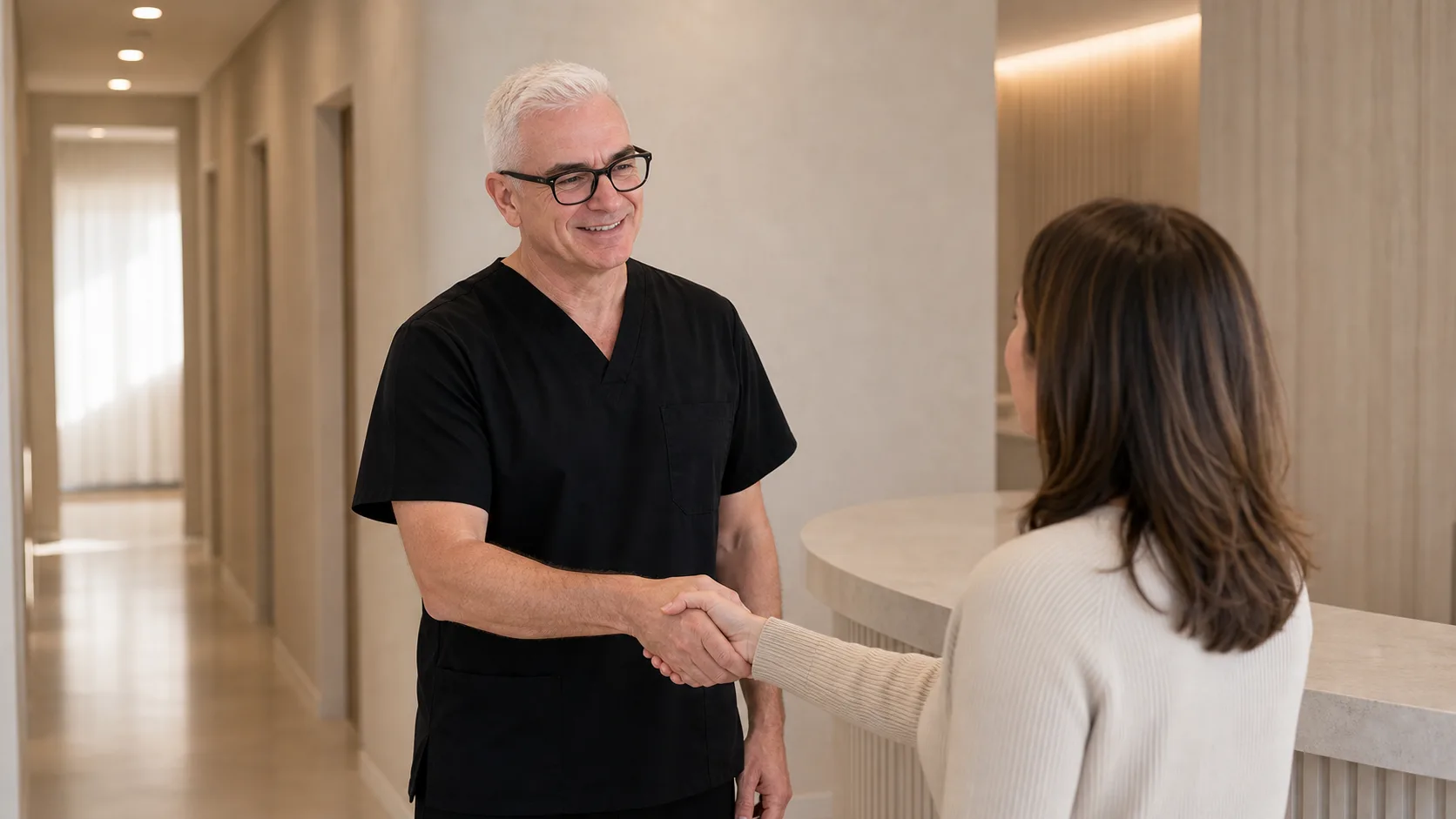
Questions before An Aesthetic Consultation helps patients check who is responsible for assessment, consent, risk discussion and follow-up. At Core Aesthetics, Corey Anderson RN conducts consultation personally and patients can verify registration details before deciding. The goal is informed decision-making, not pressure to proceed.
Before committing to any aesthetic treatment, the questions you ask at your consultation reveal as much about the clinic as the answers do. A practitioner who answers clearly, specifically and honestly is giving you an important signal about the kind of care you will receive. A practitioner who is vague, dismissive or evasive is giving you a different kind of signal.
This article lists the questions worth asking, and explains what good answers look like, from the clinical perspective of Corey Anderson at Core Aesthetics in Oakleigh.
“Good information changes the quality of the decision.”
Questions About Practitioner Credentials
Are you AHPRA registered and what is your registration number?
This is the foundational question. Aesthetic treatment products are prescription medicines in Australia and should only be prescribed and administered by practitioners with appropriate AHPRA registration. A straightforward, specific answer is the only acceptable response. If a practitioner cannot or will not provide their AHPRA registration number, you can search the public register yourself at ahpra.gov.au. Corey Anderson’s registration is publicly verifiable, registered since January 1996.
How long have you been registered and what specific training do you have in this procedure?
Registration date and overall nursing experience matter. Under the September 2025 AHPRA guidelines, registered nurses must now have at least 12 months of full time clinical experience before expanding into cosmetic procedures. The specific training relevant to the procedure you are considering is also a fair question. A practitioner with substantive clinical experience and documented ongoing education in aesthetic medicine is in a different position to one who has recently added aesthetic treatments to their practice. For context on what the new training requirements mean, see our overview of the new AHPRA guidelines for 2025.
Questions About the Consultation
Will you conduct a full individual assessment before making any recommendation?
The answer should be an unambiguous yes. A proper consultation involves assessing your facial anatomy, your skin quality, your medical history and your goals before any treatment is discussed. A consultation that begins with a predetermined treatment plan or skips the clinical assessment is not a consultation in any meaningful clinical sense. It is a booking process disguised as a consultation. Our article on what happens at an injectables consultation describes what a genuine assessment looks like.
Will you tell me honestly if treatment is not appropriate for me?
This is a revealing question. A practitioner whose livelihood depends on performing treatment has a financial incentive to recommend it. Ask explicitly whether they will tell you if treatment is not right for your situation. Their answer, and the confidence with which they give it, tells you something important about their clinical values. At Core Aesthetics, a consultation outcome of “not appropriate right now” or “a different approach would work better” is as valid as one that results in a treatment booking.
Questions About Realistic Outcomes
What realistic improvement can I expect for my individual face?
Ask about your face, not about the treatment in general. A practitioner who has genuinely assessed your anatomy may offer a specific, proportionate answer about what is achievable for your individual situation. A practitioner who gives you a generic answer about what the treatment can do is not yet assessing you as an individual. The distinction matters enormously for your expectations and your satisfaction with the outcome.
Are there any reasons treatment might not be appropriate for me?
This question invites the practitioner to think about your individual contraindications, medical history and suitability factors out loud. A practitioner who engages with this question is conducting a proper individual assessment. One who brushes past it is not.
Questions About Safety and Aftercare
What happens if I have a concern after my treatment?
Before any procedure, you should have a clear answer to this question. How do you contact the clinic? What is the process if swelling is more than expected? What happens in the event of a more serious complication? A responsible practice has clear, direct answers. Our articles on wrinkle aftercare and facial volume treatment aftercare give you a sense of what responsible post treatment guidance looks like.
What are the risks of this specific treatment?
All injectable treatments carry risks. A practitioner who explains the risks specific to the procedure being discussed, in plain language and proportionate to the actual risk profile, is giving you genuine informed consent material. A practitioner who minimises or glosses over risks is not. Our patient safety page covers how Core Aesthetics approaches informed consent.
A Final Question Worth Asking Yourself
After the consultation, ask yourself whether the practitioner listened to your concerns, whether their recommendation was clearly based on what they observed in your face rather than a standard protocol, and whether you felt any pressure to proceed. The answer to that last question in particular is informative. For more guidance, see our article on red flags when choosing a cosmetic injector in Melbourne and our guide to choosing a cosmetic clinic in Melbourne.
Ready to take the first step?
Book your consultation at Core Aesthetics, Oakleigh.
Book online at any time.
Related: Read more about what to expect at a consultation and book a consultation at Core Aesthetics, Oakleigh.
General Information Only. This article is general in nature and does not replace a consultation with a qualified health practitioner. Treatment outcomes, suitability and risks vary by individual. Any medical or prescription treatment options can only be discussed and provided where clinically appropriate following an individual assessment.
Safety, Suitability and Clinical Assessment
All aesthetic treatment procedures carry risk. The suitability assessment at consultation identifies any contraindications or relative risk factors specific to your circumstances, including medical history, current medications, previous procedures, and anatomical features that may affect the risk profile for a given treatment area. This information is reviewed before any treatment is planned.
For certain conditions and medications, injectable treatments are not appropriate, or require modification of technique or timing. For others, the treating practitioner may recommend that you consult with your primary healthcare provider before proceeding. These are clinical judgements that can only be made with accurate, complete medical history information, which is why the consultation history taking process is thorough.
Complication recognition and initial management are part of the clinical competency required of practitioners performing injectable treatments under AHPRA’s September 2025 guidelines for nonsurgical cosmetic procedures. The practitioner at Core Aesthetics holds current training in this area and maintains the relevant management supplies on site. Understanding that risk exists and is actively managed is more useful than assuming risk does not exist.
Review Appointments and Ongoing Care
A review appointment at four to six weeks is a standard part of every treatment cycle at Core Aesthetics. The review is not contingent on whether you have concerns, it is a clinical standard that applies to every patient. At review, the practitioner assesses the result across all treated areas, compares the outcome to the pretreatment clinical photographs, identifies any asymmetry or variation in response between sides, and determines whether any adjustment is appropriate within the same treatment cycle.
The review is also where longitudinal data about how your specific anatomy responds to treatment is recorded. Over multiple treatment cycles, this accumulated data allows the practitioner to refine the dosing and approach to better match your individual response pattern, which is one of the most significant advantages of maintaining a consistent treating practitioner rather than moving between clinics.
If you have any concerns in the period between your treatment and your review appointment, contact the clinic directly. The practitioner who treated you has the clinical context to respond accurately to any post treatment question, which is preferable to relying on general online information that may not reflect your specific situation.
About This Information
The information on this page is provided for general educational purposes. It is not a substitute for clinical advice and does not constitute a recommendation that you proceed with any particular treatment. Aesthetic treatments are prescription medical procedures. They carry risks that vary between individuals and that must be assessed and discussed in a clinical context before any treatment decision is made.
At Core Aesthetics, Corey Anderson assesses every patient individually. The consultation is the point at which your specific anatomy, medical history, and goals are evaluated together. No treatment is offered at a first appointment, and no treatment is appropriate for everyone. This page is a starting point, a way to understand what is involved before you decide whether a consultation is the right next step for you.
If you have questions about anything on this page or about whether treatment might be appropriate for your situation, you are welcome to call the clinic or book a consultation at no obligation.
This page provides clinical information about Questions to Ask Your Cosmetic Injector Before Any Treatment. It is intended for adults aged 18 and over who are considering aesthetic treatment and want to understand the clinical process, suitability factors, and what to expect from a consultation based practice. All treatment decisions at Core Aesthetics follow individual assessment, no treatment is offered at a first appointment without a separate consultation. Results vary between individuals and are reviewed at follow up.
Why The Most Useful Questions Are The Ones That Reveal How The Practice Works
Patients preparing for a first aesthetic treatment consultation often arrive with a list of questions about specific products, expected outcomes, or pricing. These are reasonable questions and deserve straightforward answers. They are not the questions that most reliably reveal the quality of the practice. The more diagnostic questions are the ones that ask about how the practice operates structurally, because the structural conditions of a clinic shape the care provided in ways that individual product or pricing answers cannot.
Useful questions to add to the standard list. What is your prescribing pathway, and where can I verify your AHPRA registration. What is your consultation policy for new patients, and how do you observe the AHPRA September 2025 cooling off interval requirement. How is the recommendation made when the assessment indicates that a different treatment, a deferral, or no treatment would be more appropriate than what I have requested. What documentation is kept of my treatment, and can I request copies of my records. What happens if I am unhappy with the result, and how is the conversation about correction or dissolution structured. How do I reach you if I experience a concerning symptom in the days after treatment, and what after hours pathway is in place.
The answers to these questions reveal the operational model. A practitioner who answers them confidently, openly, and in detail is signalling something about the depth and consistency of the practice. A practitioner whose responses are evasive, generic, or visibly uncomfortable is signalling something different. The patient does not need to be a clinical expert to interpret these signals; the question is whether the response feels grounded and specific or rehearsed and defensive.
The clinic at Core Aesthetics operates under Corey Anderson, Registered Nurse, AHPRA NMW0001047575. The AHPRA registration can be verified on the public register at ahpra.gov.au, and patients are encouraged to use the same verification mechanism for any practitioner they are considering. The questions in this guide are appropriate to ask of any aesthetic treatment practitioner, including this one.
How To Use The Practitioner’s Answers To Inform Your Decision
The questions are useful only if the patient knows how to interpret the answers they receive. The interpretation framework matters because some answers that sound reassuring on first reading turn out, on reflection, to be evasive or rehearsed; conversely, some answers that initially sound less polished turn out to be the more grounded responses. The framework for interpretation is straightforward: a good answer is specific to the question asked, reflects the practitioner’s actual practice rather than generic talking points, and addresses the practical implications for the patient’s treatment.
What confident, specific answers look like. A practitioner who answers the prescribing pathway question by describing exactly which framework they operate under, citing the relevant AHPRA endorsement or the doctor prescriber relationship, is providing a specific answer. A practitioner who answers the same question with a generic statement about being properly registered is not. A practitioner who answers the recommendation against treatment question by describing how the conversation typically unfolds, what the patient’s options are at that point, and how the relationship continues regardless of whether treatment proceeds is providing a specific answer. A practitioner who answers the same question with reassurance that they would never push treatment is providing a less informative answer.
The patient does not need clinical expertise to perform this interpretation. The texture of the response is reliable information about how the practice actually operates, and the patient’s intuitive sense is usually accurate. Where the answers are uniformly grounded and specific, the consultation is signalling something useful about the practice. Where they are uniformly evasive or rehearsed, that is signalling something different, and the patient is well served by attending an exploratory consultation at another clinic for comparison.
A Brief Note On Bringing The List To The Appointment
The questions are most useful when they are asked in the consultation itself rather than reviewed silently while the practitioner speaks. A printed or written list, brought into the appointment and referenced as the conversation moves through the relevant topics, supports more reliable coverage and reduces the chance of leaving the appointment with questions still unasked. The practitioner should welcome the list and treat it as a sign of an engaged patient rather than as friction.
Why Some Questions Matter More Than Others Depending On Your Stage
Patients new to aesthetic treatment benefit from emphasising the foundational questions about credentialing, prescribing pathway, and the consultation model. Patients with prior treatment experience and an established preference about treatment philosophy benefit from emphasising the questions about treatment approach, conservative dosing principles, and the practitioner\u2019s response when the assessment indicates a recommendation against treatment. Patients considering a major change in their established care relationship, such as a transition to a new practitioner after a move, benefit from emphasising the questions about how prior treatment records will be integrated and how the new clinical relationship will be structured. The list is not a checklist to be applied uniformly; it is a set of tools to be deployed selectively according to the patient\u2019s situation.
A Closing Note On The Conversation
The questions are tools rather than tests. The practitioner who answers them comfortably and specifically is signalling something useful about how the practice operates, and the patient who asks them deliberately is signalling something useful about how the relationship will unfold. The conversation that results is the foundation for whatever clinical work follows. Patients who treat the consultation as a structured conversation rather than as preliminary friction tend to leave with better information and better informed decisions, regardless of whether they ultimately proceed with treatment at this clinic or elsewhere. The verification of the practitioner\u2019s AHPRA registration on the public register at ahpra.gov.au remains the appropriate baseline check for any practitioner under consideration.
Is this for you?
Consider booking a consultation if
- You want to understand questions before an aesthetic consultation before deciding whether treatment is appropriate
- You are 18 or older and want an individual clinical assessment
- You value a consultation-first approach with risk and suitability discussed before planning
- You are open to waiting or not proceeding if that is the safer recommendation
This may not be for you if
- You are seeking a not guaranteed outcome or a same-day decision without assessment
- You are under 18 years of age
- You are pregnant, trying to conceive or breastfeeding and are seeking elective aesthetic treatment
- You have an active infection, unhealed skin or an unresolved medical concern in the area to be assessed
Suitability is confirmed at consultation. This list is general guidance, not a substitute for clinical assessment.
Frequently asked questions
What is discussed during a questions before an aesthetic consultation consultation?
The consultation reviews the concern, medical history, previous treatment history, goals, timing, risk factors and whether treatment is appropriate. Corey Anderson RN also considers facial balance and whether the concern may need a different pathway. The appointment is designed to support a careful decision, not to make you choose from a preset menu.
Can a questions before an aesthetic consultation consultation end with no treatment?
Yes. A consultation can end with education, monitoring, a delayed plan, referral, or a recommendation not to proceed. This may happen when the risk outweighs the likely benefit, timing is poor, expectations are not clinically realistic, or the concern is not suited to the available options.
How is suitability assessed for questions before an aesthetic consultation?
Suitability is assessed through the concern itself, medical history, medications, prior treatment, anatomy, timing, expectations and risk tolerance. The assessment also considers whether the requested change would support or reduce facial balance. Suitability is individual, so general information cannot replace a consultation.
What risks are discussed before deciding about questions before an aesthetic consultation?
Risk discussion depends on the concern and the area assessed. It may include bruising, swelling, asymmetry, delayed healing, dissatisfaction, medical suitability, rare complications and whether another form of care is more appropriate. The aim is to make sure the decision is informed before any plan is made.
Should I wait if I am unsure about questions before an aesthetic consultation?
Waiting can be appropriate when you feel uncertain, pressured, medically unwell, close to an important event, or unclear about what you want changed. A cautious consultation should make waiting a valid option. You do not need to proceed simply because you attended an appointment.
How does Core Aesthetics approach questions before an aesthetic consultation?
Core Aesthetics uses a consultation-first model. Corey Anderson RN assesses each person individually, discusses suitability and risk, and explains when a cautious or staged approach may be more appropriate. The clinic is based in Oakleigh and sees patients from Melbourne and surrounding suburbs by appointment.
How can I check a practitioner before booking?
Use the AHPRA public register to check registration details, and ask what role the practitioner has in assessment, consent, treatment planning and follow-up. Registration is important, but patients should also ask about scope, emergency processes, documentation and whether the same practitioner will review them if concerns arise.
What if I cannot verify practitioner information?
If you cannot verify registration, role or clinic details, pause before booking. You can ask the clinic for the practitioner name, registration number and role in your care. A cautious clinic should make this information easy to check and should not pressure you to decide quickly.
What should I bring to a questions before an aesthetic consultation consultation?
Bring a list of medications, relevant medical history, previous treatment details if applicable, allergies, upcoming events and the questions you want answered. Clear information helps the practitioner assess suitability and timing. Photographs from earlier years can also help explain what has changed over time.
Why do recommendations for questions before an aesthetic consultation vary between people?
Recommendations vary because anatomy, skin quality, facial movement, ageing pattern, medical history, previous treatment and expectations all differ. Two people with a similar concern may need different advice, and one may not be suitable for treatment at all. This is why assessment comes before planning.