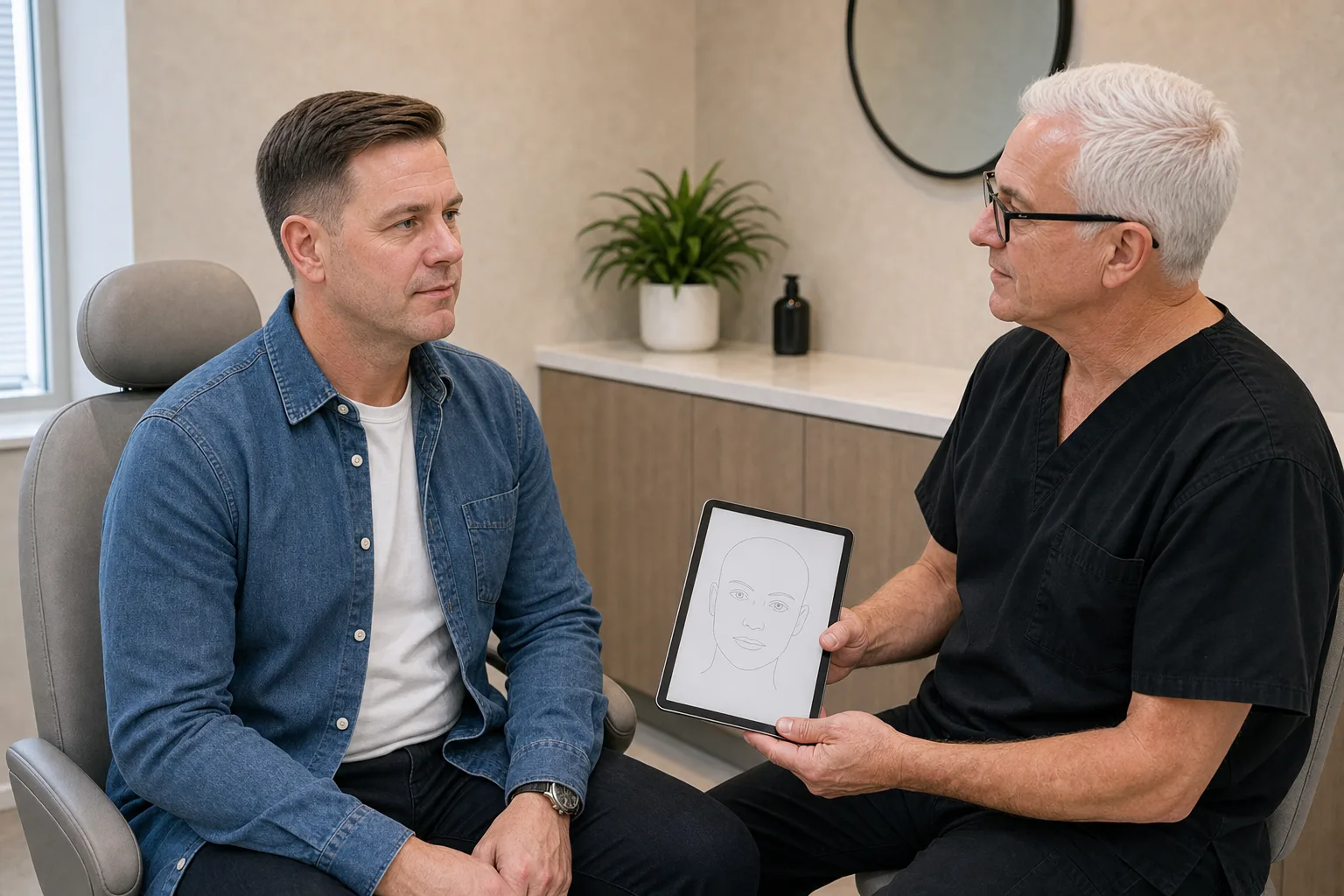
A men’s aesthetic consultation reviews facial structure, goals, medical history, suitability and risk with attention to proportion and restraint. The consultation does not assume a standard plan. Corey Anderson RN assesses whether treatment is appropriate, should wait, or should not proceed.
The proportion of men in aesthetic treatment practice in Australia has been rising steadily for at least a decade and continues to rise. The motivations are usually pragmatic. A specific line that has begun to register in professional contexts. A jaw muscle that has hypertrophied from years of clenching. A jaw clench that wakes the patient at three in the morning. The accumulated tiredness of an upper face that no longer rests easily. The conversation that begins these consultations is usually short on flourish and long on detail.
What men typically want, in our consultation experience
The most common explicit goal is no visible change to anyone else. The patient wants to look like himself, with a softer line or a calmer expression, and would consider any result that drew attention to itself as a failure of the treatment. This is a fundamentally different starting point from much of the female cosmetic conversation, where a degree of visible improvement is sometimes part of what is being asked for.
The dosing approach that flows from this preference is consistently conservative. Smaller starting doses, with structured two week reviews, with the option to add at follow up rather than start at the maximum that would be considered correct for the region. The C.O.R.E. Method approach matches this preference well, which is part of why male patients tend to settle into the practice and continue across years.
Anatomical differences that matter clinically
Male facial anatomy differs from female in ways that affect dosing. The frontalis (forehead muscle) is generally larger and more active. The brow position sits lower and is less arched. The jaw muscle is typically more substantial. Skin is thicker. Bone structure is heavier through the lateral orbital rim, the zygoma and the mandible. These are statistical generalisations rather than absolute rules and individual variation is substantial, but they shape the typical clinical picture.
The practical implication is that male doses for the same indication tend to be higher than female doses, while the conservative principle of starting at the lower end of the male range is the same. Standard female dosing in the male glabella often produces inadequate response. Standard male dosing in the female glabella sometimes produces over correction. The dose is individualised to the anatomy, not to the patient gender, but the anatomical differences are real.
Common indications in the male consultation
The most frequently treated regions in male patients at this clinic are the glabellar complex (the muscles between the brows that produce the vertical frown lines), the lateral orbital region (crows feet), the jaw muscle for bruxism or jaw squareness, and primary focal axillary hyperhidrosis. Forehead treatment is offered but is sometimes deferred or staged because the brow lowering effect of frontalis dosing in male anatomy can be more pronounced than in female anatomy and can produce a heavier looking brow if not carefully calibrated.
Volume treatment is sometimes part of the conversation, most commonly for jawline definition where the jaw muscle has been treated and the resulting softer outline benefits from carefully placed support, or for chin support where prejowl change has begun to soften the lower face profile. Lip treatment in male patients is occasional, and where it is requested the conservative principles are particularly important because over correction in this region reads as obvious in male anatomy.
Why this is a different consultation
The male consultation tends to be more directly transactional in tone. Patients arrive with the question they want to ask and the goal they want to discuss. They are usually less interested in the broader narrative of cosmetic medicine and more interested in the specific clinical answer to their specific question. This is not a value judgment; it is an observation about how the consultation runs differently.
The same standards of consultation depth apply. Suitability assessment includes motivations and expectations. Anatomical assessment is performed in repose and animation. Standardised photography is recorded for the medical record. Conservative dosing principles apply. The September 2025 AHPRA framework requirements (in person or video prescribing consultation each cycle, mandatory CPD, suitability assessment) apply equally. The depth is the same; the conversational shape is sometimes different.
The jaw muscle conversation in male patients
Male patients are over represented in jaw muscle treatment, both for cosmetic squareness and for bruxism. The combination of a stronger jaw muscle from the outset, a higher prevalence of nocturnal grinding, and the gradual recognition that morning jaw pain is not normal brings substantial numbers of men into jaw muscle slimming consultation. The dosing range is typically towards the higher end of the published range for visible bulk reduction (35 to 50 units per side), with the conservative principle still applying within that range.
For male patients whose primary indication is bruxism, the maintenance rhythm is often longer than for cosmetic indications because the symptomatic relief outlasts the visible muscle relaxation. Patients who started for the jaw pain often continue for the cosmetic benefit; patients who started for the cosmetic outcome often continue for the symptomatic benefit they discover incidentally.
What we do not do, and why
Several things we deliberately avoid in male consultations. We do not pressure patients towards treatment in the same session as consultation. We do not expand the discussion from the specific question the patient brought to a broader catalogue of possible interventions. We do not offer combination packages or bundle pricing. We do not use marketing language that frames treatment as urgent or as a solution to a generalised problem. The male patient who feels he was managed rather than helped tends not to return, and the consultation based model depends on patients returning.
Why we do not name the prescription product
Australian regulation prohibits the advertising of Schedule 4 prescription medicines to the public. That includes brand names, abbreviations and hashtags. The TGA has been increasingly active in enforcing this provision in the aesthetic treatments sector. We can talk in clinical detail about the mechanism, dose ranges, response profile and safety considerations. We do not name brands or otherwise identify products to the public.
AHPRA September 2025 considerations
The AHPRA guidelines for nonsurgical cosmetic procedures that came into force in September 2025 require an in person or video consultation with the prescribing practitioner each time a aesthetic treatment is prescribed. They apply equally to male and female patients. Suitability assessment must explicitly address motivations, which for male patients sometimes includes brief exploration of what is driving the booking (workplace expectations, partner suggestion, personal change). The same exploration is part of every consultation regardless of gender.
What patients in this clinic typically describe
Male patients who have settled into a stable treatment relationship with the clinic typically describe the experience as low key, professional and unobtrusive. Treatment cycles are scheduled around their work and life. The consultations are short when the patient knows what they want and longer when there is something to think through. There is no pressure to expand into other regions or to upgrade dose unless the patient initiates the conversation. The relationship works because it does not look or feel like a sales relationship.
Patients sometimes refer male friends or partners on the basis of the model rather than the result, which is one of the more telling indicators of how the practice fits the male patient population.
Working with Corey
Corey Anderson is the only practitioner at Core Aesthetics. Registered with the Nursing and Midwifery Board of Australia since January 1996 (AHPRA NMW0001047575), Corey runs a one practitioner, low volume clinic in Oakleigh. For male patients in particular, the continuity and unhurried structure of the practice are part of what makes it a sustainable fit across years.
Patients see Corey at every visit. Treatment notes carry the dose, placement and response duration forward across the years.
Cost framing
Pricing is straightforward. Each treatment is priced on the actual product and time involved, quoted in writing as part of the consultation. There is no surge pricing, no time limited promotional pricing and no loyalty pricing. The written treatment plan includes the realistic anticipated frequency of maintenance and the cumulative cost across the first twelve months.
Booking a consultation
Consultations are booked directly online or by contacting the clinic. The first appointment is a clinical assessment, with no obligation to proceed in the same session. Patients receive written confirmation, an intake form to complete in advance, and any specific guidance relevant to the indication. Results vary between individuals.
Core Aesthetics operates from 12A Atherton Road, Oakleigh, in Melbourne south east, with off street parking and walking distance from Oakleigh railway station.
What we do not claim
Three claims sometimes made about male aesthetic treatments do not survive clinical scrutiny and we do not make them. The first is that treatment will produce a more masculine appearance. It will not change the structural features that determine that. The second is that male patients require a specific male only dosing protocol distinct from individualised dose calibration. They do not; the dose is individualised to the anatomy in front of the practitioner. The third is that male treatment is a quick add on to a standard consultation. The same depth of assessment, planning and review applies regardless of gender.
On expression preservation in men
One of the recurring themes in male cosmetic consultations is the patient explicit preference for preserving expression in motion, even at the cost of leaving some lines visible at rest. This is sometimes more important to male patients than to female patients, partly because the visible immobility of an over treated forehead reads more conspicuously in male anatomy where the brow position is naturally lower and the resting expression is more communicative through small muscular movement. Conservative dosing in this context is not just a default principle; it is a calibrated response to a specific aesthetic preference. The patient who wants to look like himself in motion needs the dose that preserves expression more than the dose that produces the most line softening at rest.
This is the kind of nuance that emerges in repeated consultation across years. The first treatment establishes the response. The two week review establishes whether the dose was right. Subsequent cycles refine. By the third or fourth visit, the dose calibration is settled and the patient is choosing the rhythm.
A note on referrals
Many male patients arrive on the recommendation of a partner, a colleague or a dentist. Where the referral pathway is dental (typically for jaw muscle assessment in the context of bruxism or restorative concerns), the consultation often involves a brief discussion about co management with the dental practice and what a coordinated plan might look like. Where the referral is from a friend or partner, the consultation is the same as any other; the previous patient experience does not transfer, and the new patient deserves the same considered start that everyone else gets.
On the Long-Term view
Male patients who continue treatment across multiple years often describe the rhythm settling into something quietly routine. Two or three small treatments per year. The same practitioner each visit. The dose adjusted slightly across cycles based on response. The maintenance becomes lighter rather than heavier as cumulative effect builds. Patients who reach this stage often comment that the treatment has become invisible to them as a thing they are doing, which is the goal that the conservative model is built around.
The opposite trajectory (escalating doses, expanding regions, increasing frequency) is uncommon in this practice and is usually a sign that the original goal was poorly defined or that some other factor (peer pressure, marketing exposure) is driving the conversation rather than clinical indication.
On privacy and discretion
Male patients sometimes specifically value the discreet nature of a small specialist clinic over a higher volume practice with a more visible commercial profile. The one practitioner model means that the patient sees the same practitioner each visit and the staff list is short. The clinic does not maintain public facing patient imagery or endorsements and operates within the AHPRA and TGA constraints that prohibit such material. For male patients who would prefer that their treatment remain a private matter, the model is structurally compatible with that preference.
On the Melbourne south east male patient population
The patient population at this clinic includes men working in professional services, in trades, in healthcare, in education and in retired or semi retired roles, drawn from across the south east corridor and the surrounding suburbs. The common thread is not occupation but the kind of clinical question being asked, and the consultation tends to converge on the same conservative, anatomy led conversation regardless of professional background.
What unites these patients is a preference for clinical depth over commercial gloss, and that preference shapes the rhythm of the practice.
This makes the conversation easier across years, because the patient and the practice are aligned on what good practice looks like.
The geographic catchment is broad enough that the practice operates as a regional resource for male aesthetic treatment patients in the south east, rather than a hyperlocal one.
On the broader picture
The growth of male aesthetic treatments in Australia reflects a broader normalisation of small medical interventions in the lives of professional men. Treatment for jaw clench that disrupts sleep, for a forehead line that has begun to register in professional photography, for the jaw muscle prominence that is uncomfortable mechanically, for the underarm sweating that has been an unspoken daily concern for decades. These are pragmatic, time bounded clinical interventions with established evidence and predictable safety profiles. The conversation about them is straightforward.
Is this for you?
Consider booking a consultation if
- You want to understand men’s aesthetic consultation before deciding whether treatment is appropriate
- You are 18 or older and want an individual clinical assessment
- You value a consultation-first approach with risk and suitability discussed before planning
- You are open to waiting or not proceeding if that is the safer recommendation
This may not be for you if
- You are seeking a not guaranteed outcome or a same-day decision without assessment
- You are under 18 years of age
- You are pregnant, trying to conceive or breastfeeding and are seeking elective aesthetic treatment
- You have an active infection, unhealed skin or an unresolved medical concern in the area to be assessed
Suitability is confirmed at consultation. This list is general guidance, not a substitute for clinical assessment.
Frequently asked questions
What does Do Men Get Aesthetic Consultation explain about attending an aesthetic consultation at Core Aesthetics?
An aesthetic consultation at Core Aesthetics is a clinical assessment appointment. It covers the concern, medical history, anatomy, suitability, risk and realistic expectations. The consultation produces a recommendation, which may or may not include treatment. No treatment is performed at the first appointment. Specific considerations for Do men get aesthetic consultation patients are discussed at the individual consultation.
How does Do Men Get Aesthetic Consultation describe how Corey Anderson RN approaches a first consultation?
Corey Anderson RN assesses each patient from first principles without applying assumptions about what they need. The consultation covers the presenting concern in the context of individual anatomy and medical history. Recommendations are based on what assessment supports, not on presenting a treatment as a standard solution. Specific considerations for Do men get aesthetic consultation patients are discussed at the individual consultation.
What does Do Men Get Aesthetic Consultation say about the AHPRA 72-hour consultation requirement?
AHPRA guidelines require a minimum of 72 hours between the initial consultation and any non-surgical cosmetic procedure for new patients. This means the consultation and any treatment are separate appointments. Patients cannot receive treatment at the same appointment as their first consultation at Core Aesthetics. Specific considerations for Do men get aesthetic consultation patients are discussed at the individual consultation.
When might the consultation described in Do Men Get Aesthetic Consultation end without a treatment plan?
The consultation may end with a decision to monitor, a referral, education or a recommendation not to proceed. This is an acceptable and common outcome. Not every concern is appropriate for treatment, and honest assessment is more important than always ending with a plan. Specific considerations for Do men get aesthetic consultation patients are discussed at the individual consultation.
How does Do Men Get Aesthetic Consultation describe what preparation helps before attending the consultation?
Bringing a list of current medications, prior treatment records and prepared questions helps the consultation be efficient. Notes about how the concern has developed, what has changed and what the patient wants to understand make it easier for Corey Anderson RN to address the specific individual concern. Specific considerations for Do men get aesthetic consultation patients are discussed at the individual consultation.
What does Do Men Get Aesthetic Consultation explain about realistic expectations for aesthetic treatment?
Realistic expectations are an important part of the consultation at Core Aesthetics. The assessment includes a frank discussion of what an approach can and cannot achieve, what the realistic outcome range is for the individual’s anatomy and what the risk profile involves. This forms the basis for an informed decision. Specific considerations for Do men get aesthetic consultation patients are discussed at the individual consultation.
What does Do Men Get Aesthetic Consultation cover about how Core Aesthetics handles the consultation-first model?
The consultation-first model at Core Aesthetics means that every patient — including those who have had treatment elsewhere — attends a full individual assessment before any treatment is agreed. The model reflects the principle that what is appropriate for one patient is not necessarily appropriate for another with a similar presenting concern. Specific considerations for Do men get aesthetic consultation patients are discussed at the individual consultation.
How does Do Men Get Aesthetic Consultation explain the two-appointment model for new patients at Core Aesthetics?
New patients at Core Aesthetics attend a consultation as the first appointment. If treatment is recommended and agreed, a second appointment is booked with the required AHPRA 72-hour gap. This two-appointment structure is not a delay — it is a clinical and regulatory requirement that Core Aesthetics follows as standard practice. Specific considerations for Do men get aesthetic consultation patients are discussed at the individual consultation.