Wrinkle treatment for men involves prescription neuromodulator placed in defined facial muscles to soften dynamic expression lines. Male anatomy typically requires higher doses than female anatomy for the same indication. Core Aesthetics — consultation-first.
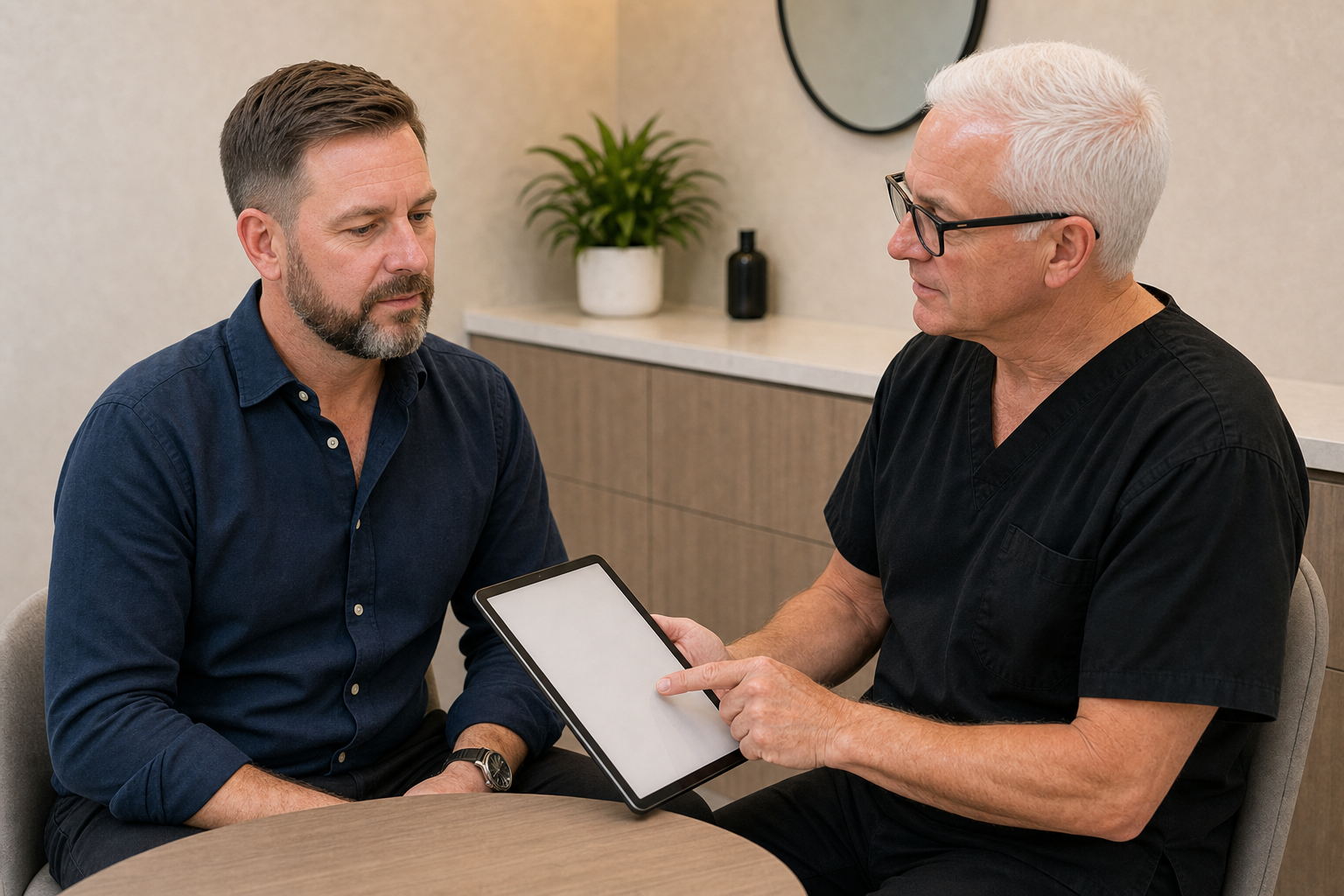
Most men who book wrinkle consultation arrive with a specific, defined goal: a frown line that has begun to register in professional contexts, a forehead pattern that has become more visible than they would prefer, or a lateral orbital crease pattern that has started to feel like part of how the face is being read. The conversation is usually short on flourish and long on detail. The dose, the duration, the realistic outcome, the maintenance rhythm and the cost are the questions that come up. The clinical conversation is often the same as a female consultation in structure but different in content because the anatomy and the dosing differ.
What makes male anatomy different for Wrinkle dosing
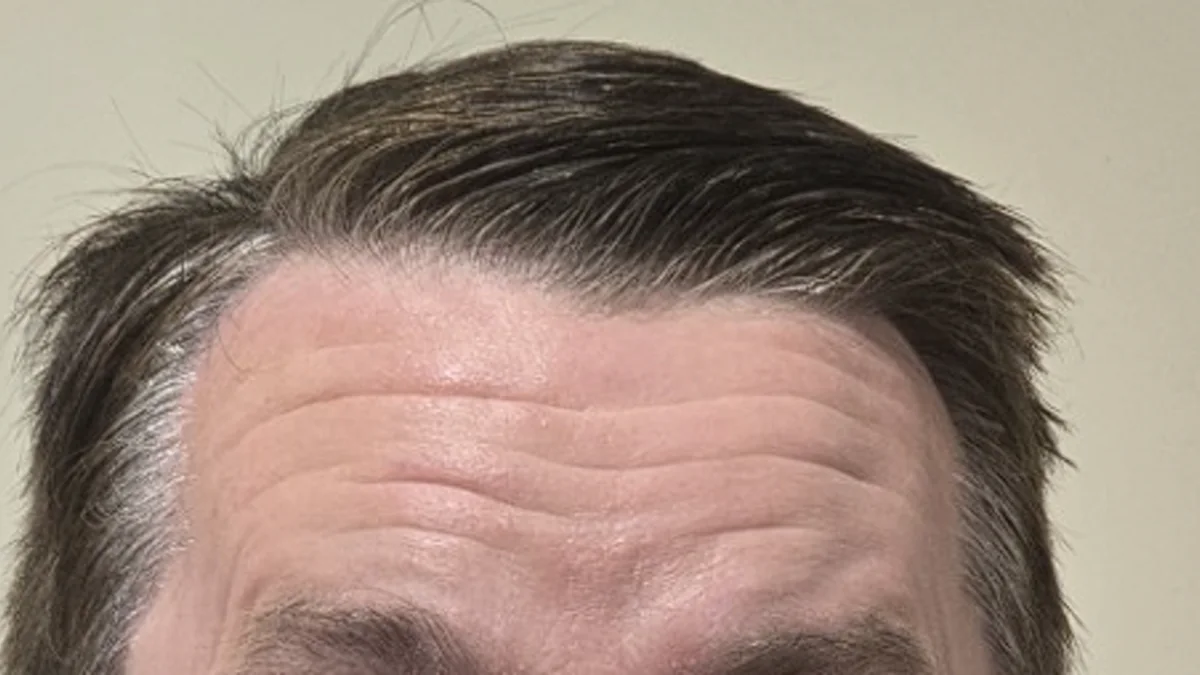
Male facial muscles tend to be larger and more active than female muscles in the same regions. The frontalis (forehead) muscle generally has more bulk and produces stronger contraction during expression. The corrugator and procerus muscles in the glabellar complex are typically more substantial. The lateral orbicularis oculi at the lateral orbit is similar in mass but often more active because of expression habits. Skin in the forehead and lateral orbit is typically thicker. Bone structure is heavier through the lateral orbital rim and the brow.
The practical implication is that the same dose that produces full softening in a typical female forehead may produce only partial softening in a typical male forehead. Standard published dosing ranges include a male adjustment for this reason, and conservative dosing in male patients still starts at the lower end of the male range rather than the lower end of the female range.
The brow position and what it means clinically
Male brows sit naturally lower than female brows and are typically less arched. Treatment of the frontalis (forehead) reduces forehead muscle activity but also slightly lowers the brow position because the frontalis is the primary brow elevator. In female patients, this lowering is often subtle and generally tolerated. In male patients, the lowering can be more pronounced and can produce a heavier looking brow if the dose is not carefully calibrated.
The clinical approach in male forehead treatment is therefore generally more conservative than in female forehead treatment, with smaller starting doses, more selective placement, and structured two week review where the dose can be adjusted upward if response has been insufficient. Patients who arrive having had aggressive forehead treatment elsewhere sometimes describe a heavier looking brow that they would not have chosen if the trade off had been explained.
Common indications in male patients
The most frequently treated regions in male patients at this clinic are the glabellar complex (vertical frown lines between the brows), the lateral orbital region (crows feet), the forehead with cautious dosing, and the jaw muscle for either bruxism or visible jaw squareness. Treatment of the upper face is the typical entry point for most male patients. lower face neuromodulator treatment in male patients tends to be region specific (mentalis for chin dimpling, depressor anguli oris for the downward pull at the corners of the mouth) and is approached cautiously.
For male patients whose primary indication is bruxism rather than aesthetic, the jaw muscle conversation typically uses higher doses (35 to 50 units per side) for the bulk reduction over time that follows from sustained muscle activity reduction. The same conservative starting principle applies within the male range.
Conservative dosing as the default
The C.O.R.E. Method approach in male wrinkle treatment is to start at the lower end of the appropriate male range, with structured two week review where dose can be adjusted upward if response has been insufficient. Going to the upper end of the range as a default first dose carries higher risk of producing changes the patient may not want, including the heavier looking brow described above and the conspicuous immobility in animated expression that male patients in particular tend to dislike.
The conservative approach errs in favour of preserving expression at the cost of an occasional second visit for top up. Across multiple cycles, the cumulative effect builds and the dose required to maintain the result often decreases.
What treatment looks like practically
The treatment is brief. After consultation and consent, the practitioner identifies the muscle locations to be treated and places small volumes of prescription neuromodulator at each. The number of injection points depends on the indication and the muscle size. Discomfort is minimal. There is no practical downtime. Patients return to normal activity immediately, with the conventional advice to avoid heavy exercise or extended head down positions for the same evening.
Onset is gradual. Most patients begin noticing softer expression at five to seven days, with full effect at around two weeks. The visible change in the upper face is usually subtle in repose and more obvious during animated expression. Patients often describe the result as feeling less like a face being held tense and more like a face that is settled.
Side effects and what we monitor
Local side effects (small bruise at an injection point, brief tenderness, occasional small lump that resolves over days) are the most common reported issues. Specific to male wrinkle treatment, the heavier looking brow described above is the most clinically relevant side effect when forehead dosing is too aggressive, and resolves over six to twelve weeks as the neuromodulator wears off. Eyelid or brow ptosis (drooping) is rare but reportable.
Conservative dosing substantially reduces these risks. Patients are given written aftercare and a direct contact for the practitioner if any concerns arise after the appointment.
Duration and the maintenance rhythm
Duration in male patients is generally similar to female patients for the same indication, typically three to four months at first treatment, sometimes longer with repeated treatment as cumulative effect builds. Patients with vigorous training regimens may experience slightly shorter durations because of accelerated metabolism and repeated strong muscular contraction. The plan is built around clinical assessment at follow up rather than a fixed retreatment calendar.
What we do not claim
Several claims sometimes made about male wrinkle treatment do not survive clinical scrutiny and we do not make them. The first is that treatment will produce a more masculine appearance. It will not change the structural features that determine that. The second is that male patients require a uniquely male protocol distinct from individualised dose calibration. They do not; the dose is individualised to the anatomy in front of the practitioner. The third is that treatment is a single session intervention with permanent effect. It is reversible, lasts three to four months at first treatment, and requires maintenance.
Why we do not name the prescription product
For more on TGA advertising rules for cosmetic prescription medicines, see our reference page.
Australian regulation prohibits the advertising of Schedule 4 prescription medicines to the public. That includes brand names, abbreviations and hashtags. The TGA has been increasingly active in enforcing this provision. We can talk in clinical detail about the mechanism, dose ranges, response profile and safety considerations. We do not name brands or otherwise identify products to the public, because the law explicitly prohibits us from doing so.
AHPRA September 2025 considerations
The AHPRA September 2025 framework is summarised on our patient reference page.
The AHPRA guidelines for nonsurgical cosmetic procedures that came into force in September 2025 require an in person or video consultation with the prescribing practitioner each time a aesthetic treatment is prescribed. They apply equally to male and female patients. Suitability assessment must explicitly address motivations and expectations. Consultation, treatment and prescription documentation are tracked at every cycle.
Working with Corey
Corey Anderson is the only practitioner at Core Aesthetics. Registered with the Nursing and Midwifery Board of Australia since January 1996 (AHPRA NMW0001047575), Corey runs a one practitioner, low volume clinic in Oakleigh. For male patients in particular, the continuity of clinician across years matters because the dose calibration becomes progressively more refined as the practitioner accumulates familiarity with the individual response.
Patients see Corey at every visit. Treatment notes carry the dose, placement and response duration forward across years.
Cost framing
Wrinkle treatment is priced on the actual product and time involved, quoted in writing as part of the consultation. There is no surge pricing, no time limited promotional pricing and no loyalty pricing. Patients receive a written treatment plan that includes the realistic anticipated frequency of maintenance and the cumulative cost across the first twelve months.
Booking a consultation
Consultations are booked directly online or by contacting the clinic. The first appointment is a clinical assessment, with no obligation to proceed in the same session. If treatment is appropriate, it can be performed in the same visit. Patients who arrive with a specific, defined goal often have shorter consultations than patients exploring options. Results vary between individuals.
Core Aesthetics operates from 12A Atherton Road, Oakleigh, in Melbourne south east, with off street parking and walking distance from Oakleigh railway station.
On the broader male aesthetic treatment picture
The growth of male aesthetic treatments in Australia reflects broader normalisation of small medical interventions for professional men. Treatment for a frown line that has begun to register, for an upper face that no longer rests easily, for the jaw muscle that has been quietly hypertrophic for years, for the underarm sweating that has been an unspoken daily concern. These are pragmatic, time bounded clinical interventions with established evidence and predictable safety profiles. The conversation about them deserves the same depth and honesty as any other aesthetic treatment consultation.
On expression preservation as a defining male preference
One of the most consistent themes in male wrinkle consultation is the explicit preference for preserving expression in motion, even at the cost of leaving some lines visible at rest. The reasoning is partly practical: men in professional contexts where animated expression is part of how they communicate find that visible immobility is conspicuous in a way that detracts from rather than supports the impression they want to make. The reasoning is partly aesthetic: a face that does not move reads as less alive in social interaction, and most male patients prefer a face that looks rested but engaged to a face that looks unchanged at rest but expressionless in motion.
Conservative dosing in male wrinkle treatment is therefore not just a default principle. It is a calibrated response to a specific aesthetic preference that male patients tend to hold strongly. The dose that preserves expression at the cost of leaving some line visible is often the right dose for the patient who explicitly values motion. The dose that flattens line at the cost of motion is rarely what the male patient actually wants once the trade off is named.
On the dosing conversation across cycles
The first treatment establishes the response. The two week review establishes whether the dose was right for the goal. Subsequent cycles refine. By the third or fourth visit, the dose calibration is settled and the patient is choosing the rhythm. This iterative process is part of why conservative starting dose is preferred over single session full dosing: it allows the calibration to happen across several visits rather than as a single irreversible commitment.
On peer referrals
Many male patients arrive on the recommendation of a colleague, partner or dentist. Where the referral is from a previous patient, the consultation is the same as any other; the previous patient experience does not transfer, and the new patient deserves the same considered start that everyone else gets. For male patients in particular, peer referral is often the most reliable signal that a clinic operates in a way that fits the male patient population, because the referral comes from someone who has actually experienced the model rather than from advertising.
On treatment timing around work commitments
Patients sometimes prefer to time treatment around specific work commitments: presentations, professional photography, conferences, periods of high public visibility. The two week onset of full effect means treatment is best scheduled at least two weeks ahead of any specific commitment to allow for settling. Bruising, when it occurs, typically resolves within a few days. The structured planning of treatment around the patient calendar is part of what an unhurried consultation supports.
On accumulated familiarity over time
Patients who have continued treatment with the practice across years often comment on how the consultation evolves over time. Early consultations focus on calibration. Later consultations focus on minor adjustments and on the broader trajectory of the face. By the third or fourth year, the conversation often takes only a few minutes because the practitioner familiarity with the patient anatomy and preferences makes most of the assessment intuitive. Treatment time correspondingly shortens, and the structured review interval becomes a brief efficient checkpoint rather than a long planning session.
This is one of the practical advantages of the one practitioner model that male patients in particular tend to value. The accumulated familiarity is not transferable to a different injector at a different visit, which is why the model rewards consistency across the practice over time.
The practice rewards continuity in the way good general practice does, and patients who value that kind of relationship tend to stay across years.
This is part of how the model fits the male patient population.
On the Long-Term experience
Male patients who continue treatment across multiple years typically describe the rhythm settling into something quietly routine. Two or three small treatments per year. The same practitioner each visit. The dose adjusted slightly across cycles based on response. The maintenance becomes lighter rather than heavier as cumulative effect builds. Patients who reach this stage often comment that the treatment has become invisible to them as a thing they are doing, which is the goal that the conservative model is built around.
The opposite trajectory (escalating doses, expanding regions, increasing frequency) is uncommon in this practice and is usually a sign that the original goal was poorly defined or that some other factor is driving the conversation rather than clinical indication.
Is this for you?
Consider booking a consultation if
- You are a male patient with specific defined dynamic expression lines (forehead, glabellar complex, lateral orbit) you would like softened
- You prefer conservative dosing with structured review rather than single session full dose treatment
- You want to preserve expression in motion rather than achieve visible flattening at rest
- You are 18 or older and otherwise in general good health
This may not be for you if
- You are looking for a clinic that markets male wrinkle treatment as a quick lifestyle product
- You have a neuromuscular condition that contraindicates neuromodulator treatment, or a known allergy to the active ingredient
- You want same day walk in treatment without a prior consultation
- You are seeking visible immediate transformation rather than conservative softening
Suitability is confirmed at consultation. This list is general guidance, not a substitute for clinical assessment.
Frequently asked questions
Is wrinkle treatment for men different from treatment for women?
The clinical structure is the same. The dosing differs because male muscles are typically larger and more active. Male doses for the same indication tend to be higher, while the conservative principle of starting at the lower end of the appropriate range still applies. The dose is individualised to the anatomy in front of the practitioner, not to gender.
Will wrinkle treatment make my forehead look heavy?
At conservative dose, no. Male brows sit naturally lower than female brows, and forehead treatment slightly lowers the brow position because the frontalis is the primary brow elevator. At aggressive doses, this lowering can produce a heavier looking brow that male patients typically do not want. Conservative dosing with structured two week review substantially reduces this risk and is the default approach.
What regions are most commonly treated in male patients here?
The glabellar complex (vertical frown lines between the brows), the lateral orbital region (crows feet), the forehead with cautious dosing, and the jaw muscle for either bruxism or jaw squareness. Treatment of the upper face is the typical entry point. lower face treatment is region specific and approached cautiously.
How long does wrinkle treatment last in male patients?
Generally similar to female patients: three to four months at first treatment, sometimes longer with repeated treatment as cumulative effect builds. Patients with vigorous training regimens may experience slightly shorter durations because of accelerated metabolism and repeated strong muscular contraction.
Will my expression be visibly affected?
At conservative dose, the visible change is usually subtle in repose and more obvious during animated expression. The face is softer rather than frozen. Patients who want to preserve expression in motion are well served by the conservative approach. Patients who arrive expecting a more dramatic flattening sometimes need to discuss whether that goal is realistic or appropriate.
What if I am very physically active?
Vigorous training tends to shorten treatment duration slightly because of accelerated metabolism and repeated strong muscular contraction. The practical recommendation is not to reduce training but to expect a slightly shorter maintenance interval and plan accordingly. The conversation at consultation accounts for activity level when discussing realistic durations and retreatment scheduling.
Can my consultation be brief if I know what I want?
Yes. Patients who arrive with a specific question and a defined goal often have shorter consultations than patients exploring options. The clinical depth is the same: suitability assessment, anatomical examination, photography and consent are non negotiable parts of every appointment. The conversational length adjusts to what the patient needs.
Do you offer male only consultation hours?
No. Consultations are scheduled individually and no clinic time is gender segregated. The clinic is private, one practitioner and unhurried, which means the consultation environment is the same regardless of who else is in clinic that day. Male patients sometimes specifically value the discreet nature of the small specialist clinic over a higher volume practice.
Should I have wrinkle treatment if I want to prevent lines rather than treat existing ones?
Preventative treatment may be considered when muscle activity is consistently creating early dynamic lines, but whether it is appropriate depends on individual anatomy, age, skin quality and treatment goals. A clinical assessment is required to determine whether treatment makes sense at this point, and what dose and timing would be appropriate for your situation.
Is it safe to have wrinkle treatment while taking blood-thinning medications or supplements?
Certain medications and supplements, including aspirin, ibuprofen, fish oil, vitamin E and some herbal supplements, can increase bruising risk after any injectable treatment. You will be asked about these at your consultation. In most cases, treatment can proceed, though timing and approach may be adjusted. Always disclose your full medication and supplement list before any injectable appointment.
Why does wrinkle treatment sometimes require a two-week review?
The full effect of prescription neuromodulator takes seven to fourteen days to settle. Reviewing at two weeks allows the treating practitioner to assess whether the dose was appropriate, whether any asymmetry needs addressing, and whether the result aligns with the plan discussed at consultation. It is a clinical checkpoint, not a sales appointment.