Facial volume treatment is not the answer when the original assumption is wrong, the change is temporary or still evolving, symptoms need another health pathway, previous care is unresolved, the expected change exceeds non-surgical scope, or the person cannot make an unpressured and informed decision. A hollow, fold or shadow does not prove that volume has been lost. Before discussing any cosmetic option, Corey Anderson RN should be able to name the observation, explain the likely source and uncertainty, identify what the proposed pathway cannot address, and show why adjusted timing, review with another health professional or no cosmetic procedure is not the better answer.
Start By Trying To Disprove The Volume Assumption
When someone says “I have lost volume”, Corey should not begin by proving them right. He should test competing explanations: skin surface, lighting, movement, weight or dental change, ordinary anatomy, previous care and a symptom that belongs elsewhere.
This is a deliberate countercheck. If the concern can be explained more plausibly without a volume deficit, adding volume is not a sensible first answer.
The First Four Stop Tests
| Stop test | What fails the volume assumption? | Direction |
|---|---|---|
| Wrong source | Mainly surface, pigment, movement, lighting, dental or ordinary anatomy | Use the matching pathway |
| Still changing | Recent weight, illness, swelling or previous care has not settled | Observe or reassess |
| Health concern | Sudden, painful, weak, numb or symptomatic change | Seek health assessment |
| Unresolved care | Important previous care facts are missing | Obtain records |
Three More Reasons To Stop
| Stop test | What fails the volume assumption? | Direction |
|---|---|---|
| Scope mismatch | The expected change needs another clinical or surgical pathway | Explain limits and refer |
| Unstable consent | Pressure, a crisis, copied face or unrealistic certainty drives the request | Pause and reassess |
| Review is impractical | Travel, events or access make follow up unrealistic | Choose safer timing |
Stop Test One: The Source Is Not Volume
A dark under eye can involve pigment, surface texture, lighting, swelling or ordinary contour. A fold can reflect movement and skin as well as support. A lower face change can sit beside dental, weight or structural factors.
The facial volume source map owns the full five-source assessment. This page asks a narrower question: has another source already made volume the wrong answer?
When Skin Surface Changes The Question
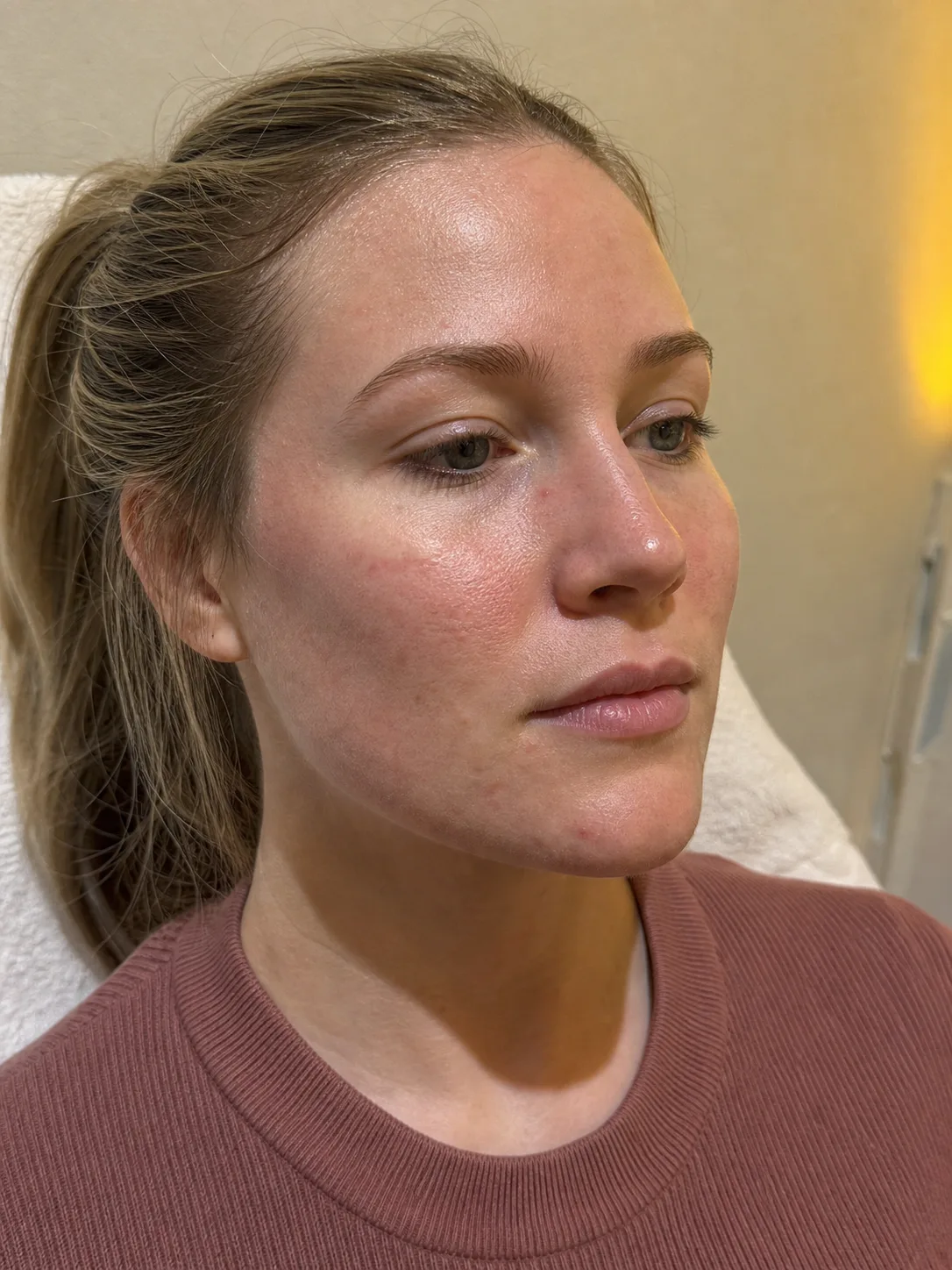
Redness, irritation, dryness, texture, pigment and directional light can make a cheek or under eye look more hollow. Adding volume does not diagnose or treat a skin condition.
Active infection concern, a new or changing lesion, broken skin or significant irritation needs the appropriate skin or medical assessment. A cosmetic consultation should not rename it as volume loss.
Use The “If We Added Nothing” Test
Ask what would happen if no facial volume were added. Would consistent lighting make the concern look different? Would a skin problem still need care? Would a dental review still be relevant? Would time clarify a recent change?
If the important next step remains the same without a cosmetic procedure, that step should usually lead.
Stop Test Two: The Face Is Still Changing
A decision made during recent weight change, illness recovery, swelling, skin inflammation or an unsettled response to previous care may be based on a moving target. The correct baseline may not yet be visible.
Waiting is not passive when it has a defined purpose. Record what needs to settle, what evidence will be compared and when reassessment would be meaningful.
Give Waiting A Review Question
| Reason to wait | Question for review |
|---|---|
| Recent weight change | Has weight and facial appearance stabilised? |
| Skin inflammation | Is the skin comfortable and has the cause been assessed? |
| Previous cosmetic care | Are the records available and has the response settled? |
| Recent dental change | Has the dental issue or bite relationship been reviewed? |
| Event pressure | Can the decision be made without a deadline? |
The review question prevents “wait” from becoming vague dismissal and prevents urgency from choosing the answer.

Stop Test Three: A Health Question Comes First
Sudden facial weakness, altered speech, significant or rapidly increasing swelling, severe pain, visual change, breathing difficulty, spreading redness, fever, altered sensation or a new one-sided change should not be managed as a routine facial volume concern.
Seek the appropriate health service. Call 000 in Australia for an emergency. A public cosmetic page cannot diagnose the cause or determine urgency for an individual.
Stop Test Four: Previous Care Is Unresolved
Do not build a new plan on a guessed history. Record the treating clinic, practitioner, date, documented areas, product or medicine if known from records, amount if documented, early response, settled response, complication and review advice.
If those facts are missing, ask the original clinic for the clinical record. New care may be the wrong answer until the previous episode is understood.
Unknown Must Stay Unknown
A photograph cannot reliably identify what was used, where it was placed or how much was provided. Memory can also compress several appointments into one.
Mark each missing fact as unknown. That is safer and more clinically useful than filling a gap with a plausible sounding answer.
Stop Test Five: The Goal Exceeds The Scope
Non-surgical care and surgery differ in magnitude, recovery, risks and what they can change. A person seeking substantial lifting, removal of lax tissue or a surgical degree of structural change should not be sold a smaller pathway as equivalent.
Core Aesthetics is not a surgical service. An independent surgical or medical opinion may be more honest when the expected change sits outside clinic scope.
Ask For The Limit Before The Benefit
Before discussing what an option might change, ask what it cannot address. The answer should name the tissue or feature outside scope, the uncertainty, and what a realistic endpoint would leave unchanged.
If the limitations remove the reason the person wanted care, adding volume is not the answer even if it is technically possible.
Stop Test Six: Consent Is Not Stable
A recent crisis, repeated comparison with edited images, pressure from another person, a request to copy a face or certainty that one change will fix wider distress can undermine a free and realistic decision.
Ahpra guidance requires holistic suitability assessment and attention to underlying psychological issues. Corey may pause, decline or recommend an independent health assessment. That is a safety decision, not a judgement about the person.
Use The Three Sentence Consent Check
- My concern is: one observable feature in my own words.
- I would still be free to decline if: the practitioner recommends adjusted timing, review with another health professional or no procedure.
- I understand this cannot: the main limitation in plain language.
If any sentence cannot be completed without pressure or certainty, the decision needs more time.
Stop Test Seven: Review Is Not Realistic
Aftercare and access to review are part of the pathway. Travel, a major event, caring duties, work restrictions or distance can make the timing unsafe or impractical even when the concern itself could be discussed.
Ask who can be contacted, how urgent concerns are handled, when routine review occurs and what happens outside clinic hours. If follow up cannot be made workable, do not treat the booking date as a deadline.
What Corey Must Be Able To Explain
Corey should be able to complete four statements: “You have noticed…”, “assessment suggests…”, “this pathway can and cannot…”, and “your reasonable alternatives are…”. The alternatives must include doing nothing where appropriate.
If the explanation jumps from a shadow to a procedure without those steps, the volume assumption has not been tested well enough.
A Small Concern Can Still Have A Large Risk Mismatch
Risk is not justified simply because an area is small or the requested change is subtle. Depending on the pathway and anatomy, harms may include pain, bruising, swelling, infection, asymmetry, lumps, an unwanted appearance, tissue injury, vascular complications, visual injury, delayed problems and further care.
Material risks, uncertainty and personally relevant factors belong in the individual discussion. A website list cannot establish that likely benefit outweighs risk.
When No Procedure Is The Positive Answer
No cosmetic procedure can be a positive, documented conclusion when the feature is ordinary variation, another pathway fits better, the expected change is too uncertain, risk is disproportionate, consent is unstable or the concern does not matter enough to the person.
The consultation can still produce useful work: a clearer source, records requested, a health referral, a controlled photo baseline or a review question.
Keep The Volume Decision Pages Separate
This page owns the seven reasons volume may be the wrong answer. Facial volume assessment Melbourne owns the five-source map. When to wait versus treat a volume concern owns timing once the source is credible. The volume consultation page explains the appointment pathway.
Read only the page that matches the unresolved decision. Repeated page wording should not substitute for a clear information architecture.
Bring A Stop-Test Note To Oakleigh
- The observation in your own words and when it began.
- Which of the seven stop tests might apply.
- Current medicines, allergies and relevant health history.
- Previous clinical records where available.
- Ordinary photographs or video only when they clarify timing or movement.
- Your main limit, alternative and reason you would choose no procedure.
Verify The Practitioner Before Sharing Records
Corey Anderson is a Registered Nurse with Ahpra registration NMW0001047575 at Core Aesthetics in Oakleigh. Phone 0491 706 705.
Compare the Core Aesthetics verification page with the independent Ahpra public register before sharing health information or paying.
Why The Public Page Avoids Product Promotion
TGA guidance prohibits public advertising of prescription medicines and indirect promotion of those goods. This page discusses assessment, reasons not to proceed and decision boundaries without naming brands, prescription substances, doses or product classes.
Any individual clinical discussion must still follow lawful prescribing, informed consent and professional scope requirements.
Questions About When Facial Volume Is Not The Answer
Does a hollow or shadow prove that facial volume has been lost?
No. Skin surface, pigment, lighting, movement, swelling, dental factors, ordinary anatomy and previous care can all alter the appearance. The observation needs a source assessment before any cosmetic option is considered.
When should a skin pathway come first?
A skin or medical pathway should lead when redness, irritation, infection concern, broken skin, a new or changing lesion, pigment or another surface problem is the main issue. Adding volume does not diagnose or treat a skin condition.
Why might recent weight change be a reason to wait?
The facial baseline may still be changing. A defined period of observation can show whether weight and facial appearance stabilise. Waiting should have a review question and should not be replaced with an automatic date or promise.
What symptoms should not be treated as a routine volume concern?
Sudden weakness, altered speech, rapidly increasing swelling, severe pain, visual change, breathing difficulty, spreading redness, fever, altered sensation or a new one-sided change needs an appropriate health assessment. Call 000 in Australia for an emergency.
What if I do not know what was used during previous care?
Ask the original clinic for your clinical record. Keep the product, amount, area or date marked as unknown until documented. A photograph or memory should not be used to invent a precise treatment history.
When is a surgical opinion more appropriate?
An independent surgical opinion may be more useful when the desired change involves substantial lifting, removal of lax tissue or a magnitude outside non-surgical scope. A smaller pathway should not be presented as equivalent to surgery.
Can emotional pressure make waiting appropriate?
Yes. A recent crisis, pressure from another person, edited-image comparison, a copied-face request or unrealistic certainty can make consent less stable. Corey may pause, decline or recommend an independent health assessment.
Why does follow-up access affect the decision?
Review and aftercare are part of safe planning. Travel, events, work, caring duties or distance may make follow up impractical. If access cannot be made workable, choosing another time or no procedure may be more responsible.
Can no cosmetic procedure be a complete answer?
Yes. No procedure may be appropriate when another pathway fits better, the feature is ordinary variation, the expected change is uncertain, risk is disproportionate or the person does not want enough change to justify proceeding.
How is this page different from the volume source map?
This page owns seven stop tests that can make volume the wrong answer. The facial volume assessment page maps five possible sources. The wait-versus-treat page addresses timing only after the concern and source are credible.
Is this for you?
Consider booking a consultation if
- Adults who want their facial volume assumption challenged before options are discussed
- People with a concern that may involve skin, movement, dental factors or previous care
- Adults willing to consider adjusted timing, review with another health professional or no cosmetic procedure
- People who want clear scope, consent and review boundaries
This may not be for you if
- Anyone with a sudden, painful or medically concerning facial change
- People seeking a promised result, copied face or surgical equivalent
- Anyone unwilling to retrieve relevant previous care records
- People unable to make review and aftercare access workable
Suitability is confirmed at consultation. This list is general guidance, not a substitute for clinical assessment.
Clinical references
- Ahpra: Guidelines for registered health practitioners who perform non-surgical cosmetic procedures
- Ahpra: Advertising higher risk non-surgical cosmetic procedures
- TGA: Advertising health services that involve therapeutic goods
- Ahpra: Public register of practitioners
- The Facial Aging Process From the Inside Out
- Facial skin ageing: Key concepts and overview of processes
- Patterns of Change in Facial Skeletal Aging