
If your upper lip looks comfortable at rest but becomes less visible when you smile, movement may be the first question to explore. If the concern is present at rest, shape, support or volume may be the closer conversation. Corey Anderson RN compares both views with you before discussing whether either pathway is relevant.
Begin with the view that bothers you
You do not need to arrive knowing the name of a treatment. Start with a simpler observation: does your upper lip look comfortable at rest but seem to roll inward or become less visible when you smile, or is the concern present even when your face is relaxed?
That distinction gives your consultation a useful starting point. Movement and resting shape can overlap, but they are not interchangeable, and neither automatically means cosmetic care is needed.
Compare the questions
The lip changes when you smile
Your upper lip may look balanced at rest, then become less visible during speech, smiling or a full laugh.
The concern is present at rest
You may be noticing border definition, projection, visible lip height or balance before expression begins.
You are not sure where it starts
Corey can compare rest and movement with you, then explain which question deserves attention first.
Start at rest, then watch the smile
At rest, notice what you mean by volume. It may be visible lip height, border definition, projection, upper and lower balance or comfortable closure. Those observations belong to a shape and support conversation.
Then watch a natural smile and a few words of speech. If the main change appears only in movement, a focused upper lip movement discussion may be more relevant. The upper lip movement service page covers that pathway in more detail without replacing an assessment.
Corey looks at both views with you, then considers tooth show, closure, symmetry, lower-face relationships, health, previous care and what you want to understand.
What each observation can tell you
| What you notice | Start with this question | Why it helps |
|---|---|---|
| The upper lip becomes less visible only when smiling | Movement | The difference appears with expression rather than at rest. |
| Shape, border or visible lip height concerns you at rest | Shape and support | The observation is present before movement begins. |
| Your smile and resting view both concern you | Compare both | Corey can separate the observations before discussing priorities. |
| You like your lips but want reassurance | Information only | A consultation can finish with clarity, waiting or no cosmetic care. |
A photo is a prompt, not the answer
A relaxed photo and a natural smiling photo can help you describe what you notice. They cannot show speech, lip closure, muscle effort, health history or how the concern feels in daily life.
Bring them if they are useful, but expect Corey to assess you in person and in motion. For the broader lower-face view, read the lip assessment guide.
Keep the risk discussion with the right pathway
A movement-focused option has movement-specific trade-offs, including temporary changes to sipping, whistling or certain sounds. A lip shape or support option has a different risk discussion, including common settling effects and rare complications that need prompt recognition.
Corey explains the material risks, alternatives, likely limits and costs for any personally relevant option before you decide. Sudden pain, colour change or another urgent concern after recent care needs prompt contact with the treating clinic or urgent medical help.

What to expect at your visit
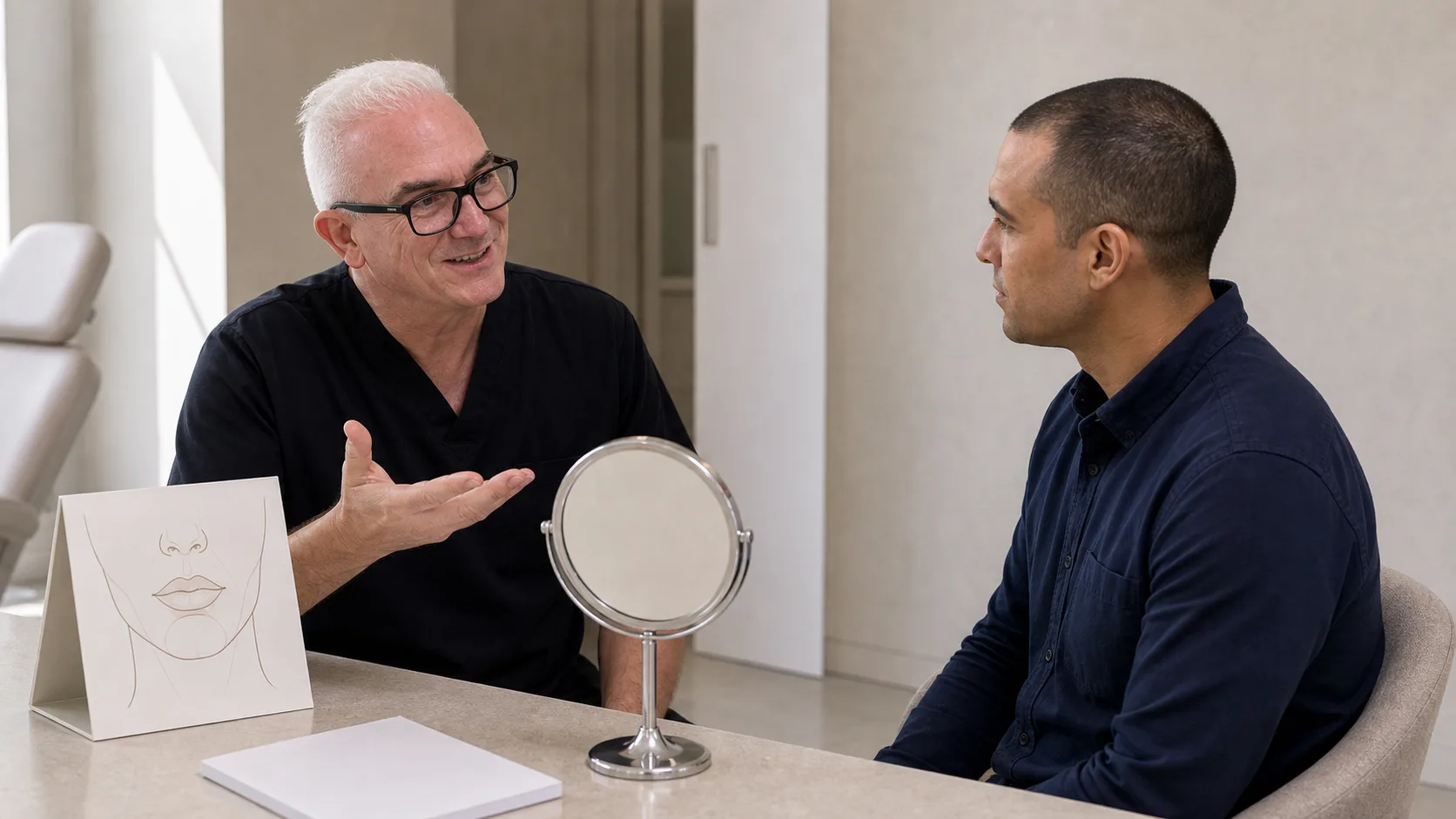
You will meet directly with Corey for a private conversation about what you notice at rest, what changes when you smile and what would feel useful to understand.
Corey compares movement, shape, support, health history and your priorities. You can use the visit for information and questions only. If an option is relevant, suitability, consent, material risks and pricing are discussed before any decision.
Bring the question, not a treatment decision
Corey can help you separate movement from resting shape and leave with a clearer next step, including waiting or no cosmetic care.
Is this for you?
Consider booking a consultation if
- Adults unsure whether their concern is a flip conversation or a volume conversation
- People whose upper lip disappears when they smile
- Patients who want mechanisms compared honestly without product marketing
- Anyone weighing subtlety, duration and cost between the two pathways
This may not be for you if
- People seeking product names or brand comparisons, which advertising rules do not permit here
- People seeking treatment without assessment, consent or risk discussion
- People with urgent symptoms after recent treatment, who need prompt care
- People seeking advice for someone who cannot provide informed consent
Suitability is confirmed at consultation. This list is general guidance, not a substitute for clinical assessment.
Frequently asked questions
What is a lip flip in plain language?
A lip flip uses a small amount of movement softening treatment in the muscle that curls the upper lip inward. With that curl relaxed slightly, more of the existing lip shows, especially when smiling. Nothing is added to the lip itself; the change comes from movement, not volume.
How is volume treatment different?
Volume treatment adds structure and fullness to the lip tissue itself, supporting the border, body and shape directly. It changes what the lip is, not just how it moves. The two mechanisms are entirely different, which is why they suit different concerns and sometimes complement each other.
Who tends to suit a flip conversation?
Commonly: people with reasonable lip volume that disappears when smiling, a strong inward curl, or a gummy smile pattern worth assessing. The flip is subtle by design. People wanting visible fullness at rest are usually in the volume conversation instead, and assessment confirms which applies.
How long does each typically last?
Flips are short lived: commonly described around six to twelve weeks, because the amounts involved are small and the mouth is busy. Volume treatment is commonly described around six to twelve months. Both ranges vary genuinely between people, and personal estimates belong at assessment.
Is the flip a cheaper way to get fuller lips?
It is usually cheaper per appointment but it does not produce fullness; it reveals existing lip during movement. Treated as a budget substitute for volume, it disappoints. Treated as what it is, a subtle movement adjustment, it satisfies the right candidates well.
Can flip and volume be combined?
Sometimes, where assessment supports each on its own merits, and usually staged rather than simultaneously so each change can be judged honestly as it settles. Combination is never the starting assumption; it is an occasional conclusion from anatomy and movement.
What are the risks of each?
Volume treatment carries the lip risks discussed across this site: bruising, swelling, tenderness, asymmetry while settling, lumps, infection, cold sore flare and rare but serious vascular warning signs. A flip adds movement specific considerations, such as temporary changes to sipping, whistling or certain sounds while it settles.
Why does my smile change the answer?
Because the flip is a movement treatment. If your concern only exists in movement, your lip vanishing when smiling, the flip conversation fits. If your concern exists at rest, thinness or lost support visible in the mirror without expression, movement treatment cannot address it.
Can I just try the flip first since it fades quickly?
That logic has real merit and assessment often supports it: the flip is short lived and conservative, so it can serve as a low commitment trial of a subtle change. It still needs proper consent and the same honesty: if your concern is resting volume, the trial will prove the wrong thing.
Why does this page not name the products involved?
Both pathways involve prescription only medicines, and Australian therapeutic goods advertising rules restrict naming them publicly. Names, evidence and specifics are discussed openly in consultation with Corey Anderson RN, where they can be matched to your assessment rather than marketed.
How do I verify the clinic before booking?
Lip consultation at Core Aesthetics is led by Corey Anderson, Registered Nurse, Ahpra registration NMW0001047575. Use the Verify Core Aesthetics page, the clinic contact details and the Ahpra public register to confirm details before booking.