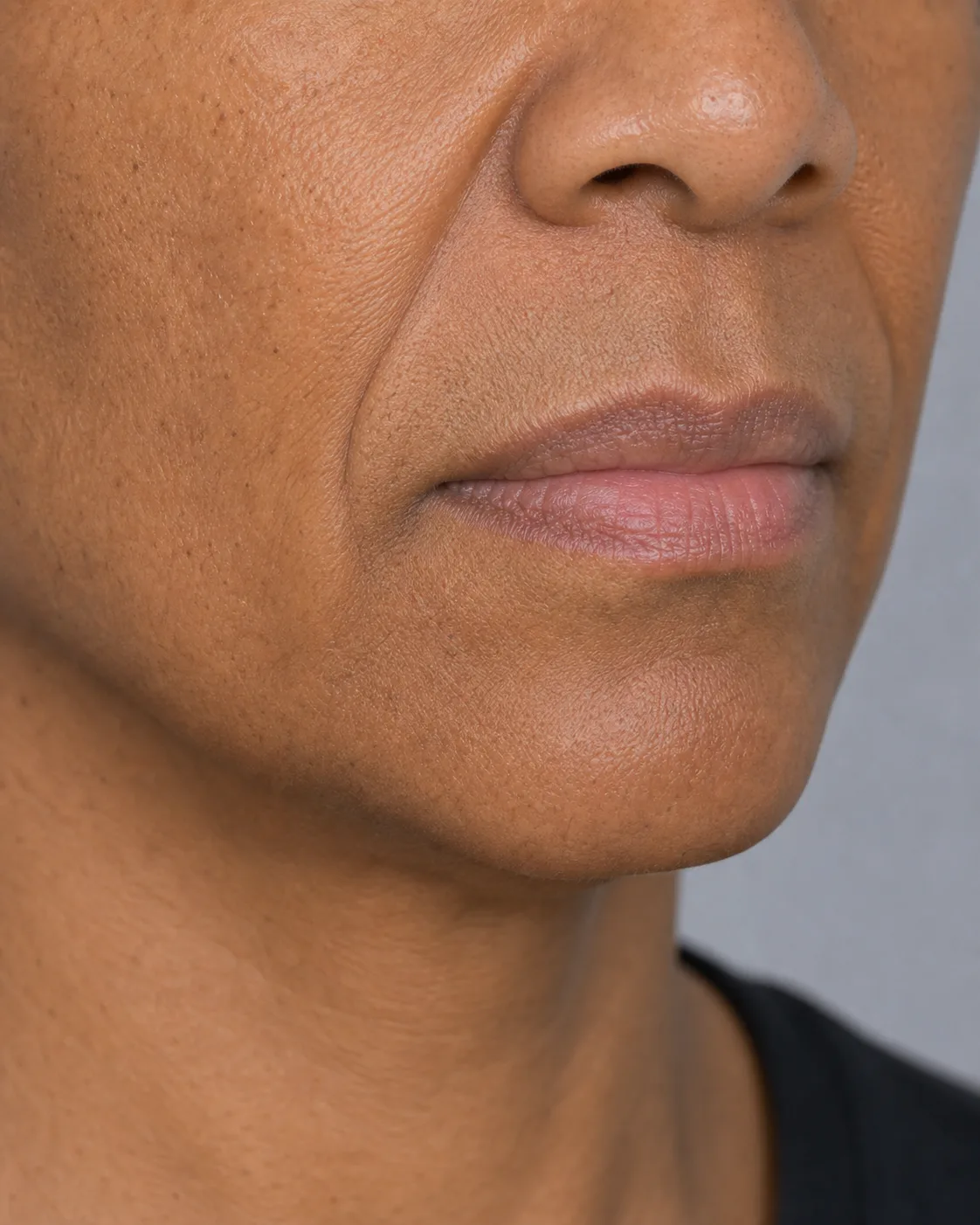
Marionette lines are folds or depressions that begin near the corners of the mouth and extend downwards towards the chin or lower jaw. Anatomical literature also calls this the labiomandibular or melomental fold. It is not the same as a nasolabial fold, a jowl, the horizontal crease beneath the lower lip or a mouth corner that turns down only during movement. Assessment should locate the feature at rest and in motion before discussing what may contribute to it.
First, Point To Where The Line Begins
Use a mirror and find the upper end of the feature. If it begins beside the nose and runs towards the mouth, it is in the nasolabial region. If it begins at or just below the mouth corner and travels towards the chin or jaw, it may be the fold commonly called a marionette line. If the hollow begins lower, immediately in front of a jowl, the prejowl region may be doing more of the visual work.
This small act of pointing prevents a familiar label from swallowing the entire lower face. It also gives Corey a better starting question: are you concerned about a fixed crease, a shadow, the position of one corner, or a change that appears only while speaking?

What Is A Labiomandibular Fold?
Anatomical papers use several names, including labiomandibular fold, melomental fold and mandibular fold. The shared idea is a natural boundary that runs from the lower mouth corner towards the mandible. Cadaver research describes two relative fixation points: the skin insertion of the depressor anguli oris muscle above and the mandibular ligament below.
Those landmarks help explain why animation and tissue change can make the fold more visible. They do not mean one muscle or ligament is the sole cause. Skin, soft tissue, surrounding volume, chin and jaw support, dental context, inherited anatomy and the way the mouth moves can all affect what is seen.
Why The Name Can Be Less Helpful Than The Landmark
The puppet comparison is memorable, but it can make a normal fold sound theatrical or defective. A person may simply notice an oblique shadow below one mouth corner. Corey can use that description without assigning an emotion to the face or implying that it looks sad, angry or old.
Words matter because appearance labels can quietly become diagnoses. “I see a line here in side light” is useful information. “This fold makes my face wrong” is not a clinical finding and should not be reinforced by the consultation.
How Is This Different From A Nasolabial Fold?
A nasolabial fold starts beside the nose and runs towards the mouth corner. A labiomandibular fold starts lower, at or near the mouth corner, and travels towards the chin or lower jaw. The two may appear to meet in photographs, but they cross different anatomical regions.
That distinction matters for page intent too. The nasolabial fold guide focuses on the crease between nose and mouth, cheek support and smile dynamics. This page stays below the corner and asks how that feature relates to the chin, prejowl and lower jaw.
Is A Downturned Mouth Corner The Same Thing?
No. The oral commissure is the point where the upper and lower lips meet. Its resting position and movement can influence the top of a labiomandibular fold, but a corner that turns down during a particular expression may exist without a strong fixed fold.
Corey compares the corner at rest, during ordinary speech and with a natural smile. He does not ask for the strongest frown and treat that exaggerated pose as daily anatomy. The question is whether movement creates the concern, reveals an existing fold or merely changes the shadow around it.
Where Does The Prejowl Hollow Fit?
The prejowl hollow sits along the lower jaw in front of the jowl and beside the chin. It can visually continue the lower end of a labiomandibular fold, especially in angled light. The jowl itself is the fuller tissue lateral to that hollow. Neither is simply another name for the line from the mouth corner.
An angled view needs to include the mouth corner, chin and jaw border. If the concern becomes much stronger below the fold, the lower face definition guide may answer more of the question than a page about the fold alone.
Do Not Confuse It With The Chin Crease
The mentolabial crease runs mainly across the face beneath the lower lip and above the chin. A labiomandibular fold runs down and out from a mouth corner. They can be visible together, yet they describe different boundaries and movements.
If the main concern is central chin texture, bunching or the horizontal fold, the chin dimpling and movement guide is the more precise starting point. Extending a mouth corner plan into the central chin without a clear reason would be scope drift.
What Changes Between Rest, Speech And A Smile?
At rest, Corey can see whether the fold remains visible without a posed expression. Ordinary speech shows how the corner, lower lip and chin move together. A natural smile shows whether the fold softens, deepens or changes direction as the corner lifts. Gentle lip closure can reveal chin strain, but it should not be forced.
One movement cannot diagnose the cause. The value is in the comparison. A fixed groove, a moving corner and a changing shadow are different observations even when a phone camera gives all three the same label.
Lighting Can Draw A Line That Is Barely There In Person
Side lighting creates a bright ridge and dark trough across small differences in tissue height. A wide angle phone camera held below the face can strengthen the lower jaw shadow, while chin projection and neck posture change the apparent depth of the prejowl area.
Bring one ordinary photograph if it shows the concern, but do not build a folder of filtered close views. Corey needs to see the face in consistent room light, from the front and an angle, before deciding whether the photograph represents a stable feature or a camera effect.
What Anatomy Research Can And Cannot Tell You
Dissection, histology and imaging studies support the idea that the labiomandibular fold is a distinct anatomical boundary shaped by fixation points, muscle relationships, skin and soft tissue. Research also describes variation in how the fold appears and how ageing changes surrounding tissues.
These studies cannot identify the cause in a selfie, supply a universal depth scale for the public or show that a visible fold needs cosmetic care. Samples, methods and populations differ. Corey uses the research to ask better questions, not to turn an average into a target.
Which History Can Change The Interpretation?
Timing is often more informative than intensity. Corey asks when you first noticed the feature, whether it has been stable, whether one side changed first, and whether it followed weight change, dental work, facial surgery, skin disease, trauma or previous cosmetic care. Medicines, allergies, smoking, sun exposure and relevant health conditions belong in the history too.
Bring previous provider records when they exist. An uncertain baseline may lead to records review, observation or referral. Adding further care before the area is understood can make the next assessment less reliable.
What Does Corey Map During An Individual Review?
The assessment separates the landmark, movement and history before any option is considered.
| Observation | What Corey compares | What it cannot establish alone |
|---|---|---|
| Upper end of the line | Whether it begins beside the nose, at the mouth corner or lower near the jaw. | Which structure is responsible. |
| Fold at rest | Depth, symmetry, skin surface and whether it remains without expression. | That cosmetic care is needed. |
| Speech and smile | How the corner, lower lip and chin move through ordinary expression. | That one muscle explains the pattern. |
| Prejowl and jowl | Whether a lower jaw hollow or adjacent fullness continues the shadow. | That the mouth corner is the main concern. |
| Chin and dental context | Chin support, comfortable lip closure, recent dental change and relevant symptoms. | A dental or skeletal diagnosis. |
| Timeline and previous care | Stability, one sided change, records, surgery, trauma and prior procedures. | That another intervention should occur now. |

What Can An Older Photograph Actually Tell You?
One or two ordinary older photographs may help establish whether the fold, mouth corner or prejowl shadow changed gradually. Look for a relaxed expression, similar head angle and familiar camera distance. Family or work photographs are often more honest than beauty portraits.
The photograph is a timeline clue, not an instruction to recreate an earlier face. Differences in light, weight, dental support, camera lens and expression should remain visible as uncertainty. A responsible consultation does not score a younger photograph as the standard the present face must meet.
When Does The Question Belong With A Dentist Or Doctor?
A changing bite, dental pain, difficulty closing the lips comfortably, recent dental work or new jaw symptoms may justify dental review. A new skin lesion, persistent sore, lump, unexplained bleeding or other focal skin change belongs with a GP or appropriate skin clinician rather than being labelled a fold online.
Seek urgent medical assessment for sudden facial drooping or weakness, new numbness, severe pain, rapidly increasing swelling, colour change, fever, trauma, or difficulty speaking or swallowing. A routine cosmetic appointment is not urgent care.
What Can A Responsible Consultation Conclude?
The useful outcome may be a clearer description and reassurance that the feature is normal. It may be consistent photography, a period of observation, previous records, skin or dental review, a broader chin or lower face assessment, discussion of an appropriate option, or no cosmetic care.
If an option is discussed, it should match the main contributor and remain proportionate. A shadow that is mostly prejowl should not be sold as a mouth corner problem. A moving corner should not be assessed from a still image alone.
How Are Risks And Consent Discussed?
Risk depends on the option under consideration. Discussion may need to include swelling, bruising, tenderness, infection, asymmetry, contour irregularity, unwanted movement change, a result that differs from the plan and rarer serious complications. The exact risks, alternatives, aftercare, warning signs and review arrangements must be explained for the individual option.
This page does not advertise or select a prescription medicine. Website education cannot replace informed consent. You can pause, request written information, seek another opinion or decline. Booking an appointment does not confirm that any procedure will occur.
How does the consultation lead to a clear plan?
Sometimes, but only after Corey has clarified the concern, reviewed relevant history, assessed suitability, discussed realistic expectations, risks and alternatives, and confirmed that consent and follow up are workable. Individual assessment guides which options are worth discussing and how the next step is planned.
Waiting may be more appropriate when symptoms are new, the area is changing, dental or medical review is needed, previous records are missing, event timing is poor or you want more time. A consultation remains useful even when the decision is not to proceed.
Choose The Next Page By The Landmark
Use the marionette line consultation guide for the appointment pathway. Read nasolabial folds if the crease begins beside the nose, lower face definition if the prejowl or jowl dominates, and the chin consultation guide if central chin support or movement is the main issue.
Before deciding, review how suitability is assessed, patient safety before aesthetic decisions and why a consultation may end with no.
Confirm The Practitioner And Clinic
Core Aesthetics consults from Atherton Road in Oakleigh. Consultations are led by Corey Anderson RN, Ahpra registration NMW0001047575. The clinic phone number is 0491 706 705.
Use the Core Aesthetics verification page and the Ahpra public register to confirm practitioner and clinic details. If you want an individual lower face assessment, use the consultation booking page.
Review And Evidence Boundaries
This page was reviewed on 5 September 2026 by Corey Anderson RN. Current TGA and Ahpra guidance informed its consultation led, risk visible wording. Anatomy statements are limited to PubMed and PubMed Central research on the labiomandibular fold and lower face morphology.
The page does not diagnose a fold, assign an emotion to a face, promote a prescription medicine, promise an outcome or imply that a normal age related feature needs correction.
Questions About Lines Below The Mouth
Where does a marionette line actually start?
It starts at or just below the corner of the mouth and travels downwards towards the chin or lower jaw. Anatomical papers also call it the labiomandibular or melomental fold. If the crease begins beside the nose, it is in the nasolabial region. If the main hollow sits lower along the jaw in front of a jowl, the prejowl region may be the more accurate landmark.
Is a downturned mouth corner a marionette line?
Not necessarily. The mouth corner can change position during speech, smiling or another expression without a strong fold being present at rest. The corner may also influence the upper end of an existing fold. Corey compares the face at rest, during ordinary speech and with a natural smile rather than using an exaggerated frown to define the everyday concern.
What is the difference between a marionette line and a nasolabial fold?
A nasolabial fold runs from beside the nose towards the mouth corner. A marionette line begins lower, near the mouth corner, and travels towards the chin or mandible. They may look connected in a photograph, but they cross different facial regions. Identifying the upper end of the line is the simplest way to separate them.
Is the prejowl hollow part of the marionette line?
It can visually continue the lower end, but it is a separate lower jaw landmark. The prejowl is the depression in front of the jowl and beside the chin. A shadow that is strongest along the jaw may need broader chin and lower face assessment rather than being treated as a mouth corner concern by default.
Why does the line look deeper in some photographs?
Side lighting creates a dark trough beside a brighter ridge, and a low or wide angle phone camera can strengthen lower face shadows. Head position, neck posture and expression also matter. One ordinary photograph can help show the concern, but Corey needs front and angled views in consistent light plus natural movement before deciding what the photograph represents.
Does one visible fold mean something is medically wrong?
Usually a gradual fold is a normal anatomical and ageing feature, but a webpage cannot assess a new change. Seek appropriate medical care for sudden facial drooping, weakness or numbness, rapidly increasing swelling, severe pain, colour change, fever, trauma, speech or swallowing difficulty, a persistent sore, unexplained bleeding or a new lump.
Can previous cosmetic or dental care change the assessment?
Yes. Previous procedures, facial surgery, dental work, dentures, a changing bite or trauma can change the baseline and the meaning of the same shadow. Bring dates, provider details and records if available. Corey may recommend records review, observation, dental or medical input, or waiting rather than adding further care while the history is uncertain.
Can the consultation end without treatment?
Yes. The outcome may be education, reassurance, consistent photographs, observation, previous records, dental or medical review, broader lower face assessment, time to think or no cosmetic care. If an option is appropriate to discuss, Corey still needs to explain relevant risks, alternatives, uncertainty, cost, consent, aftercare and follow up before you decide.
What should I bring to a marionette line consultation?
Bring your current medicines and supplements, allergies, relevant health and dental history, previous procedure dates and records, and the timing of any change. One or two ordinary older photographs may help establish the timeline. Be ready to point to the exact corner, fold or jaw shadow you mean rather than arriving with a fixed treatment request.
Is this for you?
Consider booking a consultation if
- Adults who want to identify whether a line begins at the mouth corner, beside the nose or lower along the jaw
- People willing to compare rest, ordinary speech and a natural smile
- Adults able to discuss health, dental context, previous care and the timing of change
- People open to education, observation or another clinically appropriate pathway
This may not be for you if
- Anyone seeking diagnosis or option selection from a photograph
- People with sudden facial weakness, drooping, numbness, rapid swelling, severe pain or speech or swallowing difficulty
- Anyone treating a normal fold as proof that cosmetic care is required
- People seeking a promise that one local intervention will address every lower face shadow
Suitability is confirmed at consultation. This list is general guidance, not a substitute for clinical assessment.
Clinical references
- TGA: Advertising health services that involve therapeutic goods
- TGA: Advertising health services and cosmetic injections FAQs
- Ahpra: Advertising higher risk non-surgical cosmetic procedures
- Ahpra: Performing non-surgical cosmetic procedures
- PubMed: The anatomy of the labiomandibular fold
- PubMed: Labiomandibular fold anatomy using micro computed tomography
- PubMed Central: Facial fold and crease development, a morphological classification
- PubMed Central: Development and validation of a scale to assess marionette lines