Perioral lines are usually vertical skin lines around the mouth, most often in the cutaneous upper lip between the vermilion border and the nose. They are different from the normal grooves within the coloured lip, the philtral columns beneath the nose, a nasolabial fold beside the nose and a marionette line below the mouth corner. Some appear only during movement; others remain visible at rest. Location and movement should be established before causes or options are discussed.
Start With A Fingertip, Not A Beauty Label
Point to the upper and lower end of the line. If it sits entirely inside the coloured part of the lip, it may be normal vermilion texture or dryness rather than a perioral skin line. If it starts at the lip border and travels upwards through the skin, it fits the usual description more closely. If it runs from the side of the nose towards the mouth, it belongs to the nasolabial region.
This takes less than a minute and prevents the phrase “lip lines” from turning several separate landmarks into one problem. It also lets Corey ask a concrete question: is the concern a fine surface groove, a deeper fixed crease, makeup travelling beyond the border, or a line visible only in one expression?
The White Lip And Coloured Lip Are Different Surfaces
Clinical anatomy uses cutaneous lip or “white lip” for the skin between the nose and the coloured lip. The coloured part is the vermilion. The line where they meet is the vermilion border. Each surface has different structure, texture and exposure, so a groove in one should not automatically be described as a defect in the other.
Natural vertical grooves in the vermilion help the lip move. Dryness can make them look stronger for a time. A line in the skin above the border is a different observation, even when the two appear to meet in a close photograph.
Do Not Mistake The Philtral Columns For Wrinkles
The philtrum is the central channel between the base of the nose and the Cupid’s bow. Its two raised borders are the philtral columns. They are normal landmarks, not paired wrinkles that should be erased. A horizontal crease can also appear higher in the philtrum during some expressions; that is not the usual vertical perioral line pattern.
Corey checks whether the feature is central or lateral, raised or indented, vertical or horizontal, and present at rest or only during movement. Those observations are more useful than applying a single ageing label to the whole upper lip.
Rest, Speech, Pursing And Smile Answer Different Questions
A relaxed mouth shows which lines remain without a posed expression. Ordinary speech reveals repeated folding without asking the person to perform. Gentle pursing shows radial grooves created as the circular mouth muscle contracts. A natural smile changes the tension and may soften one line while making another edge more visible.
The sequence matters. An exaggerated pucker can create lines in almost anyone, so it should not be photographed as proof that a fixed concern exists. The everyday observation is the difference between positions, not the most dramatic frame.
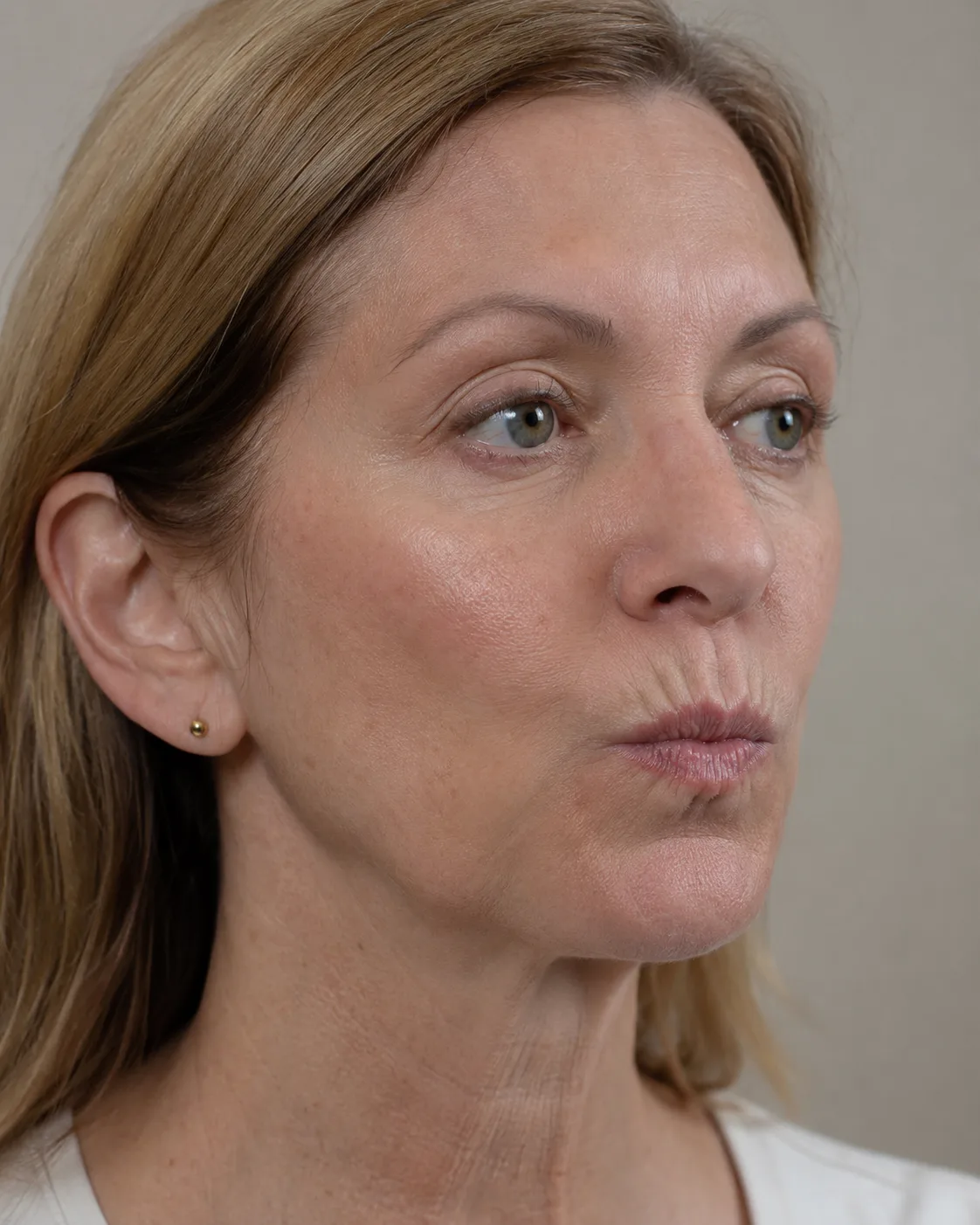
A Line Seen Only While Pursing Is Still A Real Observation
Movement-only lines are real, but they are not the same as lines visible at rest. The orbicularis oris muscle closes and purses the lips, and the overlying skin must fold as it moves. Repetition is part of speaking, eating and expression; it is not a bad habit that can or should be removed from normal life.
If a line first becomes noticeable during movement, the consultation should preserve that distinction. Describing it as “deep” from a still image taken at maximum pursing would overstate the usual appearance.
Perioral Lines Are Not The Same As Lip Ageing
Upper lip ageing can involve changes in skin, the vermilion border, visible lip height, philtral definition, upper lip length and underlying support. Perioral lines are one possible surface observation within that broader region. One does not prove that all the others are present.
The lip ageing guide covers the wider anatomical picture. This page deliberately stays with line location and movement. A side view is useful because it shows when the concern is really broader border definition, length or profile rather than a vertical skin crease.
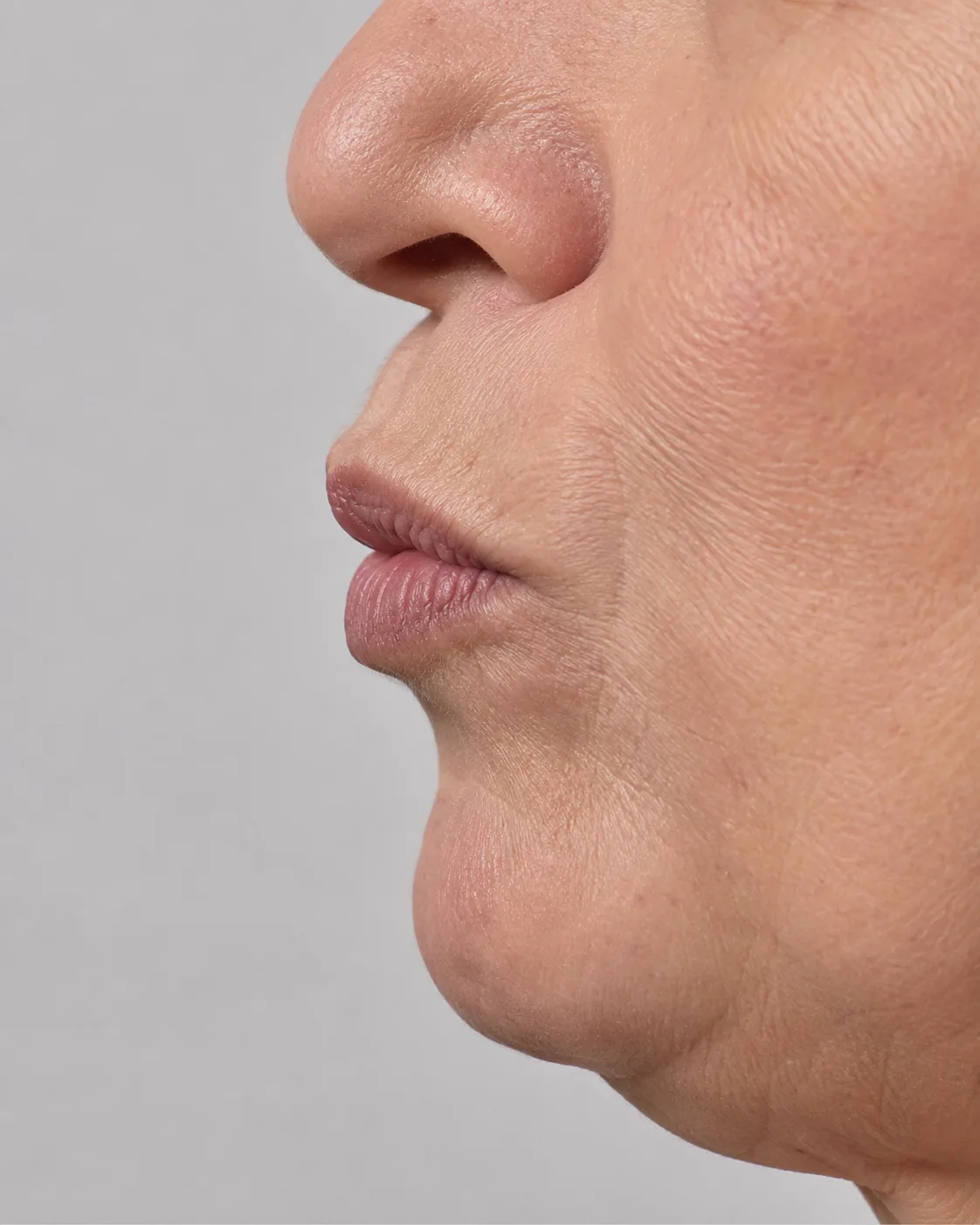
Lipstick Migration Is A Useful Clue, Not A Diagnosis
Some people first notice fine vertical channels because lipstick or balm travels beyond the border. That can help locate the line and explain why it matters to the person. It does not reveal the depth, cause or best response, and it does not mean the lip border is medically abnormal.
If makeup is the main trigger, bring the product or an ordinary photograph of what happens after wear. That is more informative than arriving with a magnified filtered image. The goal is to understand the practical concern, not to grade the lip against a smooth digital edge.
Smoking Is Not The Whole Explanation
Smoking exposure is relevant history and is associated with facial skin ageing, but the nickname “smoker’s lines” is inaccurate and can be judgemental. Many people with vertical upper lip lines have never smoked, and not every person who smokes develops the same pattern.
Age, inherited anatomy, ultraviolet exposure, skin structure, normal repeated movement and other health or environmental factors can all contribute. A consultation should ask about exposure without using it as a shortcut or a moral label.
Sun Exposure Matters Without Explaining Every Line
Ultraviolet exposure contributes to photoageing and can affect collagen, elastin, pigmentation and surface texture. It is one part of a longer history rather than a way to identify the cause of a particular line from a photograph. Daily sun protection is relevant preventive care, especially in Australia.
Read the sun protection guide for general information. A new rough, crusted, bleeding, pigmented or non-healing spot near the lip is not a cosmetic line question and should be assessed by an appropriate medical clinician.
What Research Supports, And Where It Stops
Histological research comparing younger and older upper lips has reported thinning of skin and muscle plus changes in collagen and elastic fibres with age. Imaging and photographic studies also describe changes in lip length, thickness and movement. These findings support a multi-structure explanation rather than the idea that one repeated action creates every line.
The studies cannot diagnose an individual photograph, predict the course of one groove or establish that a normal line requires care. Samples are often small or limited to selected populations. Corey uses the evidence to avoid simplistic claims, not to turn group averages into a personal target.
Which History Changes The Reading Of The Line?
Timing comes first: when did you notice it, has it changed, and is one side different? Corey also asks about sun and smoking exposure, skin conditions, cold sores, medicines, allergies, dental work, facial injury, surgery and previous cosmetic or skin procedures. Active irritation, infection or a changing lesion alters the next step.
Bring previous provider records when available. If the baseline is uncertain, records review, observation or referral may be safer than adding another intervention and making the history harder to interpret.
What Does Corey Map In An Individual Review?
The review separates the line itself from the surrounding lip and from the reason it matters.
| Observation | What is compared | What it cannot prove alone |
|---|---|---|
| Exact surface | Vermilion, border or cutaneous skin above the lip. | The cause or need for care. |
| Resting line | Length, depth, symmetry, skin texture and lighting. | How it behaves in conversation. |
| Speech and pursing | Which grooves appear, deepen or disappear during ordinary movement. | That movement is excessive or abnormal. |
| Neighbouring landmarks | Philtrum, Cupid’s bow, nasolabial fold and mouth corner. | That one local option should address the whole region. |
| Skin context | Dryness, irritation, pigmentation, sun history and focal lesions. | A skin diagnosis from appearance alone. |
| Personal meaning | Makeup migration, a photograph, recent change or a general question. | That cosmetic care is the preferred outcome. |

What Can An Older Photograph Add?
One or two ordinary photographs can show whether a line was present years ago and whether the surrounding border or upper lip changed gradually. Choose familiar lighting and a relaxed expression where possible. A family photograph is often more useful than a beauty portrait because it was not made to display the area.
The image is a timeline clue, not a target to recreate. Camera distance, resolution, makeup, expression, dental change and sun exposure can all alter the comparison. Uncertainty should remain visible in the assessment.
When Does This Belong With A GP, Dentist Or Skin Clinician?
A persistent sore, ulcer, crust, lump, unexplained bleeding, colour change or changing pigmented spot needs appropriate medical or skin assessment. Dental pain, a changing bite, new difficulty closing the lips comfortably or symptoms after dental work may justify dental review. Active cold sores or infection should be disclosed and assessed before elective cosmetic care is considered.
Seek urgent medical help for sudden facial weakness or drooping, new numbness, severe pain, rapidly increasing swelling, fever, trauma, colour change, or difficulty speaking, breathing or swallowing. A routine cosmetic consultation is not urgent care.
What Can A Responsible Consultation Conclude?
The most useful outcome may be an accurate name for the feature, reassurance, a photograph baseline, skin care education, sun protection, observation, records review, medical or dental referral, discussion of an appropriate option, or no cosmetic care. A line visible only at maximum pursing does not need to be treated as a fixed crease.
If an option is discussed, it should match the main observation and the person’s priorities. Treating lip volume, border shape and skin texture as interchangeable problems would not be an individual plan.
How Are Risk, Uncertainty And Consent Handled?
Risks depend on the option being considered. Discussion may need to cover redness, swelling, bruising, tenderness, irritation, infection, pigment change, scarring, asymmetry, contour or texture change, altered movement, prolonged symptoms, an outcome different from the plan and rarer serious complications. The relevant risks, alternatives, aftercare, warning signs and review plan must be explained for that specific option.
This page does not advertise or select a prescription medicine. General education cannot replace informed consent. You can pause, request written information, seek another opinion or decline. Booking a consultation does not confirm that a procedure will occur.
What will a lip consultation clarify?
Sometimes, but only after Corey has clarified the exact concern, reviewed health and previous care, examined the skin and movement, discussed reasonable expectations, alternatives and risks, and confirmed that consent and follow up are workable. The consultation focuses on assessment, suitable options, relevant risks, timing and an agreed next step.
Waiting is more appropriate when a line or lesion is changing, the skin is irritated, an infection is active, records are missing, medical or dental review is needed, event timing is poor or you want more time. A consultation remains worthwhile if the decision is not to proceed.
Choose The Next Page By What You Actually See
Use the perioral area consultation guide for the appointment pathway. Read lip ageing if border definition, visible lip height or upper lip length is the broader question. Choose nasolabial folds for a crease beginning beside the nose, or marionette lines for a fold beginning below the mouth corner.
Before booking, review how suitability is assessed, patient safety before aesthetic decisions and why Corey sometimes recommends no cosmetic care.
Confirm The Practitioner And Clinic
Core Aesthetics consults from Atherton Road in Oakleigh. Consultations are led by Corey Anderson RN, Ahpra registration NMW0001047575. The clinic phone number is 0491 706 705.
Use the Core Aesthetics verification page and the Ahpra public register to confirm practitioner and clinic details. If you want an individual assessment, use the consultation booking page.
Review And Evidence Boundaries
This page was reviewed on 5 September 2026 by Corey Anderson RN. Current TGA and Ahpra guidance informed its consultation-led and risk-visible wording. Anatomy statements are limited to PubMed and PubMed Central research on upper lip histology, morphology and movement.
The page does not diagnose a line, blame normal expression, present a smooth lip as an ideal, promote a prescription medicine, promise an outcome or imply that age-related change requires correction.
Questions About Upper Lip And Perioral Lines
Where are perioral lines located?
They are usually vertical lines in the skin around the mouth, especially the cutaneous upper lip between the vermilion border and the nose. A groove entirely within the coloured lip may be normal vermilion texture. A crease beside the nose is in the nasolabial region, while a line below the mouth corner may be a marionette or labiomandibular fold.
Are lines in the coloured part of the lip perioral lines?
Not necessarily. The coloured lip naturally has vertical surface grooves, and dryness can make them more visible. Perioral skin lines usually sit outside the vermilion or cross upwards from its border. Corey first identifies the exact surface because lip texture, border definition and skin lines are not interchangeable concerns.
Why do upper lip lines appear when I purse my lips?
The circular muscle around the mouth contracts during pursing and the overlying skin folds as it moves. Lines that appear only in that position are dynamic observations, not automatically fixed creases. Corey compares rest, ordinary speech, gentle pursing and a natural smile rather than using the strongest pucker as the everyday baseline.
Are perioral lines caused by smoking?
Smoking is relevant exposure and is associated with skin ageing, but it is not the only explanation and the nickname “smoker’s lines” is misleading. Many people with vertical upper lip lines have never smoked. Age, inherited anatomy, ultraviolet exposure, skin structure and normal repeated movement can all contribute, and a webpage cannot assign the cause of one person’s line.
Why does lipstick travel into the lines above my lip?
Fine channels crossing the lip border can allow some lipstick or balm to migrate. That is a practical clue to the line’s location and may explain why it matters to you, but it does not diagnose its cause or determine an option. Bringing the product or an ordinary photograph after wear can help describe the concern.
Are philtral columns wrinkles?
No. The philtrum is the central channel beneath the nose and its two raised sides are normal philtral columns. They should not be mistaken for paired wrinkles. A separate horizontal crease can also appear in the upper philtrum during expression, which differs from the usual vertical perioral line pattern.
When should a line near the lip be medically checked?
Arrange appropriate medical or skin assessment for a persistent sore, ulcer, crust, lump, unexplained bleeding, colour change or changing pigmented spot. Seek urgent help for sudden facial weakness or drooping, new numbness, severe pain, rapid swelling, fever, trauma, colour change, or difficulty speaking, breathing or swallowing.
Can a perioral line consultation end without a procedure?
Yes. The outcome may be education, reassurance, consistent photographs, skin care or sun protection advice, observation, records review, medical or dental referral, time to think or no cosmetic care. If an option is appropriate to discuss, risks, alternatives, uncertainty, cost, aftercare and follow up still need to be addressed before you decide.
What should I bring to discuss upper lip lines?
Bring your medicines and supplements, allergies, relevant skin and dental history, previous procedure details, sun and smoking history, cold sore history, and the timing of any change. One or two ordinary older photographs may help. Be ready to point to whether the line sits in the coloured lip, crosses the border or remains in the skin above it.
Is this for you?
Consider booking a consultation if
- Adults who want to identify whether a line sits in the vermilion, crosses the border or lies in the skin above the lip
- People willing to compare the relaxed mouth with ordinary speech, gentle pursing and a natural smile
- Adults able to discuss skin, dental, health, exposure and previous procedure history
- People open to education, observation or another clinically appropriate pathway
This may not be for you if
- Anyone seeking diagnosis or option selection from a magnified photograph
- People with a changing lesion, active infection or unresolved medical or dental symptoms
- Anyone with sudden facial weakness, drooping, numbness, rapid swelling or speaking, breathing or swallowing difficulty
- People seeking a promise that every upper lip line can or should be removed
Suitability is confirmed at consultation. This list is general guidance, not a substitute for clinical assessment.
Clinical references
- TGA: Advertising health services that involve therapeutic goods
- TGA: Advertising health services and cosmetic injections FAQs
- Ahpra: Advertising higher risk non-surgical cosmetic procedures
- Ahpra: Performing non-surgical cosmetic procedures
- PubMed: The aging lip, a comparative histological analysis of the upper lip complex
- PubMed: Perioral age-related changes in smile dynamics
- PubMed Central: Upper lip horizontal line, characteristics of a dynamic facial line
- PubMed Central: The facial aging process from the inside out