
Cheek filler correction addresses volume stacking that has created distortion of the midface. Assessment determines the distribution of filler, its relationship to the lower face and jawline, and whether the problem is overfilling, migration, or poor initial placement. Treatment pathways include staged dissolution, gradual reduction over time, or careful rebuilding with smaller volumes and longer intervals.
The Structural Complexity of the Midface
The midface is the region between the eyes and the upper lip, encompassing the cheeks, temple areas, and the area beneath the eyes. It is a complex three-dimensional structure with multiple layers of anatomy. Superficially, the skin varies in thickness and elasticity across the region. Deep to the skin are muscles of facial expression, fascial layers, and fat pads that are arranged in specific anatomical compartments. The cheeks themselves are not a homogeneous area; the medial cheek (the area closer to the nose), the apical cheek (the highest fullest part), and the lateral cheek (towards the temples) all have different structures and respond differently to filler placement.
The relationship between the midface and the lower face is critical for overall facial aesthetics. The cheekbones should appear supported and defined, not bulging or swollen. The cheeks should have contour and dimension, not flatness. The lateral part of the face should taper from the upper cheek towards the jawline, creating a sense of definition and frame. When filler is placed in the cheeks, it alters these relationships. If the volume is excessive, it creates widening rather than definition. If the volume is placed too low, it emphasises jowls and nasolabial folds rather than lifting the face. If the volume is placed too high or too much in the temple area, it creates a top-heavy appearance.
The cheeks also have a natural ptosis (downward descent) with age. The cheekbones actually move downward and forward as the face ages, and the skin and underlying fat descend as well. This is a normal part of ageing. Filler can either support the natural position of the cheeks, helping to restore a more youthful elevation, or it can be placed in a way that exacerbates the ptotic appearance by simply adding volume without addressing the architectural descent. When correction is needed, understanding the structural relationships allows the clinician to address not just the amount of filler, but its relationship to the underlying skeletal structure and to the lower face anatomy.
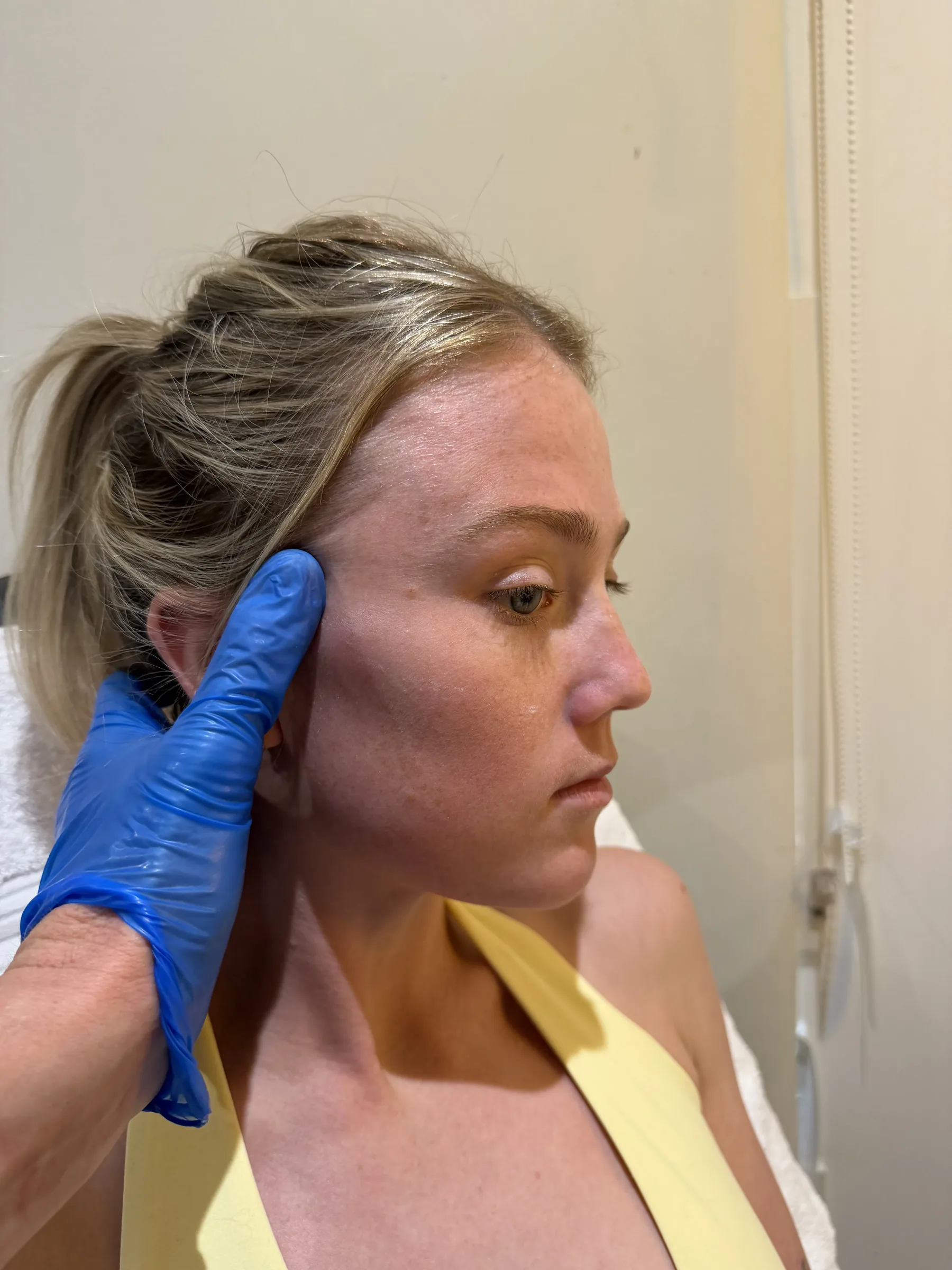
Volume Stacking and the Cause of Distortion
Volume stacking is the primary cause of cheek filler problems. This occurs when filler is injected repeatedly without full resolution of previous filler, or when increasing volumes are injected at each treatment without consideration for cumulative effect. Over a series of treatments, the cheeks accumulate filler that was meant to add subtle augmentation, and the cumulative effect is a dramatic increase in cheek volume that is often perceived as unnatural or disproportionate.
Volume stacking happens for several reasons. First, some hyaluronic acid fillers persist longer than marketed. A filler marketed as “lasting twelve months” may still have 40-50 percent of its volume present at eighteen months in the cheeks, which are a relatively static region with less movement and metabolism than more mobile areas. When a patient receives a touch-up at twelve months, they are adding new volume to filler that is still significantly present. Over multiple years, this results in substantial accumulated volume.
Second, filler tends to migrate and integrate into the tissue over time. As the filler becomes incorporated into the dermal matrix, it may appear to spread or to create a broader area of fullness than the injected volume would suggest. The cheeks in particular are prone to this integrative process because the tissue is less mobile than the lips, and the filler has more time to settle and incorporate.
Third, practitioners and patients may become accustomed to seeing a particular level of cheek fullness and may not perceive that further treatments are creating a cumulatively excessive appearance. The changes are gradual, and each treatment adds a small increment of volume that does not seem dramatic on its own. But over time, the total volume becomes excessive, the cheeks appear puffy rather than defined, and the balance of the face is distorted.
How Excessive Cheek Filler Creates Widening and Heaviness
When cheek filler is excessive, it creates a widening of the midface. The natural contours of the face are lost. Rather than a gradual tapering from the high point of the cheekbones outward and downward towards the jawline, the face becomes rounded and broad. The cheeks protrude, making the face appear wider. This widening can make the face appear heavier, older, and less refined. Some patients describe their face as looking “puffy” or “swollen” even when there is no acute swelling; the excessive filler creates a chronic appearance of puffiness.
Heaviness is another consequence of excessive cheek filler. The filler adds weight to the midface, and over time, this can contribute to increased ptosis of the cheek tissue itself. The skin and underlying tissue become stretched by the volume beneath, and as filler gradually metabolises or becomes incorporated, the stretched tissue remains, creating a slightly slack appearance even if some volume is subsequently removed. This downward descent of tissue, in turn, can emphasise the nasolabial folds, marionette lines, and jowls. A patient who sought cheek filler to appear more youthful may find that excessive volume has paradoxically accelerated the appearance of lower face ageing.
Loss of cheekbone definition is also characteristic. Well-placed cheek filler should enhance the natural cheekbones, creating definition and lift. Excessive filler obliterates this definition. The cheekbones, rather than appearing higher and more pronounced, disappear beneath rounded, full cheeks. The face loses the architectural definition that characterises youthful facial aesthetics. Some patients describe the appearance as “doughy” or “pillowy,” terms that indicate a loss of the natural contours that should define the midface structure.
Assessment: Distinguishing True Volume from Perceived Volume
Assessment of cheek filler problems begins by understanding what is genuinely present. How much of the current appearance is true filler volume, and how much is the result of tissue changes, skin quality issues, or lighting and angle perception? This assessment is done through observation and palpation. The clinician observes the cheeks from multiple angles, in different lighting, and during different expressions. Palpation reveals where the filler is located, how dense it is, and how much true volume is present versus how much fullness is due to skin texture, swelling, or perceived volume that may not require treatment.
A critical part of this assessment is comparing the two sides of the face. Is the filler distributed symmetrically, or is one cheek fuller than the other? If there is asymmetry, is it due to unequal filler distribution, or is it due to natural facial asymmetry that was already present before filler treatment? The patient is asked to identify specific concerns: Are the cheeks themselves too full, or is the problem primarily in the area below the cheekbones? Are the nasolabial folds appearing deeper because of the cheek volume? Is there a sense that the face has become disproportionately wide? These specific concerns guide the assessment towards understanding what correction is most needed.
The assessment also considers the patient’s face shape and proportions. Some patients have naturally rounder or wider face shapes, and what might be excessive filler volume for one patient with a naturally narrow face might be appropriate for a patient with a naturally broader face. The age and skin quality of the patient matter as well. Younger patients with good skin elasticity may tolerate filler volume that would look obviously excessive in an older patient with diminished elasticity. The assessment contextualises the filler within the patient’s individual characteristics rather than applying a one-size-fits-all standard.
Assessing Filler Distribution and Relationship to Lower Face
The distribution of cheek filler across the midface is a key assessment element. Has the filler been placed in the apical cheek, creating a lifted, structured appearance? Or has it been placed more medially or inferiorly, creating a swollen appearance that is less flattering? Has filler migrated beyond where it was intended? Are there areas of uneven distribution, creating a bumpy or asymmetrical appearance? Palpation and observation from multiple angles help map the distribution. Photography from profile views is particularly helpful for assessing whether the filler placement respects the natural lines and contours of the face, or whether it has obliterated them.
The relationship between the cheek filler and the lower face anatomy is critical. How does the cheek fullness relate to the nasolabial folds? If the cheeks are very full, do the nasolabial folds appear deeper by contrast? Is there a sense that the cheek volume is pushing downward into the lower face, contributing to a jowly or droopy appearance? Assessment from a profile or three-quarter view particularly reveals these relationships. In profile, the cheek should have a gentle forward projection, but it should not create a bulging appearance that distorts the facial outline. The relationship between the highest point of the cheek and the jawline should taper smoothly; excessive cheek filler can create an imbalance where the midface is so much fuller than the jawline that the face appears unstable or disproportionate.
The temple region is also assessed. Some cheek filler migrates laterally into the temple area, and some patients receive direct temple filler that integrates with cheek filler, creating excessive volume across the entire upper face. If the fullness extends too far laterally, it creates a heavy, wide appearance. Assessment determines whether the problem is primarily in the cheek itself, or whether the issue is that filler has accumulated across a broader region of the upper face than is aesthetically ideal.
Assessing Symmetry and Balance
Symmetry assessment compares the two cheeks carefully. Are they equally full? Do they sit at the same height? When the patient smiles, do they have equal fullness bilaterally, or is one cheek more prominent? Asymmetry can be due to unequal filler injection, or it can be due to natural anatomical asymmetry that was present before filler treatment. If asymmetry exists, the patient is asked whether it bothers them specifically, or whether their primary concern is the overall fullness or appearance of the cheeks. Some patients are willing to tolerate mild asymmetry if the overall excessive volume is reduced.
Balance between the midface and lower face is also assessed. The lower face encompasses the jaw, chin, and jowl area. If the cheeks are very full and the jaw is relatively narrow or undefined, the face appears unbalanced with a top-heavy appearance. If the cheeks are full and there is also lower face sagging or jowl formation, the excessive cheek volume may be contributing to an aged appearance rather than a youthful one. Assessment determines whether correction should focus on reducing cheek volume, or whether a more comprehensive approach addressing both midface and lower face might be more effective.
The patient’s perception of balance is also relevant. Some patients describe their cheeks as “too high” or “too far forward,” suggesting that they perceive the cheek fullness as disrupting the natural balance of their face. Others describe “droopy cheeks” or jowls, suggesting that while cheek volume may be the primary issue, there are secondary effects on lower face ageing. The assessment captures these perceptual concerns as they guide the discussion about what correction is likely to address the patient’s actual concerns.
Assessment of Skin Quality and Tissue Changes
The skin quality of the cheeks is assessed independently of the filler volume. Has the skin become stretched, thin, or poorly hydrated due to the filler? Are there new fine lines or texture changes? Some patients report that cheek filler treatment has accelerated the appearance of ageing in the cheek area, creating new lines or making existing ones more visible. This may be due to the physical stretching of the skin by the filler volume, or to reactive inflammation, or to changes in how light reflects off the altered cheek contour.
Pore enlargement or skin texture changes are also assessed. Some patients report that their cheeks feel rougher or have more visible pores after filler treatment. This may be temporary, related to swelling or irritation, or it may be a more persistent change. The assessment identifies whether skin quality changes are acute and likely to resolve, or whether they are chronic changes that will persist even if filler is removed. If skin quality has been compromised, this influences the decision about whether and when to consider re-treatment; rebuilding over compromised skin is less likely to achieve good aesthetic results.
Pigmentation changes or discolouration may also be noted. Some patients develop uneven pigmentation on the cheeks after filler treatment, or find that their skin appears dull or lacks the vitality it had before. These changes are usually temporary and related to the inflammatory response from treatment, but if they persist, they are relevant to the overall assessment of how filler treatment has affected the patient’s appearance.
Treatment Pathway: Staged Dissolution
Dissolution using hyaluronidase enzyme is one correction option for cheek filler. Unlike the lips and under eye region where dissolution must be very conservative due to delicate anatomy, the cheeks are more forgiving of fuller dissolution. However, staged approach is still preferred. The first dissolution session dissolves a portion of the filler, typically focusing on areas where there is most excessive fullness or most distortion. The cheeks are reassessed two to three weeks later to determine whether further dissolution is needed.
Staged dissolution allows the cheek contours to declare themselves gradually. The patient experiences the change over time, rather than dramatic change happening all at once. Some patients find that after one dissolution session, the cheek appearance has improved sufficiently and they are satisfied with the result. Others require two or three staged sessions before the desired level of reduction is achieved. The staged approach also allows for course correction; if the first dissolution session has removed too much volume too quickly, the second session can be delayed or adjusted based on the intermediate result.
Dissolution in the cheeks typically causes moderate swelling in the immediate aftermath, which resolves within a few days to a week. The patient may experience temporary numbness or altered sensation as the enzyme works, but this resolves as the filler is broken down. The cheeks may appear temporarily red or irritated, which is normal. Post-dissolution, the patient is advised to avoid strenuous activity, excessive sun exposure, and other provocations of swelling for a week or so after each dissolution session, to allow optimal healing and to minimise reactive inflammation.
Treatment Pathway: Gradual Reduction Through Deferred Re-treatment
Not all cheek filler correction requires dissolution. Some patients are candidates for gradual reduction through the simple strategy of deferred re-treatment. Many hyaluronic acid fillers are marketed as lasting twelve months, but they are not permanent; they gradually metabolise. If a patient receives filler, allows it to fully metabolise, and then skips a re-treatment cycle or two, the total cheek volume gradually decreases. For patients who are not extremely bothered by their current cheek fullness but recognise that too much filler is present, this gradual approach may be more comfortable than active dissolution.
This pathway requires patience. If the patient has been receiving cheek filler every year, and they stop for one year, the total volume will decrease by roughly the amount that was injected in that last year. If they stop for two years, the volume will decrease by that amount plus additional metabolism of the previous filler. By year three, the cheeks may be approaching a more appropriate volume. This timeline is acceptable for patients who are not distressed by their current appearance but who recognise that change in strategy is needed. It is also an appropriate approach for patients who are uncertain whether they truly want their cheeks significantly reduced, or who want to make a gradual transition to a smaller volume.
The gradual approach also allows the patient to experience filler metabolism naturally, which can reveal whether the problem is truly filler volume or whether it is tissue changes, positioning, or other factors. By the time the cheek filler has fully metabolised, the patient may have a clearer sense of what their actual concerns are and whether re-treatment is truly desired.
Treatment Pathway: Careful Rebuilding After Reset
For patients with significant cheek filler excess or complications, the most appropriate approach is a full reset: complete or nearly complete dissolution of existing filler, waiting for full tissue stabilisation, and then, several months later, carefully rebuilding the cheeks with conservative volumes and precise placement. This pathway is chosen when the distortion is significant enough that partial reduction is unlikely to be satisfactory, or when the accumulated volume is so great that staged reduction would require many sessions and extended timelines.
The reset approach has the advantage of allowing a true baseline to be established. Once all the filler is dissolved, the patient’s natural cheek anatomy is fully visible. The clinician and patient can see together what the baseline face looks like. The patient can make a fully informed decision about whether they want to pursue re-treatment, and under what parameters. Many patients discover that their natural cheeks, once fully visible, are less concerning than they feared, and that re-treatment is not needed.
When rebuilding is chosen after a reset, the approach is deliberately conservative. Smaller volumes are used than in the original excessive treatment. Precise placement focuses on creating definition and lift rather than pure volume. The clinician and patient discuss realistic goals: The goal is not to restore the full appearance from before correction, but rather to enhance the cheeks in a way that is proportionate, balanced, and sustainable. The interval between treatments is extended; rather than annual touch-ups, treatments are spaced at eighteen to twenty-four month intervals, allowing the face to age naturally and reducing the risk of accumulating excessive volume again.
Why Removing Too Much Too Fast Causes Problems
While staged dissolution is time-consuming, there is a reason why it is preferable to complete aggressive dissolution. Removing large amounts of filler from the cheeks rapidly can cause several problems. First, it triggers a significant inflammatory response. The cheeks may be quite swollen and bruised in the immediate aftermath, and this acute swelling takes weeks to fully resolve. For some patients, the swelling from excessive dissolution is as bothersome as the excessive filler was.
Second, rapid dissolution can create a dramatic change in facial contour that some patients experience as shocking or deeply unsatisfying. The cheeks, which have been full and supported by filler for a long time, suddenly become noticeably hollow. The skin, which has been stretched by the filler volume, may appear to sag or lose elasticity. The nasolabial folds and marionette lines may become more pronounced as the support from the cheek filler is withdrawn. While these changes are temporary and often improve as the tissue adjusts, the immediate post-dissolution appearance can be quite distressing to the patient.
Third, rapid extensive dissolution can occasionally cause tissue reaction or adverse effects on skin quality. Although serious complications are rare, the safer approach is staged dissolution, which allows the tissue to adapt gradually and allows the clinician to assess response to each session before proceeding with further dissolution. If the clinician and patient determine after the first dissolution that the result is satisfactory, the need for additional sessions is eliminated. If they determine that more dissolution is needed, a second session can be performed with confidence.
What Happens After Cheek Dissolution
Post-dissolution, the cheeks undergo significant transformation over weeks and months. The acute swelling caused by the dissolution procedure itself resolves within one to two weeks. The cheeks gradually become less full. Fine lines and natural contours begin to become apparent as the filler support is withdrawn. Some patients find this process emotionally difficult; they see their face looking older and less full, and they worry that the correction was a mistake. This period requires reassurance that the appearance will stabilise as swelling resolves and skin begins to rehydrate and adapt.
The timeline for full stabilisation is typically four to twelve weeks post-dissolution. During this time, the skin adapts to the loss of filler support. Some tightening and remodelling of the skin occurs. The patient’s perception of their cheeks shifts as they become accustomed to the less-full appearance. Many patients report that what looked concerning at two weeks looks acceptable by eight weeks. The natural contours and definition of the cheekbones become apparent. If the original problem was that excessive filler had obscured the natural cheekbones, this is often experienced as a positive change.
Some residual changes may persist. The skin that was stretched by years of filler may not return to its pre-filler state. There may be persistent mild sagging or loss of elasticity, particularly if the patient is older or if skin quality was compromised before filler treatment. Fine lines that were plumped by the filler become more visible. These changes are typically minor compared to the distortion that excessive filler caused, but they are relevant to the patient’s experience of the post-correction appearance. The nasolabial folds may be more visible, which is expected because the supporting filler that was masking them is now gone. This is not a problem with the correction; it is a clarification of the baseline anatomy.
The Settling Process and Timeline for Re-evaluation
After cheek filler dissolution, a period of settling is necessary before re-treatment is considered. The minimum recommended interval is two to three months. During this time, swelling resolves completely, the skin rehydrates and adapts, and the patient’s perception stabilises. At the three-month mark, cheeks can be re-evaluated with confidence that the appearance represents the true baseline rather than a transient post-dissolution state.
Many patients benefit from waiting longer, four to six months or even longer, before considering re-treatment. This extended timeline allows them to fully adapt to their cheeks without filler. In many cases, patients discover that they are satisfied with their natural cheeks, or that they only want minimal re-treatment. The extended timeline also gives them the opportunity to observe whether their concerns were actually about the filler excess, or whether there are other contributing factors to their appearance that re-treatment will not address.
During the settling period, the patient can engage in strategies to optimise skin health and quality. Consistent sunscreen use, retinoid products, hydrating serums, and other skin care can improve skin quality and may create a more favourable baseline for re-treatment if it is chosen. Professional treatments such as skin resurfacing or light-based therapy can address skin texture and fine lines. By the time re-treatment is considered, the skin may be in better condition than it was at the time of correction, creating a foundation for better results.
When and How to Rebuild the Midface
If re-treatment is desired after a reset period, the rebuilding process is deliberate and conservative. The goal is to enhance the cheeks in a way that creates definition, proportion, and facial balance, not to restore maximum volume. The new treatment plan begins with clarity about where filler will be placed: Is it in the apical cheek to create lift and definition? Is it in the medial cheek to support the medial face and smooth the nasolabial region? Is it in the temporal region to provide lift to the lateral face? Is a combination of these needed?
Placement precision is critical. Rather than injecting large volumes in broad areas, the approach is to place smaller volumes in specific locations where they will have the most favourable structural effect. The filler is placed in planes where it will provide support and definition, not in planes where it will simply add bulk. The relationship between cheek placement and lower face anatomy is carefully considered; filler is placed to complement the jaw and chin, not to overwhelm them or to create a top-heavy appearance.
The volume used in rebuilding is substantially smaller than the volume in the excessive pre-correction state. A patient who previously received 4 millilitres of cheek filler at each annual treatment might receive 1.5 to 2 millilitres at rebuilding, placed with greater precision. This smaller volume is often surprisingly effective because it is placed with strategic intent rather than simply for augmentation. The result is enhanced cheeks that look natural, proportionate, and defined, rather than full and bulging.
Long-Term Strategy with Lower Volumes and Longer Intervals
After rebuilding following correction, the long-term strategy for the cheeks is fundamentally different from the pre-correction pattern. Rather than annual top-ups or treatments every twelve to eighteen months, the new interval is extended to twenty-four months or longer. This extended interval serves multiple purposes. First, it prevents re-accumulation of excessive volume. If a patient receives filler every twelve months, and each treatment adds to whatever filler is still present from previous treatments, volume will accumulate again over time. By extending the interval to twenty-four months or longer, the risk of re-accumulation is minimised.
Second, the extended interval is more aligned with how the face actually ages. The face changes over two-year intervals more substantially than over one-year intervals. By spacing treatments further apart, the treatment plan can account for natural ageing and changes in facial structure. A patient whose cheeks are treated in year one will age over the next two years, and the treatment can be adjusted in year three to account for these changes, rather than automatically re-treating at the twelve-month mark.
Third, longer intervals reduce the patient’s psychological dependence on filler. Some patients who received frequent treatments became accustomed to seeing themselves with significant augmentation, and they struggled to accept their appearance without that level of treatment. Extended intervals help patients to reconnect with their baseline appearance and to recognise that they do not need constant augmentation to look acceptable. Many patients report that after an extended interval, they feel less pressure to pursue re-treatment, and they are more able to make informed choices about whether further treatment is truly desired.
The strategy also includes acceptance that the face will change with age. The cheeks will gradually lose volume and descend with time; this is normal and expected. The goal of long-term cheek enhancement is not to maintain a static appearance indefinitely, but rather to support a natural trajectory of ageing while maintaining proportion and balance. Over years, the patient may receive fewer and fewer treatments, accepting gradual changes as a normal part of ageing. This is a psychologically healthy and sustainable approach to aesthetic treatment.
Psychological Considerations and Managing Expectations
Cheek filler correction often involves significant psychological adjustment. Many patients who sought cheek filler treatment wanted to appear more youthful and lifted. The experience of having excessive cheek filler can feel like a failure or a loss of control. The discovery that the treatment they pursued has created problems rather than solving them can create regret or disappointment. The correction process itself requires them to experience an interim period where their face looks thinner, older, or less full than they had become accustomed to. These emotional responses are valid and warrant empathetic acknowledgement.
Setting realistic expectations helps. The patient needs to understand that correction may result in an appearance that is different from both their pre-filler appearance and their current excessive-filler appearance. The timeline for acceptance of the new appearance can be weeks to months. They should know that the goal of correction is not to restore some “perfect” pre-filler state, but rather to achieve balance and proportion. They should also understand that if re-treatment is chosen, it will be with smaller volumes and a different treatment philosophy, and that the result will be different from what they had before.
Some patients experience relief after cheek filler is corrected. They feel that they look more like themselves, and they are grateful to have the excessive volume removed. Others experience grief or loss; they had accepted the fuller, more augmented appearance as their new normal, and returning to a less-full appearance feels like a loss. Some worry about what others will think of the visible change in their appearance. These diverse emotional responses are normal. Support through the correction process, both practical support in terms of addressing the aesthetic concerns, and emotional support in processing the experience, helps patients navigate this transition successfully.
Realistic Outcome Expectations
The realistic outcome of cheek filler correction is restoration of facial balance and proportion. If the problem was excessive fullness and widening of the midface, the outcome is a narrower, more defined face where the cheekbones have clear contours. If the problem was heaviness and ptosis, the outcome is a lighter, more lifted appearance. If the problem was distortion of lower face anatomy from excessive midface volume, the outcome is a face where the lower face relationships are more balanced and natural.
Patients should not expect their cheeks to look exactly as they did before filler treatment. Time has passed, the face has aged, and the tissue has been altered by the filler experience. Some patients note that their cheeks have a slightly different appearance or texture even after filler is removed. These variations are typically minor and become imperceptible as time passes and the face continues to age naturally. The primary goal is resolution of the aesthetic distortion and achievement of balanced, proportionate facial contours.
If re-treatment after correction is chosen, the outcome is enhanced cheeks that are proportionate, defined, and balanced with the rest of the face. The cheeks should appear lifted and supported, not bulging or excessively full. If the result of re-treatment looks too full or creates the same distortion that prompted correction, something has gone wrong and adjustment or reversal should be pursued. The benchmark for success is a natural-appearing enhancement that looks like a refined version of the patient’s face rather than like an obviously augmented appearance. The focus is on quality and sustainability rather than on volume or drama.
Frequently asked questions
Is cheek filler dissolution painful?
Cheek filler dissolution is similar in discomfort to injection. Most patients experience mild stinging during injection, which subsides quickly. Swelling and mild tenderness afterward are normal and resolve within a few days.
How many dissolution sessions are needed for cheek filler correction?
This depends on the amount of excess filler present. Some patients need only one session; others need two or three. Staged sessions allow for assessment between treatments to avoid over-correction.
Will my cheeks look hollow after filler is dissolved?
Immediately post-dissolution, there may be a sense of reduced fullness. Over time as swelling resolves and tissue adapts, the cheeks typically appear proportionate and natural. Hollowness that persists beyond the settling period can be addressed by conservative re-treatment.
How long should I wait before refilling my cheeks?
A minimum of two to three months is recommended for swelling to resolve. Four to six months or longer is ideal to allow full stabilisation and to ensure that re-treatment is truly desired rather than impulsive.
Can I prevent cheek filler problems if I choose to have filler again?
Yes. Using smaller volumes, precise placement, and extended intervals between treatments significantly reduces the risk of re-accumulating excessive volume. Working with a clinician experienced in conservative aesthetic approach helps ensure better outcomes.
What if I have lower face concerns like jowls along with excess cheek filler?
Both can be addressed. Reduction of excessive cheek volume often improves the appearance of jowls by restoring balance between the midface and lower face. Lower face specific treatments can then be considered based on the new baseline.