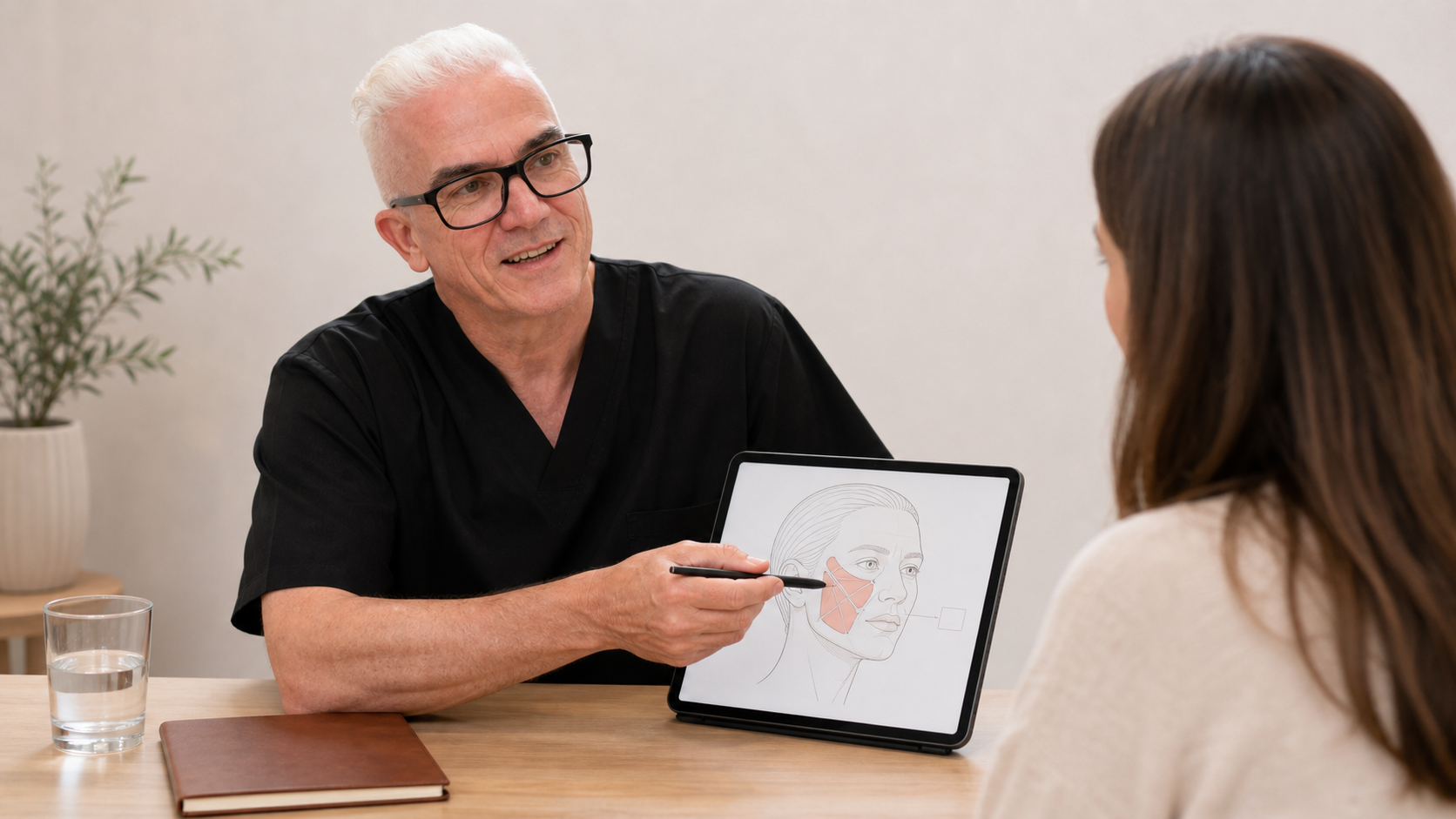
Facial volume treatment is not offered during pregnancy at Core Aesthetics. The decision to defer is based on the absence of safety data specific to pregnancy, the ethics of not enrolling pregnant patients in cosmetic trials, and alignment with TGA and AHPRA guidance.
The three timing decisions: before, during, and after
Patients planning pregnancy often fall into one of three timing scenarios. Understanding which one applies to you is the first step in practical planning.
Treatment before pregnancy begins. If you are thinking about facial volume treatment and you are also planning to try to conceive within the next 6 to 12 months, the clinical conversation is about whether to have treatment now, with the knowledge that you may become pregnant before the volume treatment has fully settled. Some patients choose to proceed anyway. Others choose to defer until after they have finished breastfeeding.
Becoming pregnant after recent treatment. If you have had volume treatment and then discover you are pregnant, no specific action is required regarding the volume treatment itself. The product used in facial volume treatment is gradually metabolised by your body. There is no clinical need to dissolve or reverse placed product because of pregnancy.
Treatment after pregnancy and breastfeeding. The most common pathway, and often the one that feels least urgent, is to schedule treatment once breastfeeding has fully ended. This allows treatment planning without the backdrop of pregnancy related physiological change, and it aligns with the conservative regulatory guidance.
Why the evidence base is thin, and why that matters
Facial volume treatment has not been studied in pregnant patients. This absence is deliberate, not accidental.
The product used in facial volume treatment is biocompatible and is gradually broken down and metabolised by the body. In theory, a small amount placed under the skin should pose minimal risk. However, “in theory” and “studied in clinical trials” are not the same thing.
Pregnancy is an ethically protected category in medical research. Enroling pregnant patients in trials for elective cosmetic procedures is not considered ethical, regardless of theoretical safety, because there is no clinical need that would justify that risk. The absence of pregnancy specific safety data is the correct outcome of that ethical protection, it is not a failure of research, it is a feature of protecting pregnant patients.
For medical treatments with strong clinical indications, medications for gestational diabetes, antibiotics for infection, blood pressure management, decisions to use them in pregnancy are made on the basis of “clinical need outweighs evidence gaps.” For elective cosmetic treatment, that calculation is straightforward: there is no clinical need, so evidence gaps make proceeding inappropriate.
The practical timing question: how far in advance should I have volume treatment done?
This depends on your personal comfort with the uncertainty, and on the type and location of the volume treatment.
If you want treatment now and you are actively trying to conceive: Facial volume treatment in the cheek, jawline, or temple area typically lasts 12 to 18 months. If you have treatment today and you conceive within the next 2 to 3 months, you will likely be about 6 months into a pregnancy when the volume treatment is at its most settled. This is clinically acceptable. The volume treatment will continue to soften and metabolise throughout your pregnancy and breastfeeding, and will be substantially absorbed by the time you return to treatment planning after weaning. Some patients are comfortable with this. Others prefer to defer entirely.
Lip treatment timing is different. Lip treatment typically softens and reduces within 6 to 12 months because the lips have high muscle activity. If you have lip treatment and you conceive quickly, you may find the result has changed significantly during your pregnancy, not because of the pregnancy itself, but because lip treatment generally has a shorter lifespan. Many patients defer lip treatment until after breastfeeding for this reason.
If you want to maximise visible result throughout your pregnancy: The longest lasting facial volume treatment placement is tear trough, which can persist 12 to 24 months. If the specific concern is undereye area, treatment done now would likely be most visible and settled during your second and third trimester when many patients feel most comfortable having photos taken. This is a legitimate clinical reason to proceed.
The decision is yours, but it is made with full information about longevity and pregnancy related changes rather than with any absolute claim.
What actually changes in your face during pregnancy
Pregnancy does produce real, observable changes to facial soft tissue and volume distribution. Understanding this is important because it affects how you should think about planning treatment.
Volume shifts. Many pregnant patients experience an increase in facial fullness, particularly in the cheeks and lips, because of changes in fluid retention and oestrogen related shifts in tissue. This can make preexisting facial volume treatment feel more noticeable or can change the overall proportion.
Hormonal skin changes. Pregnancy hormones affect oil production, melanin deposition (sometimes causing melasma), and skin texture. These changes are independent of facial volume treatment but are noticeable enough that some patients find their treatment priorities shift. A patient who was concerned about cheek volume before pregnancy may find that concern has changed by six months into pregnancy.
Postpartum changes. After birth, particularly after breastfeeding ends, many patients experience volume loss that feels more dramatic than pre pregnancy because it happens quickly. Cheeks that felt full during pregnancy suddenly feel less supported. This is normal, but it is important context for the decision to proceed with volume treatment now versus after.
If you become pregnant after recent treatment: what you actually need to know
If you had facial volume treatment and then discovered you are pregnant, you are in a very common situation. Reassurance first: no specific action is required regarding the volume treatment itself.
Existing facial volume treatment will not harm your pregnancy or your baby. It is not systemically absorbed at clinically significant levels and will continue to be gradually metabolised throughout your pregnancy. You do not need to have it dissolved, reversed, or removed.
What is different is that no additional volume treatment top ups or new placements are offered until after the end of both pregnancy and breastfeeding. The clinical reasoning is the same: without pregnancy specific safety data for cosmetic use, elective additional treatment is deferred.
Informing your medical team. As part of routine antenatal care, you should mention to your obstetrician that you have had facial volume treatment. This is not because there is a known risk, but because complete disclosure of any recent procedures is standard practice. Most obstetricians are familiar with this situation and will not flag it as a concern.
Monitoring the volume treatment during pregnancy. Facial volume treatment does not require any special monitoring during pregnancy. You do not need a follow up appointment with the cosmetic nurse during your pregnancy. If you experience any unusual symptoms (persistent swelling, infection signs, or acute changes), those should be discussed with your obstetrician rather than treated as a cosmetic issue.
The consultation during pregnancy option
You can have a consultation during pregnancy if you want to plan future treatment. This is often a clinically useful conversation because it gives you time to discuss your goals without booking pressure, to ask detailed questions about longevity and aftercare, and to think about whether your priorities have shifted since before pregnancy.
Consultations are clinical assessments, not appointments that lead automatically to booking treatment. During pregnancy, the consultation is purely exploratory. You will discuss your aesthetic goals, the areas you are considering, the realistic timelines for facial volume treatment in those areas, and the aftercare expectations. You will not be offered any product or treatment during the appointment itself.
Many patients find that scheduling a consultation early in pregnancy allows them to return to treatment planning quickly after breastfeeding ends, because the practical and clinical questions have already been worked through.
When you can return to treatment after birth
The technical answer: treatment is typically revisited after the end of both pregnancy and breastfeeding, not immediately after birth.
The practical answer: most patients schedule a consultation within the first one to three months after fully weaning from breastfeeding. This allows the body to return to a stable hormonal and metabolic baseline, and it gives time for postpartum volume changes to have mostly settled.
The case for a fresh assessment rather than re booking the old plan. If you had a treatment plan before pregnancy, you may notice that your facial priorities have changed. Volume loss may feel more noticeable in different areas than you expected. Your skin texture may have shifted. Breastfeeding related sleep deprivation and stress can make some patients reassess what they actually want to focus on.
For these reasons, the consultation after breastfeeding is often treated as a fresh starting point rather than a return to the previous plan. This is not a commercial upsell, it is clinical good practice. Your face has changed, and your goals may have changed too. The assessment should reflect that.
Realistic expectations about timing and change
If you do proceed with facial volume treatment before attempting pregnancy:
- Facial volume treatment is temporary. Its presence and visibility will change over the months of your pregnancy and through the breastfeeding period.
- You will not be able to have touch ups or adjustments during pregnancy or breastfeeding, so if the aesthetic outcome matters a lot to you, this is important context.
- Pregnancy and breastfeeding produce real changes to facial volume and skin texture that are independent of the volume treatment.
- Your priorities and preferences may shift, and that is normal.
This guide is not written to discourage you from having treatment before pregnancy. It is written to ensure that if you choose to proceed, you do so with clear understanding of what will and will not happen.
The regulatory and professional context
The decision to defer elective facial volume treatment during pregnancy is not a business decision. It is a professional requirement under AHPRA’s guidelines for registered nurses performing nonsurgical cosmetic procedures.
A nurse who proceeds with elective cosmetic treatment on a pregnant patient is outside those guidelines, regardless of patient preference or the nurse’s clinical judgment that the treatment is safe. This is treated as a serious professional matter.
Core Aesthetics will not proceed with any elective cosmetic treatment, facial volume treatment or wrinkle, during pregnancy under any circumstance. This is a safety position that is not negotiable.
How Facial volume treatment Is Used as a Structural Tool
Facial volume treatment is often described in terms of volume, adding more to make something look bigger. This framing misrepresents how volume treatment functions in skilled clinical practice. Volume treatment is a structural tool. It can restore lost support in areas where facial volume has diminished with age. It can define a contour that was never clearly pronounced. And in some cases it can shift the proportional relationships between facial regions in a way that changes how the face reads overall.
Volume, in the sense of visible fullness, is sometimes a goal. But the mechanism is anatomical. Volume treatment placed in the right tissue plane, at the right depth, with an understanding of the surrounding anatomy, produces a different result than volume treatment placed superficially to fill a surface irregularity. This is why technique, placement, and clinical knowledge matter far more than product selection.
At Core Aesthetics, treatment decisions are based on a full facial assessment. Corey evaluates the face as a whole before deciding whether volume treatment is appropriate, where it would be most effective, and what volume would be consistent with a proportionate outcome. This assessment may lead to a recommendation not to treat, and that outcome is equally valid.
Understanding Facial Volume Loss and Why It Matters
The face changes with age through a combination of processes: bone resorption, fat pad redistribution, muscle changes, ligament laxity, and skin quality decline. These processes do not happen uniformly or at the same rate in different people. Two people of the same age may present very differently because of genetics, lifestyle, sun exposure, and individual anatomical variation.
Volume loss is one of the most clinically significant contributors to an aged appearance. When the structural support provided by subcutaneous fat and bone diminishes, the overlying skin is no longer held in place by the same framework. Features that once appeared well defined become less distinct. The relationship between facial thirds can shift. Hollowing in specific areas, the cheeks, the temples, the under eye region, creates shadows and contours that are often interpreted as tiredness or loss of vitality.
Understanding the underlying anatomy is essential to treating it appropriately. Volume treatment placed to address a surface concern without accounting for the structural deficit beneath it will produce a less effective and less enduring result. The consultation process at Core Aesthetics focuses on identifying the anatomical contributors to the concerns you have raised, not just addressing the surface appearance.
The Assessment Process Before Any Volume treatment
At Core Aesthetics, the consultation for facial volume treatment is a structured clinical appointment, not a sales conversation. Corey assesses the face in three dimensions, at rest, during movement, and from multiple angles. The goal is to understand the structural landscape of your face before deciding where, how much, and whether volume treatment is the right approach.
Key aspects of the volume treatment assessment include evaluating facial symmetry and identifying natural asymmetries that should be preserved or addressed; assessing the depth and distribution of any volume deficit; reviewing skin quality to determine how volume treatment would integrate; and discussing your goals in the context of what is anatomically achievable. For some concerns, volume treatment alone is sufficient. For others, a combination of treatments, or a different approach entirely, may be more appropriate.
You will leave the consultation with a written treatment plan that documents the assessment findings, the proposed approach, and the expected outcomes. Treatment is scheduled at a separate appointment, allowing time to consider the plan, ask further questions, and make an informed decision without any time pressure.
Dissolution, Complications, and Revision
Hyaluronic acid volume treatments are reversible. If a complication arises, if the result is unsatisfactory, or if a patient wishes to return to their baseline, hyaluronidase enzyme can be injected to dissolve the volume treatment. This is an important safety feature that distinguishes hyaluronic acid products from permanent or semi permanent volume treatments, which cannot be dissolved.
Dissolution does not always produce an immediate return to the pretreatment state. The process requires time, and in some cases more than one dissolution treatment. Swelling from the dissolution procedure can temporarily alter appearance. Corey will explain this clearly at consultation so that patients understand what reversal involves before they commit to treatment.
At Core Aesthetics, only hyaluronic acid formulations are used for facial volume treatment, the reversibility of these products is a deliberate clinical choice. Emergency protocols for vascular occlusion, the most serious potential complication of volume treatment, are maintained at the clinic. Patients are briefed on the signs of this complication and given emergency contact instructions as part of every treatment appointment.
Clinical accountability and how volume treatment decisions are made
The volume treatment related guidance in “Facial volume treatment and Pregnancy: A Planning Guide” reflects how Corey Anderson, AHPRA registered nurse (NMW0001047575), approaches facial volume treatment decisions at Core Aesthetics: anatomy led, conservative on volume, and willing to defer or refuse treatment when the assessment doesn’t support it. Volume treatment is a structural intervention. The decisions about where, how much, what depth, and what cannula or needle approach are clinical judgements that depend on the individual face in front of the practitioner. Results vary between individuals, and the same volume can read very differently on two faces with different bone structure, fat pad distribution, or skin quality.
Specific to facial volume treatment pregnancy: the assessment Core Aesthetics performs before any volume treatment includes facial proportions, skin quality, prior treatment history, and the patient’s stated goals, and considers whether facial volume treatment is the right intervention at all. For some patients, the right answer is no volume treatment this visit. For others, the right answer is a smaller amount than the patient anticipated. For others, the right answer is to address skin quality or to dissolve existing volume treatment before considering anything new. Results vary between individuals, and a conservative starting dose is almost always the better long term decision. The treatment correction after previous treatment Melbourne page covers an adjacent volume treatment decision in more depth.
Patients reading this page who want to verify Corey Anderson’s AHPRA registration can do so directly on the AHPRA public register at ahpra.gov.au using registration number NMW0001047575. The Core Aesthetics clinic operates from 12A Atherton Road, Oakleigh VIC 3166, Tuesday to Saturday, by consultation appointment. All new patient treatment at Core Aesthetics follows a structured clinical consultation, consistent with the September 2025 AHPRA cosmetic procedures guidelines. Treatment may be scheduled for the same day as consultation or at a subsequent appointment, depending on clinical assessment and individual circumstances. Patients with questions about the content on this page can raise them at consultation; the practitioner is happy to walk through any clinical reasoning that the written content does not fully capture. Results vary between individuals, and the consultation is the appropriate place to discuss what those individual variations mean for a specific person’s treatment plan.
Is this for you?
Consider booking a consultation if
- Patients who are planning pregnancy and want to know whether to have facial volume treatment before attempting conception
- Patients who are trying to conceive and have had recent facial volume treatment and want reassurance
- Patients who have become pregnant after recent treatment and want to understand what happens next
- Patients who want to plan treatment for the post breastfeeding period
This may not be for you if
- Patients who are already pregnant and want to proceed with facial volume treatment, Core Aesthetics does not offer this under any circumstance
- Patients who are actively breastfeeding and want to proceed with treatment, the same deferral applies
- Patients under 18 years of age, regardless of pregnancy status
- —
Suitability is confirmed at consultation. This list is general guidance, not a substitute for clinical assessment.
Frequently asked questions
Is volume treatment offered to pregnant clients?
No. Core Aesthetics does not offer facial volume treatment to clients who are pregnant. The conservative clinical position is to defer all elective injectable treatment during pregnancy due to limited specific safety data and the elective nature of the procedure.
What about clients who are trying to conceive?
The same deferred treatment recommendation applies. Treatment with effects that persist for months may still be present during early pregnancy. Discussing timing and family planning context at consultation is appropriate before starting any treatment cycle. Results vary between individuals.
What if pregnancy is discovered after a recent treatment?
Inform both the practitioner who administered the treatment and your obstetric care provider. The clinical response varies based on the specific product and timing. Online speculation is not a substitute for individual clinical advice from both providers. Results vary between individuals.
When is it safe to consider volume treatment again after pregnancy?
After delivery and after breastfeeding has concluded, with a brief settling period. The exact timing varies individually. The postpartum face also undergoes change that’s worth allowing to settle before any major treatment plan is built. Results vary between individuals.
Can I have a consultation during pregnancy to plan future treatment?
Yes, consultations are available regardless of pregnancy status. Treatment will not be offered, but baseline assessment and discussion of future timing is appropriate. Photographs may be taken with consent for clinical record purposes.
Why is the position so conservative if volume treatment isn’t systemically absorbed?
Even when systemic absorption is minimal, the elective nature of aesthetic treatment means the risk benefit calculation favours deferring during pregnancy. There is no clinical urgency for elective cosmetic treatment that would outweigh waiting until after pregnancy.
Who reviews the volume treatment related clinical content on this page?
Should I get facial volume treatment if I am not certain I need it?
Uncertainty about whether treatment is appropriate is a valid reason to book a consultation rather than treatment. A clinical assessment can clarify whether volume loss, structural descent or skin quality change is the primary driver of what you are noticing, and whether injectable volume treatment is the right approach. Treatment is never assumed at assessment.