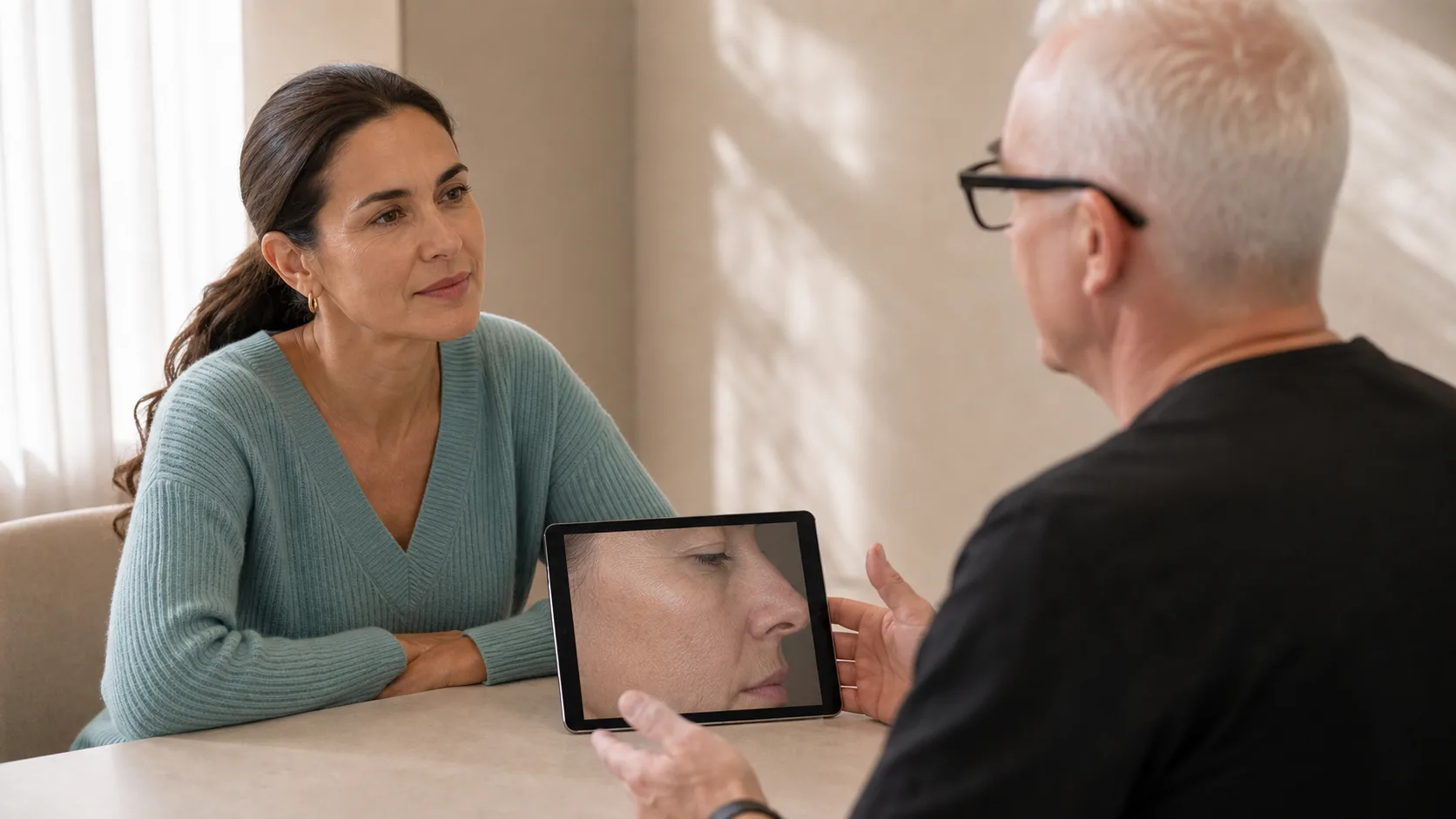
A clinical guide to facial changes from the fifth decade onward. The anatomical changes that become more pronounced, the intervention questions that become more nuanced, and what cosmetic injectable treatment can realistically do at this stage of life.
What is happening anatomically in the 50s and beyond
The 50s typically bring the most visible decade on decade change of adult life. Bone resorption that was beginning in the 40s becomes substantively visible: the orbit becomes more prominent because the bone of the brow has resorbed; the maxilla retracts slightly, changing mid face proportions; the mandible loses height and width gradually, changing jawline and chin definition.
Fat pad changes become more pronounced. The cheek fat pads have continued their gradual repositioning, often appearing as substantial flattening of the upper cheek and mid face hollowness. The buccal fat may begin to reduce, affecting the contour of the cheek jaw transition. The neck and submental area may show fat pattern changes.
Skin quality changes accelerate further. Skin elasticity is meaningfully reduced compared to the 30s and 40s. Pigmentation, texture, fine wrinkle patterns, and overall surface ageing are now substantively visible. For women, perimenopause and menopause produce specific skin and facial changes including reduced collagen production, changes in fat distribution, and sometimes altered hair pattern.
Static lines are now established and visible regardless of expression. Forehead lines, glabellar lines, crows feet, nasolabial folds, marionette lines, and lip lines are all typically present at rest. The pattern is individual; some patients show more change in some areas than others depending on genetics, life circumstances, and prior treatment history.
What intervention questions become more nuanced
Cosmetic injectable treatment in the 50s and beyond is more clinically nuanced than in earlier decades. The intervention questions are no longer “should I start treatment” or “what should I add”; they often involve more substantive trade off discussions.
How much volume restoration is appropriate when bone resorption has reduced the underlying scaffold that volume sits on? Adding filler to compensate for bone loss can produce unnatural proportions if not done carefully; the consultation discussion engages with this trade off explicitly.
How to balance volume restoration against weight changes? Many patients in their 50s and beyond gain or lose weight in patterns that affect facial appearance. Treatment plans need to accommodate these patterns rather than assuming a stable baseline.
Whether continued additive treatment serves the patient’s current goals, or whether selective dissolution and replanning would better suit them. Patients with decades of cumulative treatment may benefit from comprehensive reassessment rather than continued addition.
How to coordinate cosmetic injectable treatment with other intervention layers that may now be relevant: dermatology for skin quality, surgical consultation for structural concerns that exceed what injectable treatment can address, hormonal review for menopause related changes that affect facial appearance.
What cosmetic injectable treatment can realistically do
Cosmetic injectable treatment in the 50s and beyond can support a balanced read of the face during continued ageing. It can soften visible changes, restore subtle volume to areas where loss is most pronounced, and contribute to a healthier looking baseline. It cannot reverse ageing, restore the face of an earlier decade, or replace the structural changes that are happening at the bone and tissue level.
What it can do well: targeted volume restoration in the mid face that supports natural cheek contour; jawline support that restores some definition lost to gradual change; small lip volume restoration that maintains lip presence as natural lip volume reduces; conservative anti-wrinkle treatment that softens established static lines.
What it cannot do: replace surgical interventions for substantial structural change (significant skin laxity, jowl prominence beyond what filler can address, eyelid changes that warrant blepharoplasty consideration); reverse the effects of decades of sun exposure on skin quality; permanently halt continued ageing.
Patients in this age bracket who have realistic expectations about what cosmetic injectable treatment can do tend to have substantially more satisfying outcomes than patients whose expectations are calibrated to what they have seen in heavily edited images.
The conversation about whether to continue treatment
Some patients in their 50s, 60s, and beyond reach a point where the question is not “what new treatment should I have” but “should I continue cosmetic injectable treatment at all.” The reasons vary: priorities shift; the time and financial commitment may no longer fit; the patient may want to engage with their natural ageing rather than continuing to soften it; the cumulative pattern of treatment may have produced an outcome the patient is now reassessing.
The consultation supports patients through these conversations as much as it supports new treatment conversations. Some patients reach the conclusion that continued maintenance is right for them; others reach the conclusion that pausing or stopping is right. Both are legitimate decisions and the clinic respects both.
Patients choosing to stop treatment do not need to dissolve existing filler immediately. Hyaluronic acid filler typically continues to break down naturally over months to years. The patient’s face will gradually transition to its new baseline as the filler resolves. Some patients prefer to dissolve actively to accelerate this transition; others prefer the gradual approach.
Long horizon planning beyond the 50s
Patients on a long term Core Longevity Plan often reach the comprehensive Reassessment phase in the 50s or early 60s if they began treatment in their 30s or 40s. The Reassessment is structured to engage with the question of whether the current pattern still serves the patient’s goals, whether modifications are needed, or whether the plan should be substantively changed.
For patients beginning cosmetic injectable treatment for the first time in their 50s or beyond, the planning horizon is shorter and the priorities may be different. Some patients want a single course of treatment for a specific event or period; others want ongoing maintenance into later life. Both approaches are reasonable and the consultation supports the patient’s actual priorities rather than assuming a default.
Clinical accountability and how this guide is reviewed
The clinical content on this page is written and reviewed by Corey Anderson, AHPRA registered nurse (NMW0001047575). The content reflects how Core Aesthetics frames this clinical conversation in practice. Results vary between individuals; the descriptions on this page refer to typical patterns rather than what every patient will experience.
Patients can verify Corey Anderson’s AHPRA registration on the public register at ahpra.gov.au using number NMW0001047575. The Core Aesthetics clinic operates from 12A Atherton Road, Oakleigh VIC 3166, by consultation appointment. All new patient treatment at Core Aesthetics follows a structured clinical consultation, consistent with the September 2025 AHPRA cosmetic procedures guidelines. The team page covers the practitioner background.
Is this for you?
Consider booking a consultation if
- Patients in their 50s and beyond considering cosmetic injectable treatment, whether new or continuing
- Patients with decades of treatment history reassessing their approach in mid life
- Patients researching realistic expectations for cosmetic injectable treatment in mature anatomy
- Patients dealing with menopause related facial changes considering cosmetic injectable options
This may not be for you if
- Patients seeking dramatic anti ageing transformation rather than balanced support of natural change
- Patients seeking same day cosmetic injectable treatment without separate consultation
- Patients seeking surgical interventions (this clinic offers cosmetic injectable treatment only)
- Patients under 18 years of age
Suitability is confirmed at consultation. This list is general guidance, not a substitute for clinical assessment.
Frequently asked questions
Is it too late to start cosmetic injectable treatment in my 50s or beyond?
No. Many patients begin cosmetic injectable treatment for the first time in their 50s, 60s, or later and have positive outcomes. The treatment indications and goals may differ from younger patients but treatment is appropriate for many patients in this age bracket.
Will I need more treatment in my 50s than I needed in my 40s?
Possibly, depending on individual ageing patterns, treatment goals, and prior treatment history. Some patients find their treatment intensity stable; others find it shifts. The maintenance review appointments engage with this question explicitly.
How does menopause affect cosmetic injectable treatment?
Menopause produces specific skin and facial changes including reduced collagen production, changes in fat distribution, and sometimes altered hair pattern. The consultation discussion in this age bracket often engages with menopause related changes and how they interact with cosmetic injectable treatment planning.
When should cosmetic injectables stop being the answer?
For some patients, never; cosmetic injectable treatment continues to provide value through later life. For other patients, there is a point where structural changes exceed what injectable treatment can address and surgical consultation becomes more relevant, or where priorities shift and continued maintenance no longer fits. The dedicated <a href="https://www.coreaesthetics.com.au/when-cosmetic-injectables-stop-being-the-answer/">when cosmetic injectables stop being the answer</a> page covers this in more depth.
Should I dissolve all my filler if I stop treatment?
Not necessarily. Hyaluronic acid filler typically resolves naturally over months to years if not maintained. Patients who choose to stop treatment can let existing filler resolve gradually or can choose active dissolution to accelerate the transition. Both approaches are reasonable and discussed at consultation if relevant.
Can I have cosmetic injectable treatment in my 70s?
Yes, age alone is not a contraindication. The clinical picture and individual health considerations matter more than chronological age. Patients in their 70s and 80s do have cosmetic injectable treatment when the consultation supports it.
What other interventions might I consider alongside cosmetic injectables in my 50s?
Dermatology for skin quality concerns, surgical consultation if structural changes exceed what injectable treatment can address, hormonal review for menopause related changes if not already managed, and skincare commitment beyond the cosmetic injectable scope. These are typically discussed at consultation as part of broader planning.
How do realistic expectations change in the 50s and beyond?
Patients who calibrate expectations to balanced support of continued ageing tend to have more satisfying outcomes than patients whose expectations are calibrated to reversal or to heavily edited media images. The consultation discussion can help recalibrate expectations if needed; this is part of the informed consent conversation.