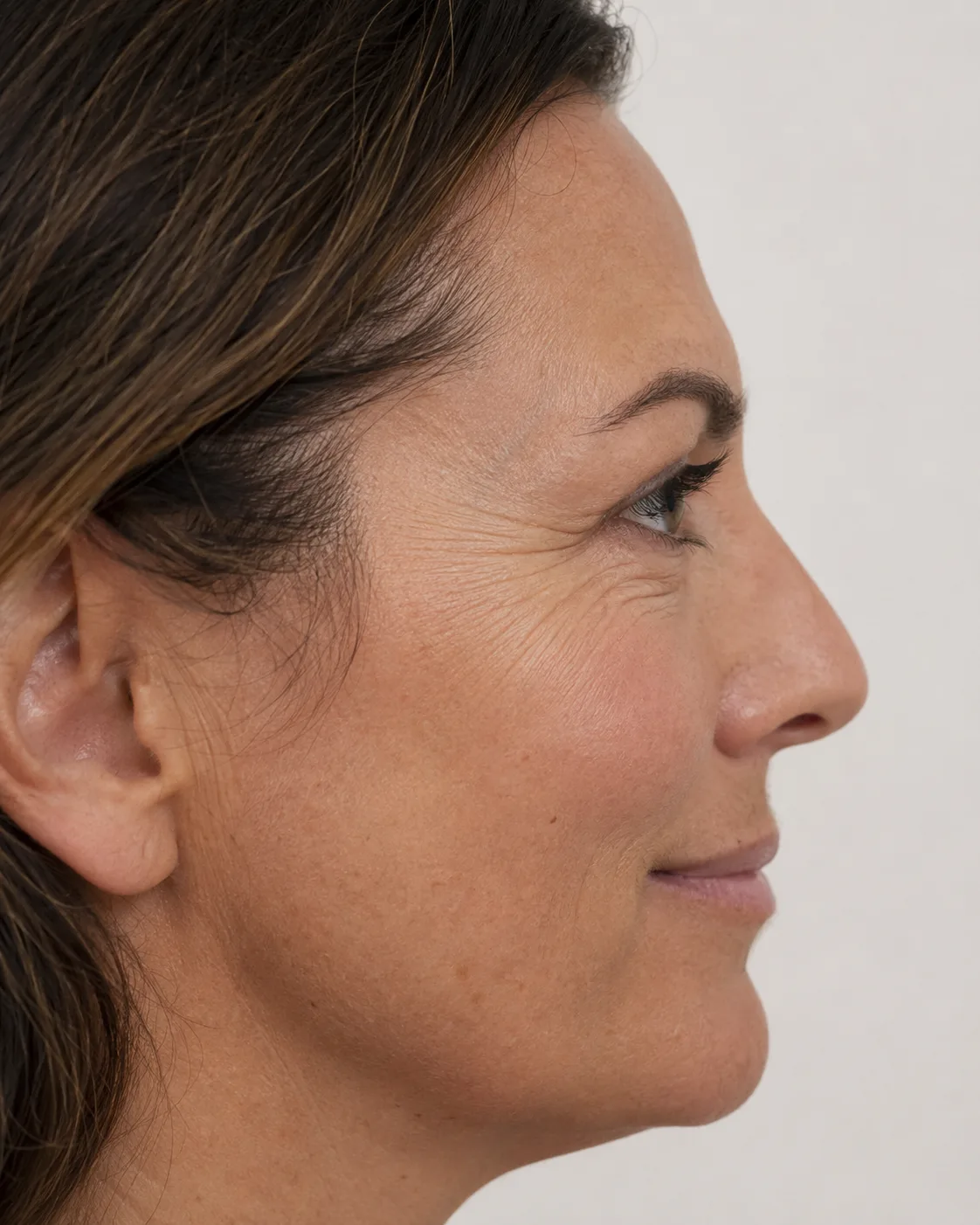
There is no single answer. Facial volume treatment longevity depends on which area was treated, how much product was placed, your individual physiology, and the kind of facial movement that area sees At Core Aesthetics, individual assessment guides every treatment decision.
Volume treatment longevity isn’t one number
Patients often arrive asking how long volume treatment “lasts” expecting a fixed answer. The honest answer is that volume treatment is a temporary product that softens and reduces gradually over many months, and the visible result usually persists longer than the product itself remains structurally distinct. By the time a review is scheduled, what is being assessed is rarely a clean before and after picture. It is a face that has settled into a new equilibrium, with some product still doing structural work, some absorbed, and the rest of the face having continued its own gradual change.
This is why the question is often more usefully framed as “when should I review?” rather than “when will it wear off?” Reviews are scheduled around the typical window for the area treated, not because the product disappears on a calendar date, but because that is the right time to assess what has settled, what has resolved, and whether maintenance is appropriate.
What genuinely affects how long your volume treatment lasts
Five things matter more than the rest:
Where it was placed. Areas with high muscle activity break down product faster than static areas. Lips move thousands of times a day; tear troughs barely move at all. That single factor is responsible for most of the variation between treated areas.
How much product was placed. Larger volumes can persist longer in absolute terms, but conservative dosing is generally preferred at Core Aesthetics for clinical, aesthetic and longevity reasons combined. Being conservative does not necessarily mean shorter results, it often means a more proportionate result that ages alongside the rest of the face.
Your metabolism and physiology. Some patients metabolise volume treatment faster than the average. Hormonal factors, lifestyle factors and the immune response all play small roles. None of this is a defect in the product or the placement; it is normal individual variation that explains why two patients with similar treatments have different timelines.
Placement technique and depth. Deeper placement, more structural placement, and placement onto bone tend to persist longer than superficial placement. The clinical assessment determines what is appropriate for the goal, not the goal of “how long will it last”.
What you do afterwards. Significant heat, vigorous prolonged exercise immediately after treatment, repeated facial massage in the early weeks, and certain non injectable treatments in the same area can affect how volume treatment integrates. Aftercare guidance addresses each of these specifically.
Lips, typically six to twelve months
The lips have the most muscle activity of any area routinely treated with volume treatment. They move during eating, drinking, speaking, smiling and expression all day, and most patients see lip treatment integrate, settle and gradually reduce within six to twelve months from placement.
Most lip treatment patients are reviewed at around the nine month mark. By that point swelling has long resolved, integration is complete, and the practitioner can assess whether the lip shape that was achieved at placement has held, softened, or shifted. Some patients return slightly earlier because they prefer a particular fullness; others return later because the residual structure has held the shape they wanted.
Cheek and midface, typically twelve to eighteen months
Cheek and midface treatment typically persists longer than lip placement because the area sees less day to day muscle activity. Most patients are reviewed at around twelve to fifteen months after midface treatment, with some persistence extending towards eighteen months in patients whose metabolism is on the slower end of the range.
Midface placement does meaningful structural work, it provides projection over the zygomatic bone, supports the upper cheek, and influences how light falls on the face. When that structural work begins to soften, what is often noticeable first is not the disappearance of cheek volume but a return of secondary changes: a slight shadow under the cheekbone, a softening of the lid cheek junction, a deepening of the nasolabial fold. The review appointment is where those secondary signals are interpreted and a maintenance plan, if appropriate, is discussed.
Jawline and chin, typically twelve to eighteen months
Jawline and chin treatment generally persist in a similar range to midface placement because both areas are relatively low motion. Patients are typically reviewed around twelve to fifteen months after lower face treatment.
A practical complication for the jawline specifically is bruxism, habitual clenching or grinding, often during sleep. Patients who clench or grind heavily can metabolise jawline placement faster than average because the surrounding muscle activity does shorten persistence. Patients who clench tend to be aware of it, and a clinical conversation about bruxism is often part of the original assessment rather than a finding at review.
Chin placement, like jawline placement, is often in service of facial proportion rather than fullness. Where it has been used to balance a recessive chin, the structural change can persist for the full duration even when patients perceive softening at the edges.
Tear trough and undereye, typically twelve to twenty four months
Tear trough is the longest lasting placement at Core Aesthetics, and the most clinically considered. The undereye area has very little muscle activity, limited lymphatic drainage, and a small volume of placement is doing precise work. As a result, product placed in this area can persist well beyond the cheek timeframe, twelve to twenty four months is a reasonable guide.
Two clinically important points follow from this:
The first is that conservative dosing matters more in tear trough than anywhere else. A small over correction in the undereye is more visible, more difficult to dissolve cleanly and more disruptive to recovery than a small over correction in the cheek. Conservative placement that lasts twenty four months is preferable to confident placement that needs partial dissolving in three weeks.
The second is that review timing is different. Tear trough reviews are typically scheduled at twelve months, not because product is expected to be gone by then, but because it is the earliest sensible point to discuss whether anything further is needed. Most tear trough patients return for one review and do not need additional product placed.
Temple treatment, typically twelve to eighteen months
Temple placement persists in a similar range to cheek and jawline treatment because the temporal area, like the upper cheek, is relatively low motion. Patients are typically reviewed at around the twelve month mark. Temple placement is often a quiet structural treatment, most observers cannot identify what was treated, only that the upper face looks fuller and more rested. Because of this, the review appointment is usually a clinical assessment rather than a top up by default.
Why review appointments are not the same as top ups
A review is a clinical reassessment. The practitioner looks at how the original placement has settled, what has changed in the face since (not all change is volume treatment related), and what the priorities are now. That conversation often concludes with no further treatment in the same session, sometimes because the original placement is still doing its work, sometimes because a different area has emerged as the next priority, sometimes because skin quality changes or volume loss elsewhere should be addressed before adding to a previously treated area.
A top up is what some patients ask for. The review is often what is more useful. At Core Aesthetics this distinction is not a matter of upselling or downselling; it is a matter of treating the face that is in front of the practitioner today rather than re treating to match the face from a year ago.
When the question is "should I dissolve and start fresh?"
A small number of patients ask, at review, whether dissolving existing volume treatment and starting again would produce a better outcome than adding more. This is a clinical question and the answer depends on individual circumstances, the location of the original placement, the kind of correction being aimed for, and whether the original placement is still in proportion with the rest of the face. Where dissolving is appropriate it is straightforward; where it is not appropriate, that is also a useful conversation. Read more about dissolving facial volume treatment at Core Aesthetics.
Realistic expectations
Volume treatment is a temporary, individualised treatment. The duration ranges described above are starting points for clinical planning, not promises. Some patients will see results inside the lower end of the range; some will see results extend beyond the upper end. Maintenance, when it is appropriate, is rarely a question of “every twelve months on the dot”, it is a question of when the face benefits from another conversation.
Treatment outcomes, suitability, and longevity all vary by individual. The duration of any specific treatment is determined at consultation rather than claimed in advance.
How Facial volume treatment Is Used as a Structural Tool
Facial volume treatment is often described in terms of volume, adding more to make something look bigger. This framing misrepresents how volume treatment functions in skilled clinical practice. Volume treatment is a structural tool. It can restore lost support in areas where facial volume has diminished with age. It can define a contour that was never clearly pronounced. And in some cases it can shift the proportional relationships between facial regions in a way that changes how the face reads overall.
Volume, in the sense of visible fullness, is sometimes a goal. But the mechanism is anatomical. Volume treatment placed in the right tissue plane, at the right depth, with an understanding of the surrounding anatomy, produces a different result than volume treatment placed superficially to fill a surface irregularity. This is why technique, placement, and clinical knowledge matter far more than product selection.
At Core Aesthetics, treatment decisions are based on a full facial assessment. Corey evaluates the face as a whole before deciding whether volume treatment is appropriate, where it would be most effective, and what volume would be consistent with a proportionate outcome. This assessment may lead to a recommendation not to treat, and that outcome is equally valid.
Understanding Facial Volume Loss and Why It Matters
The face changes with age through a combination of processes: bone resorption, fat pad redistribution, muscle changes, ligament laxity, and skin quality decline. These processes do not happen uniformly or at the same rate in different people. Two people of the same age may present very differently because of genetics, lifestyle, sun exposure, and individual anatomical variation.
Volume loss is one of the most clinically significant contributors to an aged appearance. When the structural support provided by subcutaneous fat and bone diminishes, the overlying skin is no longer held in place by the same framework. Features that once appeared well defined become less distinct. The relationship between facial thirds can shift. Hollowing in specific areas, the cheeks, the temples, the under eye region, creates shadows and contours that are often interpreted as tiredness or loss of vitality.
Understanding the underlying anatomy is essential to treating it appropriately. Volume treatment placed to address a surface concern without accounting for the structural deficit beneath it will produce a less effective and less enduring result. The consultation process at Core Aesthetics focuses on identifying the anatomical contributors to the concerns you have raised, not just addressing the surface appearance.
The Assessment Process Before Any Volume treatment
At Core Aesthetics, the consultation for facial volume treatment is a structured clinical appointment, not a sales conversation. Corey assesses the face in three dimensions, at rest, during movement, and from multiple angles. The goal is to understand the structural landscape of your face before deciding where, how much, and whether volume treatment is the right approach.
Key aspects of the volume treatment assessment include evaluating facial symmetry and identifying natural asymmetries that should be preserved or addressed; assessing the depth and distribution of any volume deficit; reviewing skin quality to determine how volume treatment would integrate; and discussing your goals in the context of what is anatomically achievable. For some concerns, volume treatment alone is sufficient. For others, a combination of treatments, or a different approach entirely, may be more appropriate.
You will leave the consultation with a written treatment plan that documents the assessment findings, the proposed approach, and the expected outcomes. Treatment is scheduled at a separate appointment, allowing time to consider the plan, ask further questions, and make an informed decision without any time pressure.
Dissolution, Complications, and Revision
Hyaluronic acid volume treatments are reversible. If a complication arises, if the result is unsatisfactory, or if a patient wishes to return to their baseline, hyaluronidase enzyme can be injected to dissolve the volume treatment. This is an important safety feature that distinguishes hyaluronic acid products from permanent or semi permanent volume treatments, which cannot be dissolved.
Dissolution does not always produce an immediate return to the pretreatment state. The process requires time, and in some cases more than one dissolution treatment. Swelling from the dissolution procedure can temporarily alter appearance. Corey will explain this clearly at consultation so that patients understand what reversal involves before they commit to treatment.
At Core Aesthetics, only hyaluronic acid formulations are used for facial volume treatment, the reversibility of these products is a deliberate clinical choice. Emergency protocols for vascular occlusion, the most serious potential complication of volume treatment, are maintained at the clinic. Patients are briefed on the signs of this complication and given emergency contact instructions as part of every treatment appointment.
Clinical accountability and how volume treatment decisions are made
The volume treatment related guidance in “How Long Does Facial volume treatment Last?” reflects how Corey Anderson, AHPRA registered nurse (NMW0001047575), approaches facial volume treatment decisions at Core Aesthetics: anatomy led, conservative on volume, and willing to defer or refuse treatment when the assessment doesn’t support it. Volume treatment is a structural intervention. The decisions about where, how much, what depth, and what cannula or needle approach are clinical judgements that depend on the individual face in front of the practitioner. Results vary between individuals, and the same volume can read very differently on two faces with different bone structure, fat pad distribution, or skin quality.
Specific to how long does facial volume treatment last: the assessment Core Aesthetics performs before any volume treatment includes facial proportions, skin quality, prior treatment history, and the patient’s stated goals, and considers whether facial volume treatment is the right intervention at all. For some patients, the right answer is no volume treatment this visit. For others, the right answer is a smaller amount than the patient anticipated. For others, the right answer is to address skin quality or to dissolve existing volume treatment before considering anything new. Results vary between individuals, and a conservative starting dose is almost always the better long term decision. The how long does jawline treatment last page covers an adjacent volume treatment decision in more depth.
Patients reading this page who want to verify Corey Anderson’s AHPRA registration can do so directly on the AHPRA public register at ahpra.gov.au using registration number NMW0001047575. The Core Aesthetics clinic operates from 12A Atherton Road, Oakleigh VIC 3166, Tuesday to Saturday, by consultation appointment. All new patient treatment at Core Aesthetics follows a structured clinical consultation, consistent with the September 2025 AHPRA cosmetic procedures guidelines. Treatment may be scheduled for the same day as consultation or at a subsequent appointment, depending on clinical assessment and individual circumstances. Patients with questions about the content on this page can raise them at consultation; the practitioner is happy to walk through any clinical reasoning that the written content does not fully capture. Results vary between individuals, and the consultation is the appropriate place to discuss what those individual variations mean for a specific person’s treatment plan.
Is this for you?
Consider booking a consultation if
- Patients who have had facial volume treatment and want a realistic understanding of timelines
- Patients researching facial volume treatment ahead of a first consultation
- Patients comparing what they have been told elsewhere with practitioner delivered information
- Patients planning maintenance and trying to budget review timing
This may not be for you if
- Anyone seeking a predetermined duration figure, this guide explains why such absolute claims are not clinically honest
- Anyone seeking a recommendation for a specific brand or product, products are determined at consultation in line with TGA prescribing rules
- Anyone under 18, facial volume treatment is not appropriate for minors regardless of timing
Suitability is confirmed at consultation. This list is general guidance, not a substitute for clinical assessment.
Frequently asked questions
Why does facial volume treatment duration vary so much by area?
Areas with high daily mobility (lips, mouth) metabolise volume treatment faster. Areas with low mobility (temple, cheek, chin) typically settle for longer. The body’s natural turnover of the soft tissue product is influenced by movement and individual metabolism. Results vary between individuals.
What is the typical duration range across areas?
Lips: 6-12 months. Cheeks: 12-18 months. Chin: 12-18 months. Jawline: 12-18 months. Tear trough: 12-18 months. Temple: 12-18+ months. Nasolabial: 9-15 months. These are typical ranges; individual results vary.
Does volume treatment disappear suddenly at the end of its duration?
No, the product gradually metabolises rather than ending sharply. Most clients experience a slow softening of the structural effect over weeks. The next decision (top up, reduce, or pause) is made at follow up based on the resulting position. Results vary between individuals.
Does the second appointment in the same area last longer?
Sometimes yes. Many clients find the second cycle settles for slightly longer than the first as the tissue adjusts. The interval between treatments tends to lengthen across the first few cycles before settling into a maintenance pattern. Results vary between individuals.
What individual factors affect volume treatment duration?
Individual metabolism, the specific area treated, the volume placed, the depth of placement, the client’s facial movement patterns, and exercise level. Each client’s pattern is observed across cycles rather than predicted in advance. Results vary between individuals.
How is the maintenance interval determined?
By assessment at the review appointment. The interval is whatever the individual response and the client’s preference suggest. Some clients return at twelve month intervals; some at eighteen; some less frequently. The plan is individual. Results vary between individuals.
Who reviews the volume treatment related clinical content on this page?
Should I get facial volume treatment if I am not certain I need it?
Uncertainty about whether treatment is appropriate is a valid reason to book a consultation rather than treatment. A clinical assessment can clarify whether volume loss, structural descent or skin quality change is the primary driver of what you are noticing, and whether injectable volume treatment is the right approach. Treatment is never assumed at assessment.
Is it safe to have facial volume treatment while pregnant or breastfeeding?
Prescription injectable products are not recommended during pregnancy or breastfeeding. There is insufficient safety data on these products in pregnant or lactating individuals, and the precautionary standard is to defer treatment until after this period. If you are pregnant, planning pregnancy, or breastfeeding, please discuss this at your consultation.