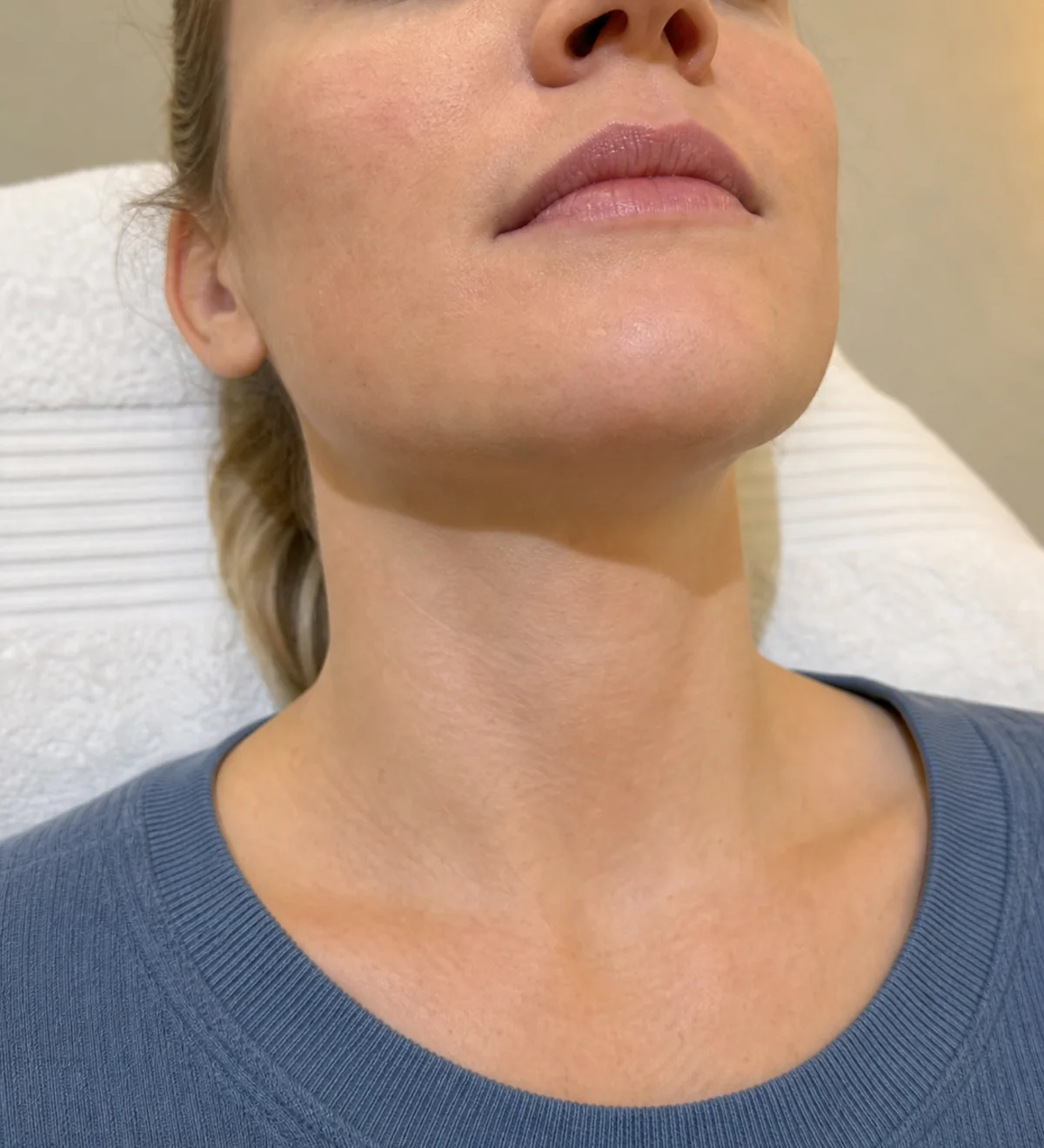
A useful platysma assessment compares the lower face and neck at rest, during ordinary speech, during a brief deliberate movement and after the neck relaxes again. Corey Anderson RN maps what changes across three regions: above the jawline, under the jaw and through the front and side of the neck. That sequence helps separate a cord or pull seen only in movement from a change that remains at rest, but it cannot diagnose the cause or establish suitability from photographs alone.
Start With One Sentence, Not An Anatomy Label
Before booking, finish this sentence: “I notice ___, in ___ part of my lower face or neck, when ___.” “A cord at the front of my neck when I speak” is more useful than deciding that you need a particular treatment. “The left mouth corner has moved differently since previous care” is more useful still.
The first description records your observation. The second step is to establish whether it appears only with movement, remains at rest, follows earlier care or arrives with symptoms outside cosmetic scope.
Use The Four View Record
| View | What to notice | What not to conclude |
|---|---|---|
| 1. Neutral rest | What remains visible after the face, jaw and shoulders settle. | That a resting line is caused by one muscle. |
| 2. Ordinary speech | Whether a cord, lower lip change or broad pull appears during normal words. | That an unusual expression represents daily movement. |
| 3. Brief deliberate activation | Which region tightens and whether the pattern is even. | That the strongest possible contraction defines the concern. |
| 4. Return to rest | What disappears, what lingers and whether discomfort occurs. | That a photograph can establish health, risk or suitability. |
A short, steady video can preserve the sequence better than four unrelated selfies. Do not repeatedly strain the neck or provoke pain for the sake of a recording.
Plot The Change Across Three Regions
For this page, the neck is divided into a practical observation map rather than a treatment template. Region one is the lower face edge above the mandible, including lower lip and mouth corner movement. Region two is beneath the jaw between the mandible and upper neck. Region three is the front and side of the cervical neck.
An anatomical study of 55 cadaver heads described facial, submandibular and cervical platysma regions with different continuation and attachment patterns. That is a reason to assess the area region by region, not evidence that a reader can locate a safe plan from a diagram.
Turn The Record Into A Six Line Note
- First noticed: date or approximate period.
- Main region: above jaw, under jaw, front or side of neck.
- Trigger: rest, speech, a familiar expression, exertion or previous care.
- Pattern: cord, broad sheet shaped tension, lower lip change, discomfort or another description.
- Side: left, right, central or both.
- Recovery: disappears at rest, partly remains, or has changed over time.
Bring earlier clinical records when the concern followed care elsewhere. The note is a memory aid, not a score or diagnosis.
Why Does Rest Versus Movement Matter?
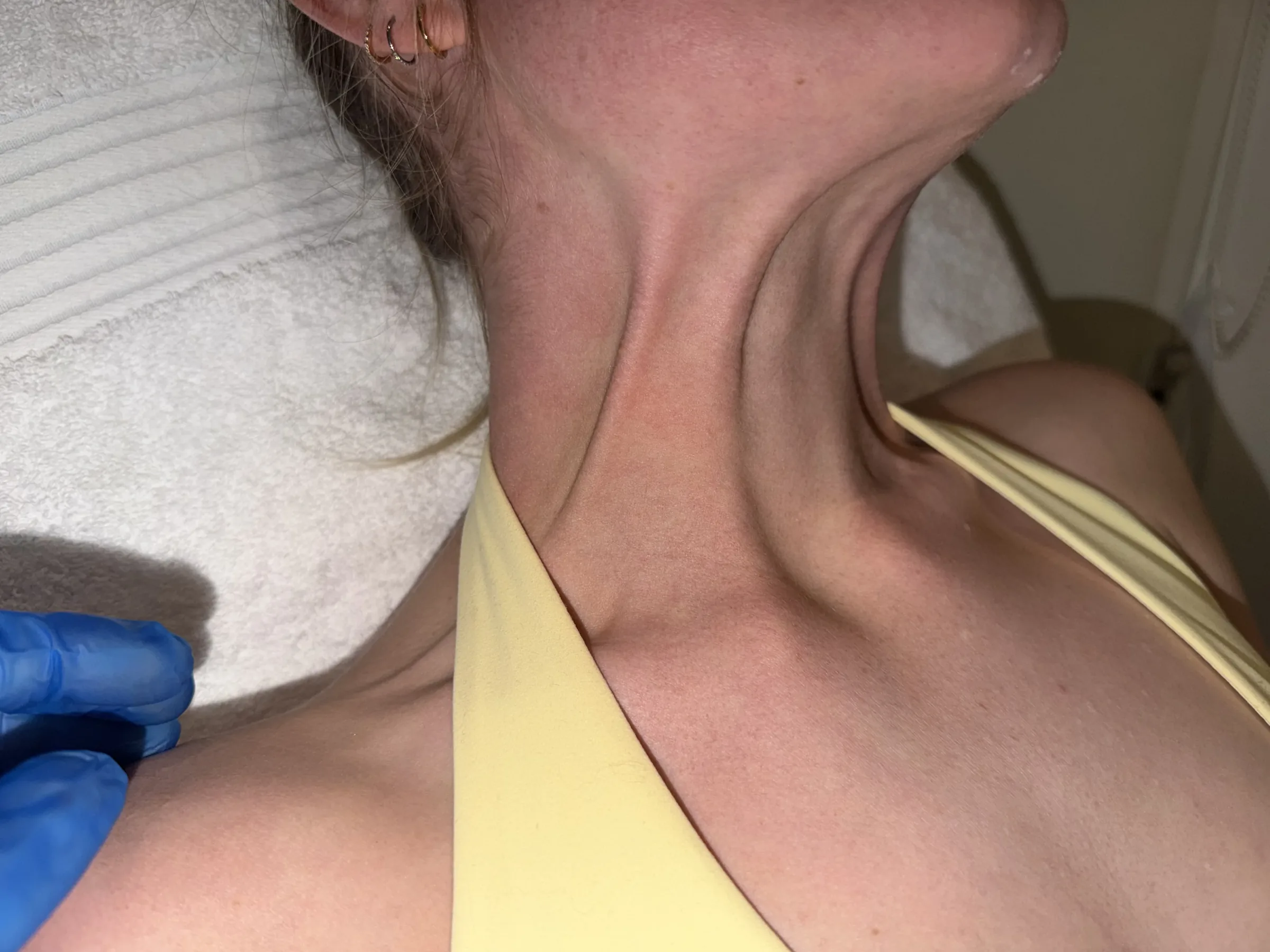
A vertical cord that appears only during movement asks a different question from skin or contour change that remains when the neck is relaxed. Both can exist together. Research comparing cadaveric findings with CT imaging suggests visible platysmal bands are not explained by contraction alone; soft tissue laxity and fascial relationships can also contribute.
That is why “the muscle moves” is not a complete explanation. Corey also reviews skin mobility, tissue position, the transition from jaw to neck, posture, symmetry and what the person actually wants clarified.
What Does Ordinary Speech Add?
Ordinary speech can show whether the lower lip, mouth corner and neck participate in the pattern that bothers you. It is more representative than holding an exaggerated pose for a photograph. Corey may compare a few familiar words with neutral rest and a brief supervised movement.
New lower lip weakness, an altered smile or speech change is not simply an appearance concern to label online. When it is sudden, unexplained, progressive or accompanied by other neurological symptoms, seek appropriate medical assessment.
Which Pattern Belongs On The Neck Band Page?
If the single concern is one or more vertical cords through the front of the neck, use the neck band assessment guide. It owns the vertical band reader question.
Stay on this page when the question crosses regions: a lower face pull with neck activity, a change beneath the jaw, different movement after previous care, or uncertainty about what is related to movement and what remains at rest.
What Happens During The Oakleigh Assessment?
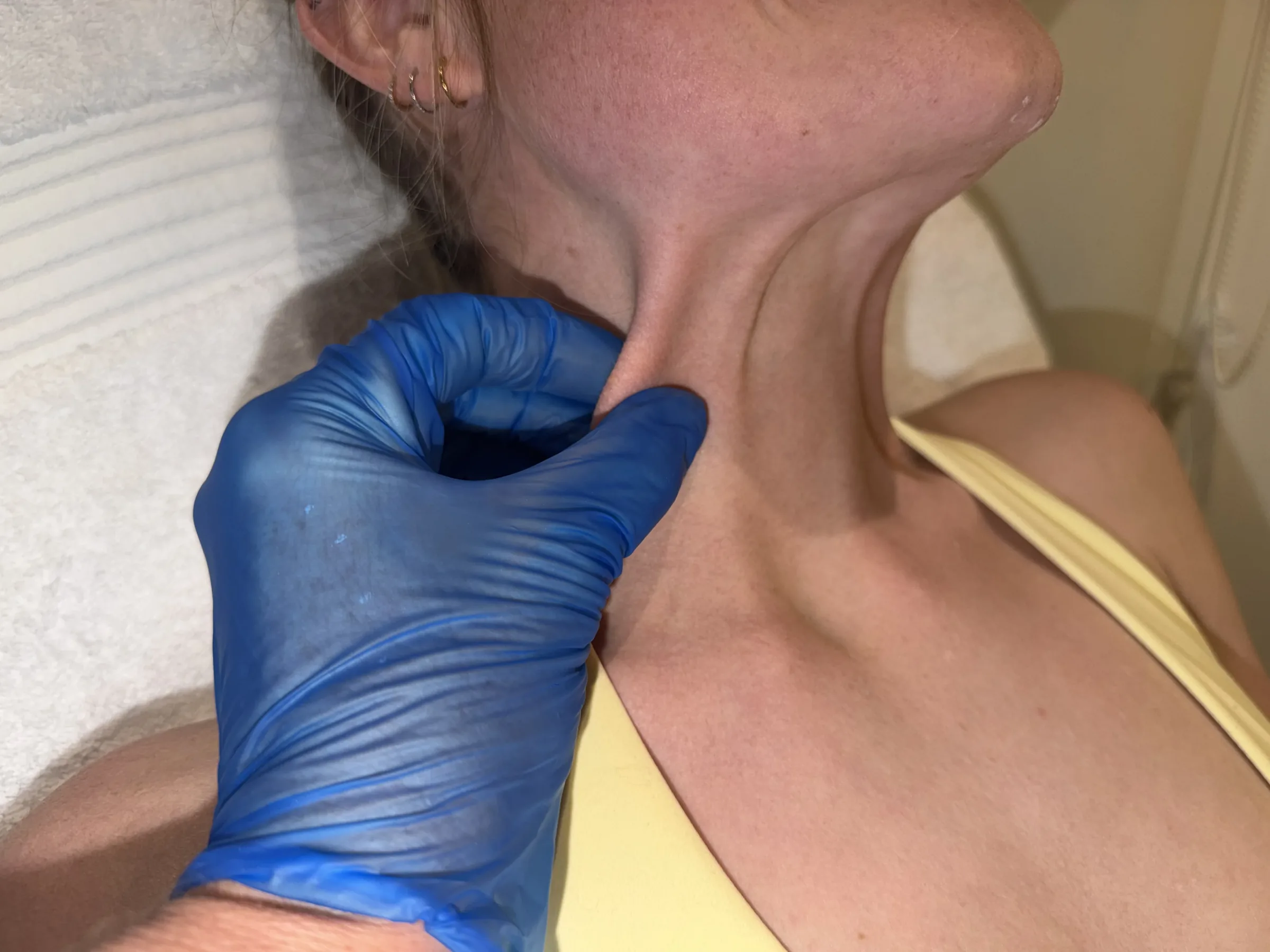
Corey first listens to the patient’s own description and reviews onset, health history, medicines, prior care and symptoms. The observation sequence is then repeated under consistent lighting and position. The lower lip and mouth corner, mandibular border, area beneath the jaw and cervical neck can be compared at rest and in movement.
Palpation and observation may add context, but the assessment still has limits. A cosmetic consultation does not replace medical, dental, ear nose and throat, neurological or surgical evaluation when the history or examination points elsewhere.
How Can Previous Care Change The Interpretation?
Record the date, area, practitioner or clinic, and any documents you have. Note whether the change began immediately, developed later, improved, remained stable or progressed. An incomplete history may make waiting or records review more responsible than adding another intervention.
Contact the original treating clinic promptly for unexpected symptoms. Difficulty swallowing or breathing, rapidly increasing swelling, severe pain, marked weakness or other urgent symptoms need timely clinical or emergency assessment rather than an online cosmetic guide.
What Can This Assessment Lead To?
| Finding | Possible next step |
|---|---|
| Movement pattern is clear and within cosmetic scope | Individual options, limitations and material risks may be discussed privately. |
| Resting tissue change is the main feature | Explain nonsurgical limits, another assessment route or another clinically appropriate pathway. |
| Earlier care is still active or records are unclear | Wait, obtain records or return to the original clinic. |
| Symptoms or weakness need diagnosis | Medical or other appropriate health assessment first. |
| The concern is minor or the balance of benefit and risk is poor | an agreed plan remains a valid outcome. |
Which Risks Need A Private Discussion?
Risk depends on the option, anatomy, health history, medicines and earlier care. For an intervention affecting neck movement, the consent discussion may need to cover temporary discomfort, bruising, swelling, asymmetry, weakness and effects involving lower face movement, speech or swallowing where relevant. The practitioner should explain warning signs, contact arrangements and the limits of correction.
This public page deliberately does not provide a dose, injection map or product recommendation. Those details are not safely transferable between people and public advertising rules also apply to prescription medicines.
When Should Cosmetic Planning Stop?
Seek appropriate health care first for new or progressive facial weakness, altered speech, difficulty swallowing or breathing, a neck lump, rapidly changing swelling, severe or persistent pain, fever or infection signs, or neurological symptoms. Call emergency services for an emergency.
Pregnancy, breastfeeding, active infection, unresolved complications, unrealistic expectations or an inability to provide informed consent can also make cosmetic care inappropriate or require delay. Care on the consultation day is never assumed from a booking.
Bring This Checklist To Consultation
- your single sentence description
- the four view observation or a short neutral video, if useful
- the three region location
- onset and change over time
- medicines, health conditions and relevant symptoms
- dates and records from previous care
- the decision you want help making
The last item might be “Is this related to movement?”, “Does it sit within cosmetic scope?” or “Would leaving it alone be more sensible?” A consultation is allowed to answer no.
Evidence Used For This Guide
- Functional anatomy of the platysma and regional innervation, a 55 cadaver head anatomical study.
- Anatomical basis for platysmal banding, combining cadaver dissection and CT imaging.
- Anatomy of the Platysma Muscle, an anatomical review.
- Decoding the ageing neck, examining skin elasticity, muscle activity and displacement.
- Ahpra public register for practitioner verification.
- Ahpra advertising hub for public health service advertising responsibilities.
- Nursing and Midwifery Board frameworks for professional practice and decision making resources.
Sources were checked on 16 July 2026. Anatomical studies explain why regional and dynamic assessment matters; they do not prove that a procedure is suitable for an individual.
Verify The Clinic Before Booking
Core Aesthetics is at 12A Atherton Road, Oakleigh VIC 3166. Corey Anderson is listed as a Registered Nurse with Ahpra registration NMW0001047575. You can check the clinic verification page and the Ahpra public register before booking.
This page provides general adult education. It is not a diagnosis, personal medical advice or a treatment recommendation.
Platysma Assessment Questions
What is the platysma?
The platysma is a thin, broad superficial muscle extending across parts of the lower face and front and side of the neck. Anatomical studies describe regional variation, so it should not be treated as one uniform sheet with one predictable appearance.
What four views are useful for platysma assessment?
Compare neutral rest, ordinary speech, one brief deliberate movement and the return to rest. Record what appears, where it appears, whether it is even and what remains after relaxation. This is an observation record, not a diagnosis.
Which three regions does this guide map?
It maps the lower face edge above the jaw, the area under the jaw and the front or side of the cervical neck. The regions help describe location consistently; they are not a treatment map.
Are visible neck bands caused only by muscle contraction?
Not necessarily. Published anatomical and imaging research indicates that soft tissue laxity and fascial relationships can contribute as well. Rest, movement, skin and tissue context need to be considered together.
Can I diagnose a platysma concern from photographs?
No. Photographs or a short video can preserve what you notice, but they cannot establish cause, health status, individual risk or treatment suitability. History and an appropriate examination remain necessary.
Should I use this page or the neck band page?
Use the neck band page when the concern is mainly vertical cords through the front of the neck. This page is more useful when the concern crosses the lower face, area under the jaw and neck regions or changes between rest and movement.
Why might Corey ask me to speak during assessment?
Ordinary speech can show how the lower lip, mouth corner and neck participate in familiar movement. It may be more representative than an exaggerated pose, but it is only one part of the assessment.
What should I bring after previous care?
Bring the approximate date, area, practitioner or clinic, any available records and a clear timeline of the change. Unclear or continuing earlier care may make waiting, record review or returning to the original clinic more appropriate.
Which symptoms need medical review first?
New or progressive facial weakness, altered speech, swallowing or breathing difficulty, a neck lump, rapidly changing swelling, severe pain, infection signs or neurological symptoms require appropriate health assessment. Seek emergency care for an emergency.
Will I leave knowing what happens next?
No. The appointment begins with assessment, followed by suitable options, timing and an agreed plan. Assessment, informed consent, health history, medicines, previous care, patient readiness, clinical time and the practitioner’s judgement all matter. Timing or another clinically appropriate pathway may be recommended.
Is this for you?
Consider booking a consultation if
- Adults who want to describe a lower face or neck movement concern clearly
- People comparing what appears at rest with what appears during speech or deliberate movement
- Patients whose concern crosses above the jaw, under the jaw and cervical neck regions
- People prepared for timing or another clinically appropriate pathway if the evidence does not support cosmetic care
This may not be for you if
- Anyone trying to diagnose themselves or copy a treatment map from photographs
- People with new weakness, altered speech, swallowing, breathing or neurological symptoms needing health assessment
- Anyone seeking a promised appearance change or treatment without assessment
- People unable to provide informed consent or expecting care on the consultation day automatically
Suitability is confirmed at consultation. This list is general guidance, not a substitute for clinical assessment.