Care provided in clinic and facial surgery are not smaller and larger versions of the same plan. Clinic care may address selected movement, proportion, support or skin questions within the practitioner’s scope. A facelift or other operation can physically lift, tighten, remove or reposition tissues and has distinct surgical risks, recovery, practitioner and consent requirements. Corey Anderson RN explains which part of your concern fits his scope and when a qualified surgical opinion would provide a more accurate comparison.
What Is The Core Difference Between The Pathways?
Care provided in clinic and facial surgery are not smaller and larger versions of the same plan. Clinic care may address selected movement, proportion, support or skin questions within the practitioner’s scope. A facelift or other operation can physically lift, tighten, remove or reposition tissues and has distinct surgical risks, recovery, practitioner and consent requirements. Corey Anderson RN explains which part of your concern fits his scope and when a qualified surgical opinion would provide a more accurate comparison.
The useful comparison starts with the tissue or function causing the concern. Choosing the less invasive sounding pathway first can still be unhelpful if it cannot address the main issue; choosing surgery before understanding a limited concern can be equally disproportionate.
Which Concerns May Fit Care Provided In Clinic?
Clinic planning may be relevant when the concern involves selected facial movement, proportion, contour, support or skin quality and the likely change sits within a conservative scope. Corey assesses anatomy, health, previous care, expectations and how much change the person actually wants.
Where assessment and informed consent support care, a suitable option can be planned with its material risks, limits, cost and review made clear. It should be chosen for fit, not because it is marketed as an easier substitute for surgery.
How Should The Pathways Be Compared?
Compare the purpose, process and trade offs rather than ranking one pathway above the other.
| Decision point | Care provided in clinic | Surgical pathway |
|---|---|---|
| Primary scope | Selected movement, proportion, support, contour or skin questions within practitioner scope. | Operations that may lift, tighten, remove or reposition facial and neck tissues. |
| Assessment | Individual anatomy, health, suitability, risk, expectations and consent with the treating practitioner. | Assessment by the appropriately qualified doctor or surgeon, including surgical and anaesthetic considerations. |
| Recovery and risk | Varies by option; care without surgery still carries material risks. | Distinct operative, anaesthetic, wound, scar and recovery considerations discussed by the surgical team. |
| When scope does not match | Corey should explain the limitation and suggest the relevant opinion. | A surgeon may also advise that surgery is unnecessary or that another pathway fits better. |
What Can A Surgical Opinion Clarify?
A qualified surgical consultation can assess whether excess skin, tissue descent, eyelid structure, neck laxity or another structural concern could be addressed by an operation, and explain operative risks, scars, anaesthesia, recovery, cost and realistic limits.
Seeking an opinion is not a commitment to surgery. In Australia, cosmetic surgery has specific practitioner, referral, consultation, consent and cooling off requirements that the surgical provider must explain.
How Does Corey Explain The Limits Of His Scope?
Corey identifies which part of the concern can reasonably be discussed in his clinic and which part cannot. He should not describe conservative care as a “facelift alternative” when the person’s main issue requires lifting, removing or repositioning tissue.
He can still discuss suitable in scope concerns while recommending a surgical opinion for another part. A referral for one component can sit alongside separate options that remain within clinic scope.
What Can A Clinic Consultation Clarify Before A Surgical Opinion?
Corey can help distinguish movement, skin quality, volume or support questions from significant laxity or structural descent. That can make a later surgical conversation more precise because the person knows which feature they are asking the surgeon to assess.
If a conservative option genuinely fits the main concern, Corey can explain it directly. If it would only add cost without addressing the cause, he can say so before the person starts a sequence of poorly matched care.
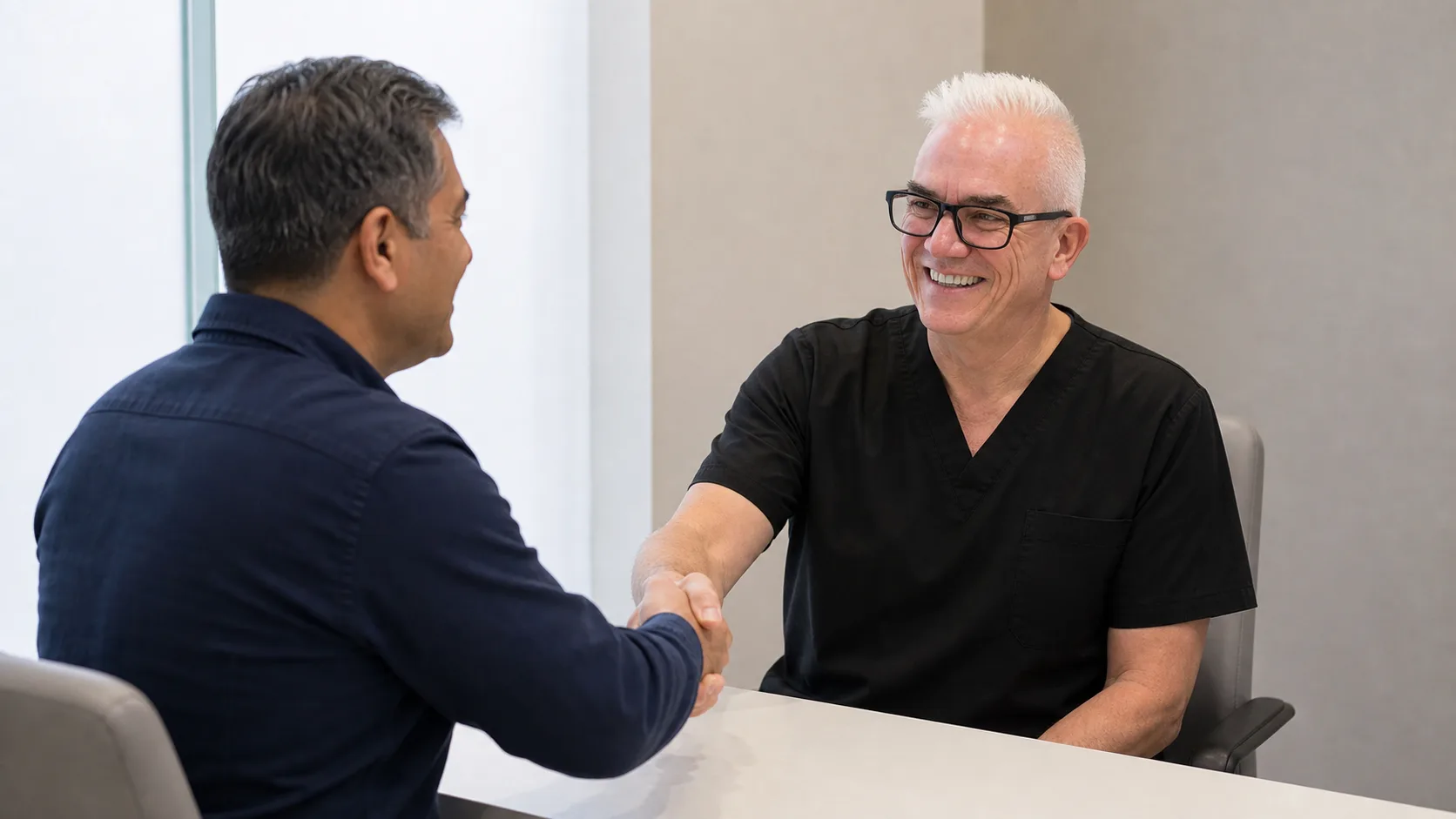
This Is Not A Competition
The question is not whether non surgical or surgical care is better in general. The better question is whether the pathway matches the problem.
For one person, a conservative non surgical plan may be sensible. For another, the same approach may add cost, delay and frustration without addressing the real issue. That is why comparison pages should not become menu pages. They should help the reader ask better questions.
What If Both Pathways Could Contribute Something?
Some people have a limited concern that fits clinic care alongside laxity or structural change that only surgery could address more directly. Others are not ready to consider surgery and want an honest account of what conservative care could and could not change.
Corey can separate those components and discuss the in scope option without claiming equivalence. A surgical opinion can be obtained for comparison, and the person can decide after understanding each pathway’s purpose and trade offs.

Which Safety Questions Belong In Both Conversations?
Both pathways require accurate medical and medicine history, realistic expectations, informed consent, practitioner verification, material risk discussion, cost and a plan for complications and follow up. The specific risks and recovery are different and must be explained by the practitioner responsible for that care.
New pain, weakness, a rapidly changing feature or another medically unusual symptom needs appropriate medical assessment rather than being routed into a rejuvenation comparison.
What If Neither Pathway Answers The Main Concern?
The concern may be primarily dental, dermatological, ophthalmic, psychological or another medical issue, or the expected change may not be realistic through either route. Corey can explain the relevant professional or assessment question rather than forcing a cosmetic choice.
This gives the person a constructive next step. Once the underlying issue is understood, any separate suitable aesthetic concern can still be considered on its own merits.
How To Prepare For The Conversation
Bring a clear description of what concerns you, when you first noticed it, any previous treatment history, current medications, relevant medical history and photos that show how your face has changed over time.
Useful questions include: what is causing this concern, is it within non surgical scope, what are the risks, what would make you say no, and would a surgical or medical opinion be more appropriate?

Which Australian Sources Explain The Distinction?
This page provides general comparison information, not a surgical recommendation. Healthdirect explains that facelift surgery lifts and tightens face and neck tissues and has operative risks and recovery. Ahpra publishes separate guidance for surgery and procedures performed without surgery.
Who Can Assess The Clinic Part Of The Question?
Corey Anderson RN conducts consultations at Core Aesthetics in Oakleigh. He is a Registered Nurse with Ahpra registration NMW0001047575. He does not perform facial surgery or replace assessment by the appropriately qualified surgical practitioner.
Use the verification page and Ahpra public register to check Corey. If considering surgery, independently verify the doctor’s registration, qualifications, experience, facility and follow up arrangements.
How Do You Book When You Are Unsure Which Scope Fits?
Book a consultation when you want Corey to assess whether the concern appears to involve movement, skin, proportion, support, excess tissue or structural descent. Bring previous care and surgical history, medicines, health details and what you hope would change.
Where a suitable clinic option fits, planning can continue after informed consent. Where surgical comparison is more useful, Corey can explain the reason and the questions to take to an appropriately qualified practitioner.
Is this for you?
Consider booking a consultation if
- You are an adult comparing non-surgical and surgical facial rejuvenation pathways
- You want honest advice about whether your concern is within non-surgical scope
- You are open to adjusted timing, review with another health professional, medical review or no treatment if that is the safer recommendation
- You value conservative planning and realistic expectation setting
This may not be for you if
- You want a promised outcome or a treatment decision without assessment
- You are seeking surgical advice from a non-surgical cosmetic clinic
- You are not an adult patient
- You are pregnant or trying to conceive and are seeking elective aesthetic treatment
Suitability is confirmed at consultation. This list is general guidance, not a substitute for clinical assessment.
Frequently asked questions
Is care provided in clinic the same as facial surgery?
No. Clinic care may address selected movement, proportion, support, contour or skin concerns. Surgery can lift, tighten, remove or reposition tissues and has distinct operative, anaesthetic, scar, recovery and consent considerations.
Can clinic care replace a facelift?
It should not be presented as equivalent when the main concern is excess skin or tissue descent that requires surgical lifting or repositioning. Corey can explain which limited components remain within his scope.
What can a surgical opinion clarify?
An appropriately qualified surgical practitioner can assess whether an operation fits the tissue concern and explain technique, risks, scars, anaesthesia, recovery, cost and realistic limits. An opinion does not commit you to surgery.
Can I still choose conservative care if I do not want surgery?
Yes, if Corey identifies an in scope option that addresses a concern you understand and accept within realistic limits. He should also explain clearly what that option cannot achieve compared with surgery.
Can both pathways be relevant to different concerns?
Yes. One person may have a movement or proportion concern within clinic scope and a separate laxity or structural concern suited to surgical opinion. Each should be assessed and consented as its own decision.
How does Corey decide whether referral is useful?
Corey identifies the tissue or function driving the concern, compares it with his clinical scope and explains when lifting, removal, repositioning, another specialty or medical assessment would answer the question more accurately.
Does a surgical referral mean clinic care is unsuitable everywhere?
No. It may apply only to one component of the concern. Corey can still discuss other suitable in scope issues without claiming that clinic care will reproduce a surgical change.
What if neither pathway fits the concern?
Corey can explain whether dental, dermatology, eye, psychological or another medical assessment is relevant. Once that issue is understood, any separate suitable aesthetic concern can still be considered independently.
What should I bring to a comparison consultation?
Bring medicines, relevant health and surgical history, previous cosmetic care, ordinary photographs if useful and a clear description of the feature, degree of change and recovery or surgery considerations you are comfortable discussing.
How should I verify a surgical practitioner?
Check the practitioner’s Ahpra registration and specialist status where relevant, qualifications, experience with the procedure, accredited facility, written costs, complication arrangements and follow up. Healthdirect provides Australian questions to ask.
How do I verify Corey before booking?
Corey Anderson RN is a Registered Nurse with Ahpra registration NMW0001047575. Confirm his identity, registration and Oakleigh clinic through the verification page and Ahpra public register.
Clinical references
- Ahpra guidelines for registered health practitioners who perform non-surgical cosmetic procedures
- Ahpra guidelines for advertising higher risk non-surgical cosmetic procedures
- Ahpra public register of practitioners
- TGA advertising health services involving therapeutic goods
- TGA advertising a health service