Clinical Specialisation

Aesthetic Treatment Only Specialist

Aesthetic Treatment Only Specialist is approached at Core Aesthetics through individual consultation, not a standard protocol.

Quick summary

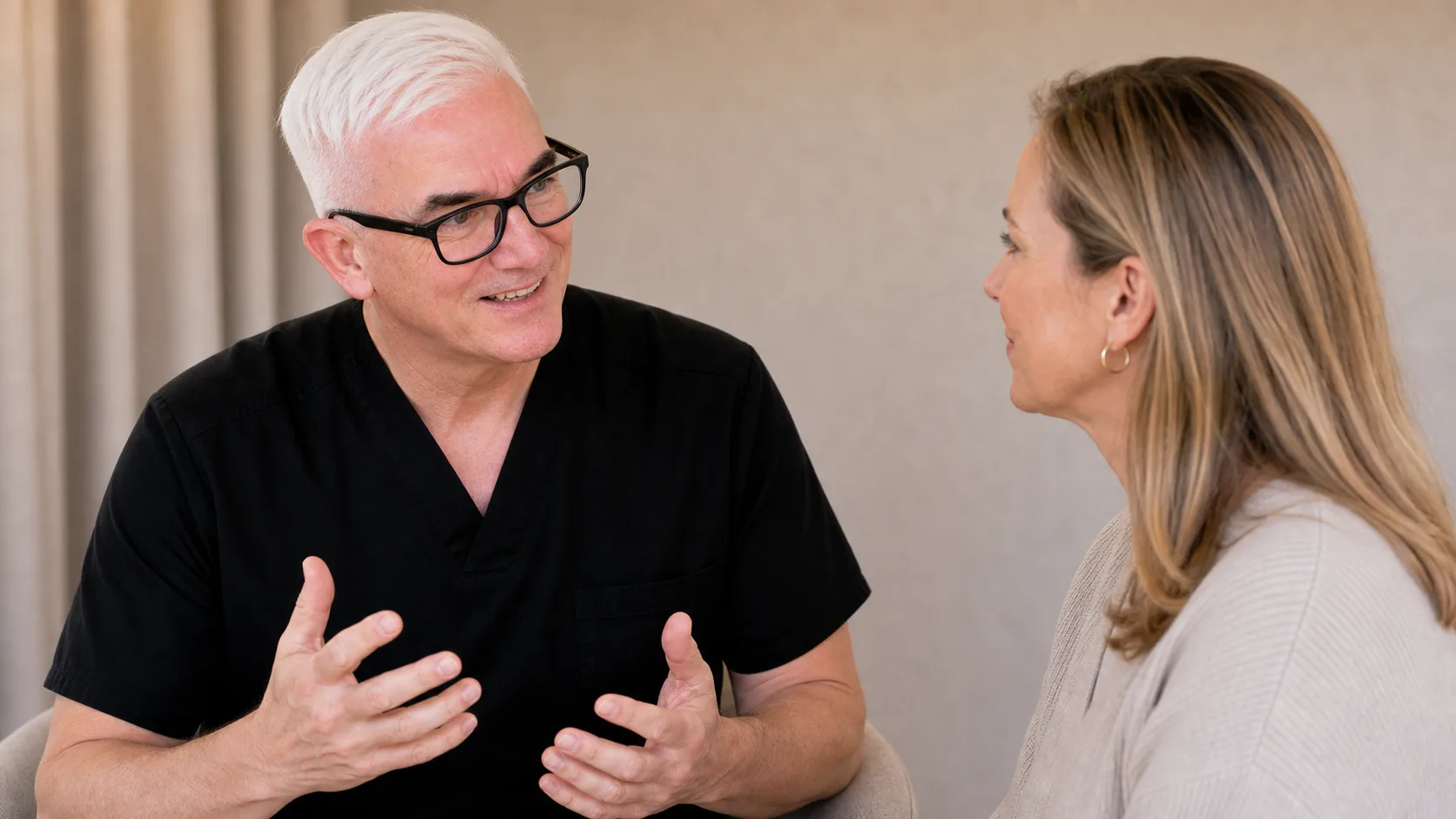
Aesthetic Treatment Only Specialist is approached at Core Aesthetics through individual consultation, not a standard protocol. An aesthetic consultation reviews the concern, medical history, timing, expectations, risk factors and whether treatment is appropriate. The aim is to make a careful decision before any plan is discussed. A consultation may lead to treatment planning, a decision to wait, referral, or a recommendation not to proceed.

What Injectable-Only Focus Actually Means

An injectable only or injectable focused clinic is one where clinical practice is centred on wrinkle treatments, facial volume treatments, facial balancing through injectables, and structural volume support. It does not offer a broad range of energy based devices or skin resurfacing as primary services.

This focus shapes how consultations are conducted, how anatomy is assessed, and how treatment plans are developed. It means injectables are not one item on a menu of many, they are the primary clinical discipline, and all expertise is developed in service of that discipline.

Why Focus Matters in Clinical Decision-Making

In medicine, focus improves clarity. When a clinician works within a specific domain repeatedly, they develop stronger pattern recognition, improved anatomical familiarity, more consistent treatment planning, refined judgement of subtle facial differences, and a clearer understanding of outcomes over time.

Injectable medicine, in particular, requires repeated exposure to facial variation because no two faces are structurally identical. A focused approach allows this experience to accumulate in a consistent way, producing increasingly precise clinical judgement over time.

The Face as a Structural System, Not a Surface

Injectable treatments do not act on the surface alone. They interact with skin layers, fat compartments, muscle activity, ligament support structures, and underlying bone anatomy. This means injectable practice is fundamentally structural medicine, and outcomes depend heavily on anatomical interpretation rather than product selection alone.

A focused injectable clinic builds expertise in reading these structures consistently. The repeated exposure to facial anatomy within a single clinical framework is what drives improved precision over time.

The Advantage of Depth Over Breadth

In aesthetic medicine, there is a meaningful difference between broad service provision and deep specialisation. A broad model may include skin resurfacing, laser therapies, device based treatments, and injectables as one of many options. A focused injectable model concentrates expertise into one domain.

The advantage of depth includes more consistent anatomical reasoning, fewer cross modality distractions, clearer treatment frameworks, stronger procedural refinement, and improved predictability in outcomes. This is particularly important in facial aesthetics, where precision matters more than treatment variety.

How Injectable Focus Improves Consultation Quality

Consultation is the foundation of injectable treatment planning. In a focused injectable practice, consultations typically emphasise full facial assessment, proportion analysis, movement evaluation, structural interpretation, staging considerations, and conservative planning frameworks.

Because injectables are the sole focus, consultation is not diluted across multiple modalities. This allows more time and attention to be dedicated to anatomical reasoning, the most important part of any treatment decision.

The Role of Restraint in Injectable Practice

One of the most important aspects of injectable medicine is restraint. More treatment does not always produce better results. Excessive intervention can lead to heaviness in facial features, reduced definition, imbalance between facial regions, loss of natural expression, and difficulty interpreting baseline anatomy.

A focused injectable model often develops a stronger culture of restraint because outcomes are evaluated repeatedly within the same clinical framework. The practitioner sees the full arc of treatment decisions and their effects over time, which reinforces conservative decision making as the standard.

Why Injectable Focus Reduces Decision Noise

Decision noise refers to unnecessary complexity in clinical reasoning. In multi modality environments, decisions may involve selecting between multiple device options, balancing skin and injectable treatments simultaneously, integrating different timelines and outcomes, and coordinating multiple treatment mechanisms.

In an injectable focused model, decision pathways are more streamlined. This allows clearer focus on structural change, facial balance, proportional adjustment, and movement modulation. Simplification improves clinical clarity and consistency.

How Injectable Focus Supports Long-Term Planning

Injectable treatments are not isolated events, they are part of an evolving facial structure over time. A focused injectable model naturally supports staged treatment planning, gradual structural adjustment, periodic reassessment, long term facial mapping, and conservative progression strategies.

Because the same modality is used repeatedly and outcomes are tracked within the same framework, changes can be observed and interpreted more accurately. This makes long term planning more precise and more responsive to how an individual face changes over time.

What Is Lost When Injectable Treatment Is Offered Alongside Everything Else

The broadening of aesthetic medicine to include an ever expanding range of treatments, devices, skin therapies, cosmeceuticals, and injectables, has created a clinical environment where each individual modality is harder to assess on its own merits. When a practitioner offers ten types of treatment, the selection of which treatment to recommend is influenced by factors beyond pure clinical assessment. Product margins, booking availability, patient psychology, and commercial positioning all shape what gets recommended even when the practitioner intends to give objective advice.

Injectable only practitioners are not immune to these pressures, but they have a narrower range of possibilities to navigate. The clinical question becomes simpler: is injectable treatment indicated, and if so, which type and in what quantity? There is no alternative modality to upsell to, no device course to recommend, no skin treatment to bundle in. The consultation outcome is either that treatment proceeds or that it does not. This simplicity, which might seem like a limitation, is actually a clinical asset. It forces a more honest reckoning with whether injectables are the right answer for a given concern.

Patients who have consulted at multi modality clinics and found themselves recommended complex, multi treatment packages may find the injectable only consultation strikingly different. The conversation is narrower in scope but often more technically detailed. The practitioner has more to say about the specific mechanisms of the treatments they offer because those treatments are what they have studied, practised, and refined over many years. At Core Aesthetics, the injectable only model reflects a deliberate clinical choice rather than a resource limitation. Corey Anderson, Registered Nurse, has focused exclusively on aesthetic treatments because that focus produces better clinical outcomes than breadth. Results vary between individuals; a consultation is required to determine suitability and appropriate treatment approach.

How Specialisation Affects the Assessment Itself

The assessment that precedes injectable treatment benefits from specialisation in ways that are not immediately obvious. A practitioner who has assessed thousands of faces for injectable suitability develops a calibrated sense of what is typical, what is unusual, and what the relationship is between what a patient describes as their concern and what is actually driving that concern anatomically. This calibration takes time and focused experience to develop. It cannot be accelerated by training courses or supplemented by experience in adjacent modalities.

Clinical pattern recognition in facial assessment includes recognising when a stated concern is amenable to injectable treatment, when it is not, when the patient’s expectations are consistent with what is achievable, and when the history of prior treatment is going to complicate the current assessment. A practitioner who assesses injectables alongside skin treatments and devices is applying pattern recognition to a much wider set of clinical questions, and the depth of that recognition in any single domain is necessarily lower than in a practitioner who works exclusively in that domain.

This has practical consequences. The injectable specialist is more likely to notice subtle signs of prior overcorrection, asymmetry that is anatomical rather than treatment related, or tissue behaviour that suggests a particular approach will not produce the expected result. These observations shape treatment decisions in ways that can be difficult to articulate in a short consultation but that meaningfully affect the quality of the outcome. Patients who have experienced poorly matched injectable treatment elsewhere may find that the specialist consultation produces an assessment that explains features of their prior experience they had not been able to understand.

The Long-Term Relationship Between Practitioner and Patient in a Specialist Setting

Injectable treatment, when it is well suited to a patient, typically continues over many years. The relationship between a patient and their injectable practitioner is therefore a long term clinical relationship, not a series of independent transactions. The quality of that relationship, the degree to which the practitioner understands the patient’s history, goals, responses to previous treatment, and changing anatomy, directly affects the quality of the ongoing clinical decisions.

A specialist who has treated the same patient across five or ten years has clinical information that no amount of pretreatment assessment can replicate. They know how the patient’s tissue responds to different products and doses, how their anatomy has changed over time, which prior approaches worked well and which did not. This accumulated knowledge is the foundation of good long term injectable practice. It cannot be transferred easily to a new practitioner, and it is difficult to build in a setting where patient turnover is high or where the practitioner’s focus is divided across many different treatment modalities.

At Core Aesthetics, the low volume one practitioner model is structured specifically to support this kind of long term clinical relationship. Appointments are not allocated on a high throughput basis, and the consultation time available for each patient reflects the importance of the ongoing relationship rather than the revenue value of the individual appointment. For patients considering their first injectable appointment in Melbourne, the injectable journey guide describes what this kind of relationship looks like from the patient’s perspective. The conservative dosing guide and gradual planning overview provide more detail on the clinical approach. Corey Anderson, Registered Nurse, sees all patients personally and maintains detailed clinical records across the entire treatment relationship.

Depth of Focus: What Specialisation Means in Clinical Practice

Specialisation in any field of medicine produces practitioners who know their domain deeply rather than broadly. In cosmetic medicine, where the range of available procedures has expanded significantly over the last two decades, the choice of scope matters more than it once did. A practice that offers injectables, laser, radiofrequency, peels, and skincare is making a different clinical commitment to each modality than one that focuses exclusively on one.

At Core Aesthetics, the decision to offer only injectables is a deliberate clinical stance, not a limitation. Corey Anderson. Registered Nurse, has structured the practice around developing the deepest possible expertise in wrinkle treatment, facial volume treatment, and the assessment of facial anatomy that informs both. This is not because other modalities lack value, many laser and energy based treatments are genuinely effective, but because doing one thing exceptionally well requires a different kind of commitment than doing many things adequately.

In practical terms, this means that every patient Corey sees is a patient who would benefit from injectable treatment, assessed by someone whose entire clinical focus is on that category. The anatomy of the face, the pharmacology of the medicines used, the technique variations that produce different results in different tissue environments, the common complications and how to prevent and manage them, these are subjects Corey encounters and refines with every single patient, not as one category among many.

Specialisation also produces a different kind of pattern recognition. A practitioner who has assessed thousands of faces specifically for injectable treatment will recognise anatomical presentations, treatment histories, and risk factors that a more generalist practitioner might miss. This is not about credentials or years of practice alone, it is about the focused accumulation of experience in one specific domain.

Results vary between individuals, and specialised expertise does not absolute claim a particular outcome. What it does produce is a higher likelihood that the treatment plan is well matched to the specific presentation, that complications are anticipated rather than encountered unexpectedly, and that the practitioner has the depth of knowledge to handle whatever arises.

What Single-Focus Care Means for the Patient Relationship

The patient relationship at a single focus practice has a different character than at a multi service clinic. Because every appointment is about injectables, the conversations are deeper. There is no need to redirect from laser recommendations or skincare packages. The assessment is focused on the specific domain of injectable treatment, and the outcomes are evaluated against goals that both patient and practitioner have discussed in that specific context.

This focus also allows Corey to say no with more confidence. When a patient requests something that isn’t appropriate, more volume in an area that doesn’t need it, treatment for a concern that has a different underlying cause, or a treatment approach that carries risk in their specific anatomy, the refusal is grounded in deep knowledge of that treatment category. It is not a conservative practitioner being overly cautious; it is a specialist applying expert judgment to a specific clinical question.

The long term relationship that develops in this kind of practice tends to be different too. Patients who return to Core Aesthetics for ongoing treatment are returning to someone who knows their face, their history, and their goals in detail. The continuity of care that comes from seeing the same practitioner over multiple sessions means that each appointment builds on what came before, rather than starting from scratch with a new person who has only the notes from prior visits.

For anyone who has experienced inconsistent results or conflicting advice at different practices, a consultation at Core Aesthetics offers the opportunity to start from a clean, thorough assessment by a practitioner whose full professional attention is on this specific area of practice. The starting question is always: what is actually happening in your face, and is injectable treatment the right response to it?

Is this for you?

Consider booking a consultation if

  • You want to understand aesthetic consultation before deciding whether treatment is appropriate
  • You are 18 or older and want an individual clinical assessment
  • You value a consultation-first approach with risk and suitability discussed before planning
  • You are open to waiting or not proceeding if that is the safer recommendation

This may not be for you if

  • You are seeking a promised outcome or a same-day decision without assessment
  • You are under 18 years of age
  • You are pregnant, trying to conceive or breastfeeding and are seeking elective aesthetic treatment
  • You have an active infection, unhealed skin or an unresolved medical concern in the area to be assessed

Suitability is confirmed at consultation. This list is general guidance, not a substitute for clinical assessment.

Frequently asked questions

What happens during an initial assessment at Core Aesthetics?

Attendance at Core Aesthetics begins with a clinical assessment by Corey Anderson RN that covers the presenting concern, medical history, current medications, prior treatment and suitability. This assessment forms the basis for any recommendation. Treatment is not performed at the consultation appointment.

How does Core Aesthetics’ consultation-first model work?

Core Aesthetics applies a consultation-first model to all patients. This means individual assessment precedes any treatment plan. The consultation for concerns described in topics like this establishes what is present, what may be appropriate and what the realistic outcome range is before any decision is made.

What does Core Aesthetics require before any treatment is considered?

A full individual assessment is required before treatment is considered. This covers medical history, current medications, prior treatment, the specific concern and suitability.

What is Core Aesthetics’ policy on the period between consultation and treatment?

At Core Aesthetics, consultation precedes any treatment decision. The consultation is structured to allow patients adequate time to understand the assessment findings and discuss timing before any treatment plan is agreed.

What factors can lead to no treatment being recommended after assessment?

What information is helpful to bring to a consultation?

A current medication list, details of any prior treatment in the relevant area, how long the concern has been present, how it has changed and any specific questions help the consultation be efficient. Photographs showing how the area has changed over time are also useful where relevant.

How does Corey Anderson RN approach each individual assessment?

Corey Anderson RN assesses each patient from first principles. Concerns of the type described here are evaluated in the context of individual anatomy, medical history and realistic expectations. A standard protocol is not applied. The recommendation reflects what the individual assessment supports, not what is typical or most common.

How does the two-appointment process at Core Aesthetics work?

New patients at Core Aesthetics attend a consultation as the first appointment. If treatment is recommended and agreed, a further appointment is scheduled to proceed with treatment when the patient is ready. This two-appointment structure is applied consistently at Core Aesthetics as a matter of clinic practice and patient care.

Clinical references

Written and reviewed by Corey Anderson RN, AHPRA NMW0001047575 · Reviewed 2026-04-26 · TGA & AHPRA compliant

Begin With A Conversation

Book your consultation.

No commitment, no pressure. A considered first step toward understanding what is and isn’t right for you.

Book Consultation

Elegance, Perfected.